

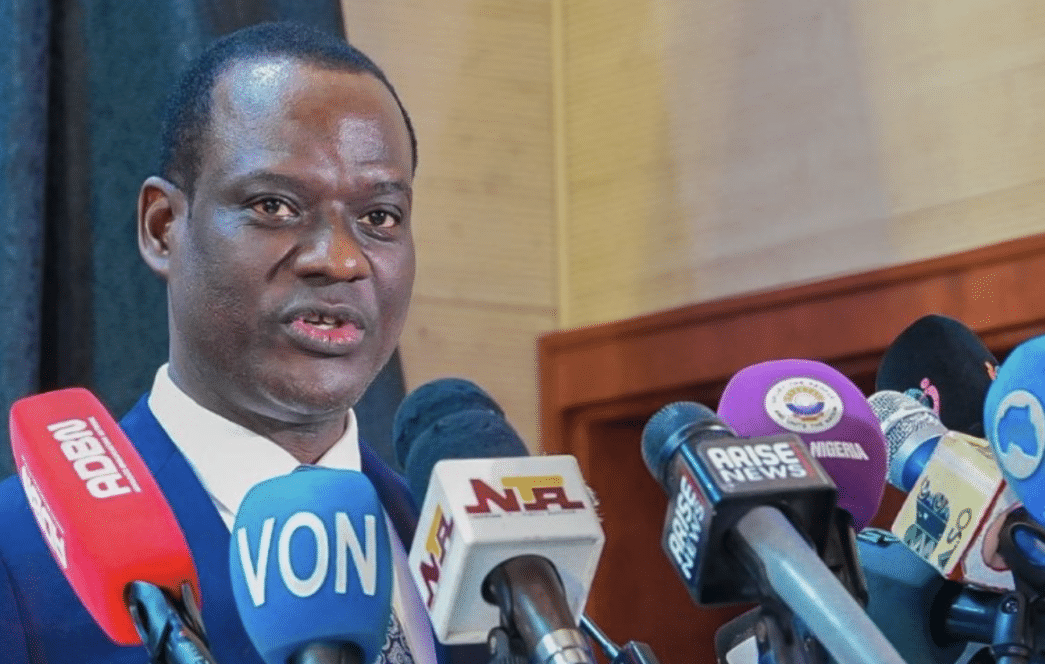
Nigeria’s renewed debate over fuel subsidy has exposed a difficult economic trade-off: how to protect households from rising petrol prices without reopening the fiscal and foreign-exchange pressures that accompanied the former subsidy regime. Finance Minister and Coordinating Minister of the Economy, Dr. Taiwo Oyedele, argues that blanket subsidies would transfer global oil-market volatility to public finances, while former Vice President Atiku Abubakar questions whether a 30-day discount at Nigerian National Petroleum Company (NNPC) Retail Limited stations offers meaningful, lasting relief. Between these competing positions lie the interests of consumers, transport operators, domestic refiners, state governments, taxpayers and investors. Enam Obiosio says the central policy question is no longer simply whether fuel should be cheaper, but how relief can be financed, distributed and sustained without undermining economic stability.
On 9 October, 2026, Dr. Oyedele said that the federal government’s 30-day petrol discount at NNPC Retail Limited stations would be funded entirely from the retailer’s margins, not public funds. The measure follows rising fuel prices linked to global supply disruptions and seeks to cushion consumers without restoring the petrol subsidy. Former Vice-President Atiku Abubakar criticised the limited duration, questioning whether the intervention would deliver lasting relief.
DECISION HIGHLIGHT
The government is using a temporary commercial discount to ease immediate pressure while resisting a return to broad fuel subsidies. Its wider response includes proposed petrol price modulation, forward crude sales to domestic refineries, targeted household support and accelerated compressed natural gas (CNG) deployment.
DECISION MEMO
The 30-day discount exposes the central tension in Nigeria’s fuel reforms: preserving fiscal stability while making market-priced energy affordable to households and businesses.
Oyedele said that Brent crude had risen above US$100 per barrel, while shipping through the Strait of Hormuz had fallen to roughly thirteen percent of its pre-war level. He argued that restoring subsidised petrol prices would transfer global price and foreign-exchange risks to public finances.
“The discount is not funded by the federal budget or the Federation Account. NNPC Retail buys petrol from the Dangote Refinery and other suppliers at market prices, on commercial terms, then adds its retail margin to set the pump price. The discount comes out of that margin alone, so the discounted pump price remains market-reflective,” Oyedele said.
However, a reduction in retail margins cannot by itself resolve the wider cost burden transmitted through transport, food distribution, manufacturing and household consumption. Its immediate benefit also depends on the discount’s size, availability across NNPC stations and whether transport operators pass savings to passengers.
Atiku, through Phrank Shaibu, Director of Strategic Communication for the African Democratic Congress (ADC) Presidential Campaign Council, challenged the intervention’s durability. “What happens on Day 31? Nigerians wake up to the same brutal prices, the same punishing transport fares and the same rising cost of food,” he said.
Atiku also questioned why relief was restricted to NNPC stations and whether transporters would reduce fares. He advocated longer-term production support tied to local refining, with safeguards to ensure consumers benefit.
The competing positions expose different tests of policy effectiveness. The government’s approach prioritises fiscal sustainability and market pricing; the opposition’s critique centres on household affordability and continuity of relief. Neither a temporary discount nor a subsidy debate resolves the underlying need for reliable supply, lower logistics costs and stronger domestic refining economics.
The proposed N1,350-per-litre ceiling on petrol’s ex-gantry or landing cost introduces another uncertainty. Under the government’s description, refiners and importers would carry excess costs temporarily and recover them later. Its credibility will depend on transparent monthly reviews, clear recovery rules and whether suppliers can sustain the arrangement without disrupting supply.
DATA BOX
- Discount duration: 30 days at NNPC Retail stations, with priority for public transporters.
- Petrol price: Approximately N830 per litre before the conflict, against a current average of about N1,400, according to Oyedele.
- Estimated annual subsidy cost: More than N20 trillion to restore pre-reform prices; over N16 trillion for a N500-per-litre intervention. These are government estimates.
- Fiscal gains: N15.8 trillion released to the Federation Account between June 2023 and December 2025, including N10.4 trillion for state and local governments.
- Petrol tax and duty waivers: Government-estimated savings of N400–N600 per litre for consumers.
- CNG deployment: More than 120,000 vehicles, 400 conversion centres, 96 refuelling stations, 18 liquefied-to-compressed natural gas stations and over 550 buses. Government says fares have fallen by 30–50 percent where these buses operate.
WHO WINS / WHO LOSES
Potential winners: Consumers purchasing discounted petrol, public transporters receiving priority, and the government if the measure eases pressure without public expenditure.
Potential losers: Households and businesses outside the discount’s reach, transport users if fare reductions fail to materialise, and refiners or importers if price modulation delays cost recovery.
POLICY SIGNALS
The government is signalling continued resistance to blanket subsidies while considering targeted cash transfers, subsidised credit, removal of illegal road levies, a possible excess-profit tax, enhanced low-income tax relief and a National Strategic Fuel Reserve. Implementation, funding and transparent eligibility rules will determine their practical value.
INVESTOR SIGNAL
For investors, the policy direction favours market-based pricing, domestic refining and alternative transport fuels. Confidence will depend on predictable regulation, transparent price-modulation rules and evidence that temporary interventions do not create hidden liabilities for suppliers or the public sector.
RISK RADAR
The principal risks are the discount’s expiry without replacement relief, weak pass-through to transport fares, renewed global supply shocks, delayed supplier reimbursements under price modulation and insufficient transparency around implementation. The decisive measure is not the announcement itself, but whether relief reaches consumers without undermining supply or fiscal stability.
Enam Obiosio is a public relations and investor relations practitioner and journalist with experience in arts and business journalism, with expertise spanning financial markets, economic policy, infrastructure, corporate communications, and the creative economy.
Discover more from StakeBridge Media
Subscribe to get the latest posts sent to your email.