

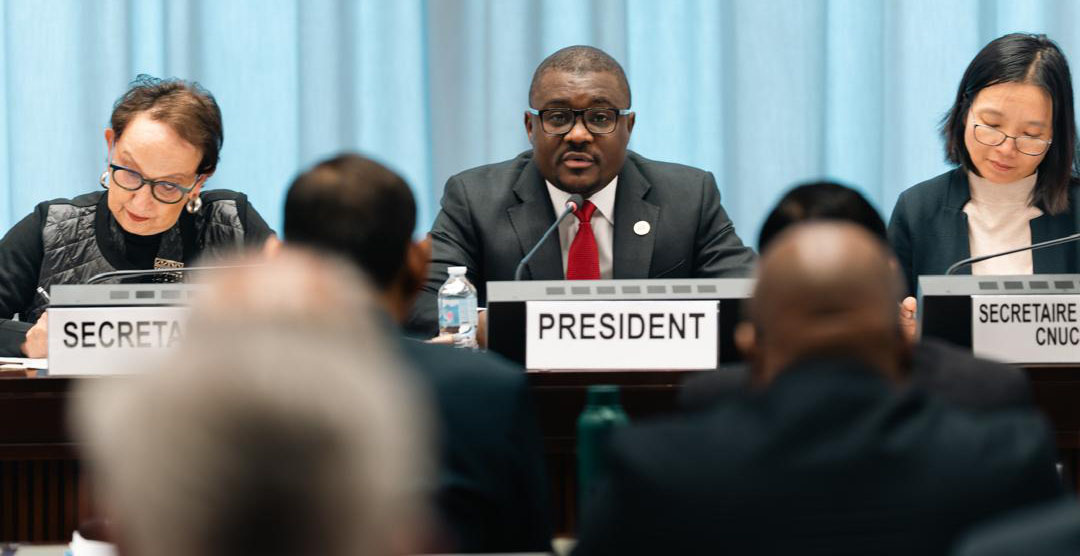
When delegates from around the world settled into their seats at the Palais des Nations in Geneva on 12 November 2025, the energy in the hall felt both formal and hopeful. It was the opening of the 42nd Session of the Intergovernmental Working Group of Experts on International Standards of Accounting and Reporting (ISAR), and at the center of the room stood a familiar figure. Dr. Rabiu Olowo, Nigeria’s Executive Secretary and CEO of the Financial Reporting Council (IFC) and immediate past Chair of ISAR-41, returned to the podium with a calm confidence that reflected a year of intense global work.
He opened with a warm, steady voice that set the tone for the day. “Good morning, excellencies, distinguished delegates, esteemed colleagues, ladies and gentlemen. It is a distinct honour to welcome you to the 42nd Session of the Intergovernmental Working Group of Experts on International Standards of Accounting and Reporting,” he said, acknowledging UNCTAD Secretary-General, Rebeca Grynspan, the ISAR Secretariat, and all Member States for the “continued commitment to advancing high-quality, transparent, and decision-useful financial and sustainability reporting across jurisdictions.” This was not just ceremony; it was a handover moment, one shaped by the lessons of a demanding year.
ALSO READ AAOIFI Standards To Boost IR As FRC Considers Islamic Finance Reporting Framework: https://stakebridgeirpr.com/media/2025/11/11/aaoifi-standards-to-boost-ir-as-frc-considers-islamic-finance-reporting-framework/
A Year Marked by Collaboration, Hard Choices
Reflecting on his tenure, Dr. Olowo spoke with the humility of someone who recognised the weight of the assignment. “Serving as Chair of the 41st Session has been a privilege,” he said, taking a moment to spell out the two priorities that guided the year: advancing harmonization and practical implementation of sustainability reporting, assurance, and ethical standards, and supporting the integration of financial and sustainability reporting through digitalization.
“These priorities reflect our shared commitment to strengthening market trust, enhancing accountability, and supporting sustainable development,” he told the delegates. It was a reminder that beyond the technicalities and the endless documents, this work touches real economies, real businesses, and, ultimately, real people.
He described ISAR-41 as a year of proof. Proof that progress is achievable when countries and institutions pursue a common goal. Proof that global frameworks can move closer to interoperability. And proof that capacity building is not an abstract exercise but a tool that can close gaps between regions.
Concrete Achievements
In a moment that felt almost like a guided tour, Dr. Olowo walked the hall through five major achievements of ISAR-41.
On harmonization, he said, “ISAR-41 significantly deepened the global dialogue on interoperability among sustainability reporting frameworks, including the ISSB Standards and the European Sustainability Reporting Standards.” He also highlighted the strengthened collaboration with the International Ethics Standards Board for Accountants, noting that it “reinforced the ethical foundations that underpin credible sustainability assurance.”
He then pointed to the progress on assurance and ethical standards, anchored by the Africa Regional Partnership–IESBA dialogue in May 2025 and an IPSASB consultative meeting on climate-related disclosures. These engagements, he explained, “supported the development of high-quality, independent sustainability assurance practices” and “enhanced user confidence and promoted integrity in sustainability information.”
Digital transformation was another pillar. “The expanded use of the UNCTAD Sustainability Reporting Taxonomy and structured, machine-readable formats is improving the accessibility, comparability, and analytical value of reported information,” he said. In his view, digitalization was no longer a technical option but a necessity for modern reporting ecosystems.
Perhaps one of the most politically significant achievements came through ISAR’s strengthened linkages with the United Nations system. Dr. Olowo recalled his role at the February 2025 ECOSOC Coordination Segment in New York, where he engaged diplomats and the UN Financing for Sustainable Development Office. “The discussions focused on advancing coordinated, inclusive, science-based and evidence-driven solutions to accelerate implementation of the 2030 Agenda,” he noted.
Across regions, he added, ISAR’s partnerships matured into genuine platforms for peer learning. Countries in Africa, Asia, Latin America, Eurasia, and the Gulf continued to hold technical workshops and capacity-building efforts that helped them align with global standards.
A Moment of Gratitude and a Firm Look Ahead
Dr. Olowo did not overlook those who worked behind the scenes. He commended the ISAR Secretariat for its “professionalism and strategic leadership” and for ensuring that ISAR remains “a credible, respected, and globally relevant forum.”
Then his tone shifted to one of sober clarity as he stressed why ISAR’s work still matters. “At a time of global environmental stress, economic uncertainty, and heightening stakeholder expectations, the relevance of ISAR’s work is more essential than ever,” he said. “Robust reporting is not merely a compliance obligation. It is a foundation for trust, fair markets, responsible investment, and sustainable development.”
What the 42nd Session Will Tackle
The agenda for the new session is tightly aligned with the progress made in the previous one. He told the gathering that the 42nd Session will focus on two priorities: reviewing developments in the harmonization of sustainability reporting requirements and integrating biodiversity and human capital considerations more clearly into reporting.
“These discussions reaffirm our shared commitment to advancing coherent, high-quality, and decision-useful sustainability reporting,” he said, highlighting the need for more precision in how companies communicate long-term value creation.
As he rounded off, Dr. Olowo also spoke with the steady gratitude of someone who had carried a difficult assignment and was now passing it on. “The achievements of the past year were made possible through partnership, shared purpose, and collective resolve,” he said. “I remain confident that the work undertaken here will continue to shape a more transparent, accountable, and sustainable global economy.”
He urged the delegates to step into the new session with purpose. “Let us move forward with clarity, unity, and commitment, knowing that the decisions we shape here contribute to the integrity of global financial systems and to the well-being of societies everywhere.”
With that, the hall rose in applause that carried both respect and expectation. A year of work had been wrapped up with honesty and clarity, and the next chapter for global reporting standards had begun.
Discover more from StakeBridge Media
Subscribe to get the latest posts sent to your email.