

For years, Nigeria’s unemployment challenge has pushed many young people to chase opportunities beyond the country’s borders. Skill exists. Talent exists. What has often been missing is access.
Now, a new path is taking shape. The Nigerians in Diaspora Commission (NIDCOM) has entered a partnership with InnoPower Africa to connect young Nigerian professionals to remote jobs in diaspora-owned businesses across the United States, Canada and the United Kingdom. The move signals a shift toward structured, global job pipelines driven directly by Nigerians abroad.
What happened
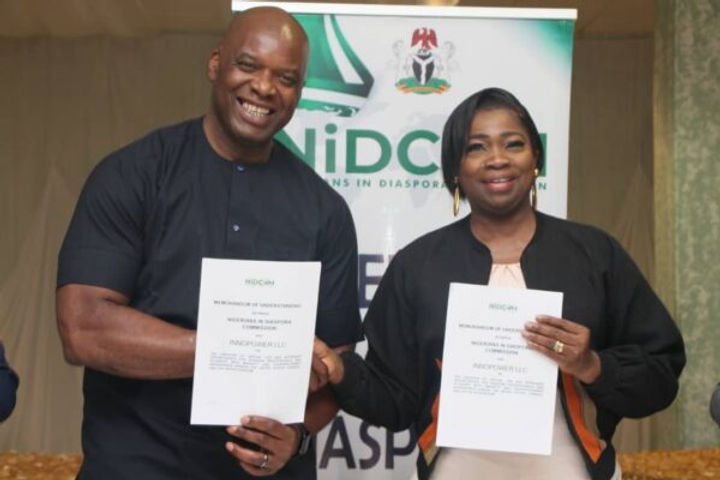
The breakthrough came during the latest 8th Nigeria Diaspora Investment Summit in Abuja. NIDCOM Chairman and Chief Executive Officer, Abike Dabiri-Erewa, announced the signing of a Memorandum of Understanding (MoU) with InnoPower Africa, positioning the initiative as a natural extension of the Commission’s mandate.
“NIDCOM is proud to champion this initiative that embodies our core mandate,” she said at the event. For her, the diaspora is not a distant community but a powerful economic force that can open doors for young people at home.
The Founder of InnoPower Africa, Emil Ekiyor, shared the same conviction. He described Nigerian talent as world-class and capable of delivering exceptional value to global businesses. For him, the partnership is not symbolic. It is a practical tool to create real job placements and sustainable youth engagement.
Who benefits
Young Nigerian professionals stand at the centre of the partnership. Remote roles in diaspora-owned companies offer exposure, income stability and the chance to compete globally without leaving home.
The diaspora also gains. Employers abroad get access to a highly skilled workforce. They reconnect with home through direct job creation rather than informal networks or goodwill alone.
NIDCOM benefits by strengthening its mission to make the diaspora an active development partner. And InnoPower Africa cements its role as a bridge linking African innovation with global economic opportunities.
Who loses
Those who thrive on fragmented systems lose footing. For years, many young people have depended on luck, unverified platforms or personal connections to access foreign opportunities. The new structure reduces guesswork. It pushes job creation into formal channels where accountability replaces chance.
What it means
The signing marks more than a partnership. It signals the start of a pipeline where Nigerian skills are matched with global demand in a systematic and transparent way.
The presence of NIDCOM’s Secretary, Engr. Dr. Sule Yakubu Bassi, and legal advisers from both sides highlighted the seriousness of the agreement. It is designed to be an enforceable platform, not an aspirational pledge.
Ekiyor believes the model will “turn things around for the youths,” and his confidence is grounded in the expanding global appetite for remote work. Nigerian professionals already excel in technology, business support, design, analytics and consulting. The partnership aims to convert that reputation into measurable opportunities.
The broader logic
Nigeria’s youth population is growing faster than local job creation. Meanwhile, Nigerians abroad run companies, lead teams and influence global industries. NIDCOM’s strategy is to convert that influence into structured pathways for employment.
It aligns with global hiring patterns, where companies increasingly want flexible, cost-efficient, remote-ready talent.
The logic is straightforward: rather than wait for foreign companies to “discover” Nigeria, empower diaspora-owned firms to become the first movers.
What to expect
The partnership is still in its early stages, but its architecture points toward a long-term plan.
Job-matching frameworks will need to be developed. Skills verification and onboarding processes must be set up. Diaspora employers will require support to access the talent pool efficiently.
But the direction is clear. The government and its partners are moving toward a future where global job opportunities for Nigerian youths are not accidental; they are organized.
If executed with discipline, the NIDCOM–InnoPower Africa model could become one of the most practical diaspora-engagement tools to emerge in recent years, offering young Nigerians not just hope, but real work.
Discover more from StakeBridge Media
Subscribe to get the latest posts sent to your email.