

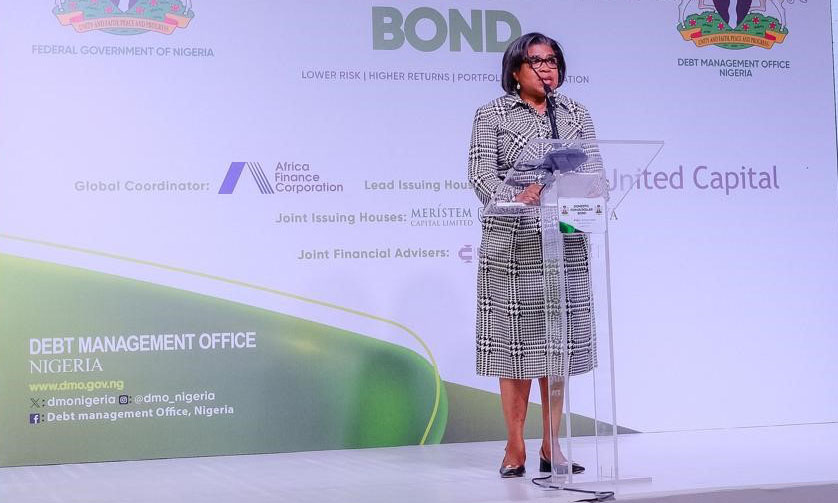
The federal government (FG) has consistently indicated its intent to rely on the domestic debt market to finance its plans. In line with this, the Debt Management Office (DMO) has announced a new round of Federal Government bond auctions worth N460 billion, reinforcing its strategy of attracting long-term savings into the fixed-income space.
What happened
The DMO announced that it is reopening two previously issued bonds. The offer includes N230 billion of the 17.945 percent FGN August 2030 bond and another N230 billion of the 17.95 percent FGN June 2032 bond.
According to the circular released recently, the auction will take place on December 15, 2025. Successful bidders will complete settlement on December 17.
This approach follows the familiar pattern set in November, when the DMO also reopened the same two instruments with the same combined size of N460 billion.
Who benefits
The offer presents a favourable opportunity for investors seeking stable, long-term returns. Both bonds pay interest twice a year, a feature that appeals to pension funds, insurance companies, fund managers, and institutions looking for predictable returns.
The government also benefits by raising long-term funds locally instead of relying heavily on external borrowing. This deepens the domestic bond market and supports budget financing.
Who loses
This offer does not introduce new coupon rates. Since these are reopenings, bidders will transact at market-driven prices. That means auction results depend entirely on yield-to-maturity bids, not on fixed coupon adjustments.
Traders who prefer short-term, high-volatility instruments may also find these reopenings less exciting.
What it means
The DMO’s choice to reopen the same bonds again reflects strong demand. In November, investor appetite was clear. Total bids reached about N657 billion, which was far above the N460 billion offered.
For the 2030 bond, bids came in at N147.869 billion, and N134.799 billion was allotted at a marginal rate of 15.9 percent.
For the 2032 bond, demand was even stronger. Investors submitted N509.392 billion in bids. A total of N448.722 billion was allotted, along with a non-competitive allotment of N6 billion. The marginal rate cleared at 16 percent.
These figures show solid confidence in government instruments. They also show that medium and long-term paper is still a favourite among institutional investors.
The pricing logic
The DMO explained that units remain priced at N1,000 each, with a minimum subscription of N50,001,000. Additional purchases must follow in multiples of N1,000.
Because these are reopenings, investors will not receive fresh coupon levels. Instead, auction prices will be shaped by prevailing yields and any accrued interest on the bond.
Both instruments will be redeemed fully at maturity through bullet repayment, meaning investors receive their entire principal at once.
What to expect
The bond market is likely to see active participation again. The instruments remain highly attractive because they qualify as trustee investments and are recognised under the Trustee Investment Act.
They also enjoy tax-related advantages under Company Income Tax Act (CITA) and Personal Income Tax Act (PITA) for pension funds and other regulated players. Their listing on the Nigerian Exchange and FMDQ ensures transparency and trading access, while banks can count them as liquid assets for liquidity ratio requirements.
This combination of safety, transparency, and predictable returns sets the stage for another strong auction. Investors searching for stability will find the December offer hard to ignore.
The government has made it clear that tapping the local bond market is central to its financing plan. The DMO’s latest offer continues that path. With strong demand in previous auctions and consistent interest from major institutions, the domestic debt market is shaping up to be a reliable pillar for government funding in the year ahead.
Discover more from StakeBridge Media
Subscribe to get the latest posts sent to your email.