

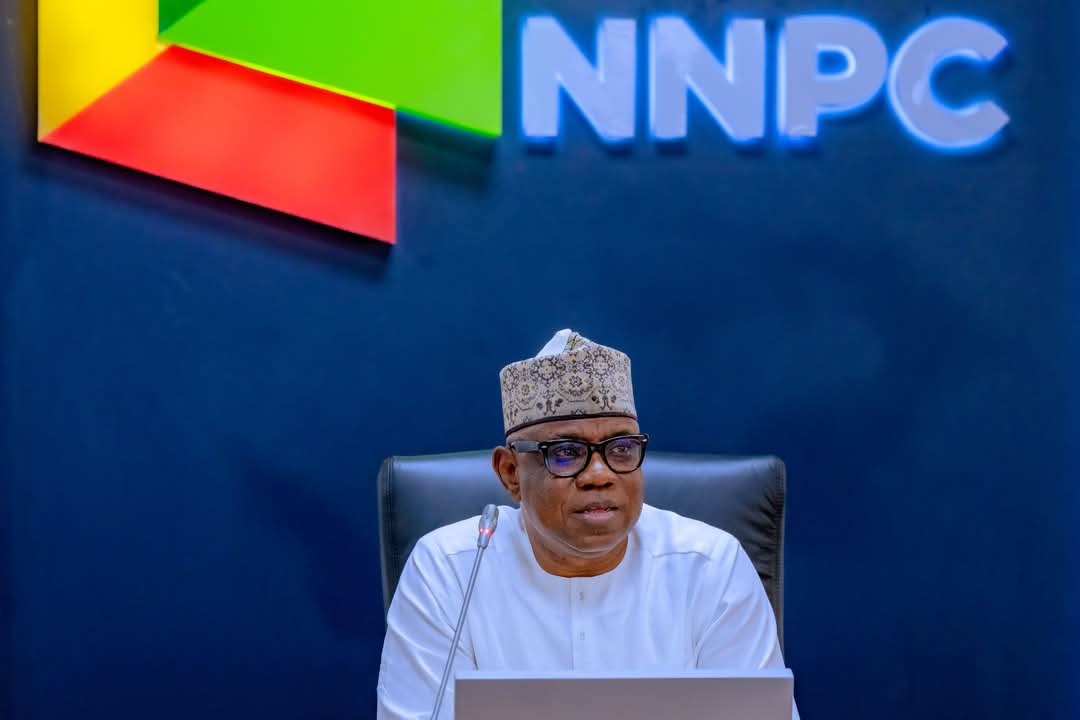
…Nigeria’s Energy Revival Already Happening, Says Ojulari
NNPC E&P Limited (NEPL), the flagship upstream subsidiary of NNPC limited, has recently recorded production of 355,000 barrels of oil per day (bpd), marking a turning point for Nigeria’s upstream sector.
It was the company’s highest daily output since 1989, and it capped a two-year surge that pushed average production from 203,000 bpd in 2023 to 312,000 in 2025. The numbers came from a mix of operational discipline, tighter asset management, and structured field development, and they positioned the subsidiary as a major force in the country’s energy recovery.
The record wasn’t accidental. It reflected an internal overhaul that has been reshaping NNPC Limited and its upstream arm. The company has been focusing on efficiency, systems, and strategic field development. As Andy Odeh, Chief Corporate Communications Officer (CCO), noted in the statement announcing the achievement, NEPL’s growth is rooted in a deliberate strategy that ties performance to operational excellence and stronger asset stewardship.
Who benefits
For the federal government, the milestone is an immediate fiscal boost. Higher production improves revenue at a time when foreign exchange pressure and budget constraints have sharpened national vulnerabilities. It also lends new credibility to presidential targets of 2 million bpd by 2027 and 3 million by 2030. These targets have often seemed out of reach, but NEPL’s current trajectory places them in sight.
Communities around oil producing areas stand to gain from more stable operations. NNPC executives have tied the gains to a stronger culture of safety, environmental responsibility, and more structured field management. If those commitments hold, communities may see fewer shutdowns, fewer disruptions, and more predictable economic activity.
Investors are also paying attention. After years of volatility, sabotage, declining output, and regulatory uncertainty, NEPL’s performance offers evidence that disciplined operations can produce dependable results. For global partners, the milestone signals that Nigeria wants to reassert itself as a reliable supplier.
Who loses
Those who profited from opacity and instability stand to lose ground. Tighter reporting, clearer asset management, and stronger oversight reduce the space for rent seeking, off-book arrangements, and inefficiency. A more capable NEPL also reshapes competitive dynamics. Private operators that have underperformed now find themselves compared with a state-owned competitor that is setting new benchmarks.
Inside the shift
Engr. Bashir Bayo Ojulari, the Group CEO of NNPC Limited, said the record output is proof that Nigeria’s energy revival is already underway, not just imagined.
“By showing its ability to exceed its own production benchmarks, NEPL confirms that the essential building blocks for scaling national output are being firmly established. The achievement signals that the machinery of production, equipment, processes, capabilities, and partnerships can be driven with commercial discipline to produce real and positive outcomes,” he said.
He stated that the milestone strengthens Nigeria’s credibility with partners and investors and reinforces the country’s position in the global energy supply chain.
Udy Ntia, Executive Vice President, Upstream, said the achievement represents more than a number.
“In a sector where shortcuts can yield short-term wins but long-term damage, NEPL is making a different point: sustainable progress must rest on responsible operations. This ensures that scaling production does not compromise worker safety, community wellbeing, or environmental protection. It reinforces a shift away from extraction at any cost towards sustainable value creation, a core requirement for any modern energy company seeking global relevance,” he said.
NEPL’s Managing Director, Nicolas Foucart, described the record output as part of a much broader transformation across NNPC Limited.
“This is a story shaped by leadership that charts a clear course; by partnerships built on alignment and accountability; and by a workforce whose hard work is turning goals into measurable progress. Our people, our processes, and principles are the real engines behind this success. We are building for tomorrow, not just celebrating today,” he said.
He stated that the milestone carries national significance. “For Nigerians, this accomplishment means far more than increased barrels; it translates into greater national revenue, stronger energy security, and a more resilient economic foundation. NEPL has not only produced more hydrocarbons; it has reignited belief in what Nigeria’s energy sector can achieve with the right systems, culture, and dedication.”
What it means
The record-setting output reshapes expectations for Nigeria’s energy sector. For the first time in years, the narrative is shifting from decline and disruption to recovery and structured performance. The achievement demonstrates that a disciplined, commercially driven state enterprise can compete with and even outperform private operators. It signals a reordering of incentives within the sector, where competence gains value over chaos.
For the broader economy, stronger production offers a chance at improved revenue stability, better macroeconomic planning, and more predictable inflows. It also strengthens the argument for deeper reforms, because the gains suggest that well-managed assets can deliver results even in a challenging environment.
What to expect
If NEPL sustains its momentum, Nigeria may begin climbing back toward sustained output levels that support both budget needs and export commitments. The company is likely to accelerate structured field development, push harder on asset integrity, and deepen collaborations with partners who can help scale production responsibly.
In the near term, the development may also encourage regulators to tighten standards and increase scrutiny across the sector. Operators who have lagged may be pushed to improve performance or exit fields they cannot manage efficiently.
Longer term, the achievement could signal the start of an industry-wide rebalance where stability replaces disruption as the defining feature of Nigeria’s upstream environment.
Discover more from StakeBridge Media
Subscribe to get the latest posts sent to your email.