

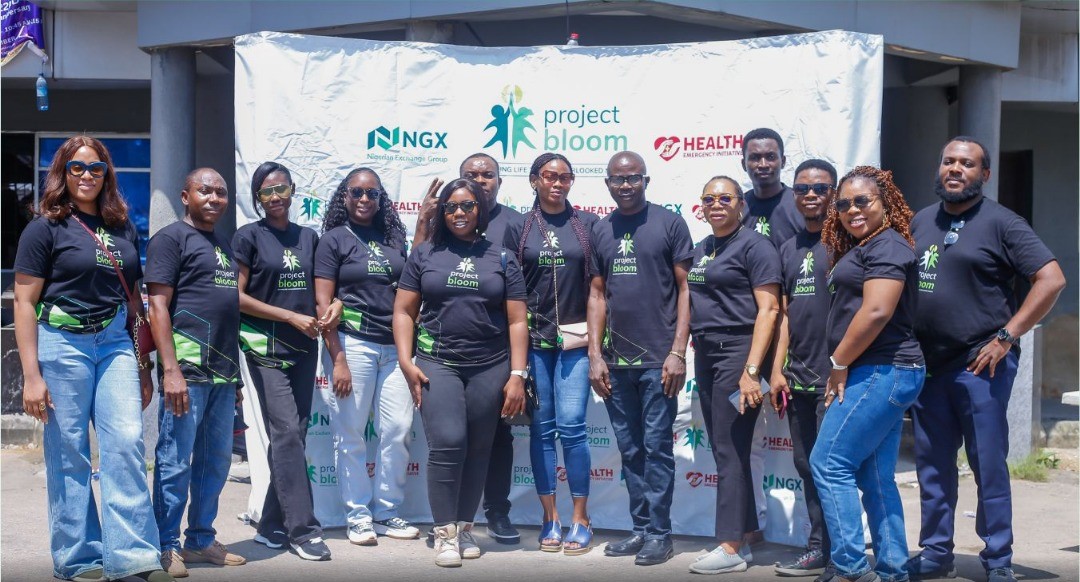
- NGX links child nutrition outcomes to long-term capital market resilience, showing how measurable social investments can reinforce economic and investor confidence
Nigerian Exchange Group Plc has expanded Project BLOOM, a child nutrition intervention, to Alimosho Local Government Area in Lagos State, deepening a public–private collaboration with the Lagos State Government and the Health Emergency Initiative. The initiative targets child malnutrition in underserved communities, linking social outcomes to long-term market resilience. NGX Group’s leadership argues that the recovery outcomes from Project BLOOM demonstrate how social foundations underpin sustainable capital markets.
DECISION HIGHLIGHT
Lead Institution: Nigerian Exchange Group Plc
Chief Advocate: Temi Popoola
Program: Project BLOOM (Bringing Life to Our Overlooked Minors)
Public Partners: Lagos State Government; Lagos State Health District I
Delivery Partner: Health Emergency Initiative
Target Outcome: Reduction in child malnutrition and preventable under-five mortality
Strategic Claim: Social investment strengthens economic resilience and market sustainability
DECISION MEMO
The NGX Group’s framing is explicit. Sustainable capital markets, in this view, are not built solely on liquidity, governance codes, or disclosure standards, but on the health and productivity of the population that underpins economic activity. Group CEO, Temi Popoola, linked Project BLOOM’s outcomes to market resilience, arguing that targeted, collaborative action can deliver measurable social returns alongside economic credibility.
The data from Project BLOOM offers partial validation. The Alimosho outreach, the third phase of the programme, reached over 120 malnourished children, providing nutritional support, medical screening, and caregiver education. Earlier interventions in Yaba and Ajegunle supported more than 320 children and 300 caregivers. Monitoring data indicates that over 50 percent of beneficiaries in the first two phases entered recovery, a material outcome in a context where child malnutrition remains a leading contributor to under-five mortality.
Execution matters. NGX Group staff volunteers worked alongside state health workers and HEI facilitators to conduct screenings and record data, with structured follow-up visits scheduled after four weeks to track recovery and escalate care where required. This design moves beyond one-off philanthropy toward outcome tracking, a key distinction if social initiatives are to be credibly linked to long-term economic value.
Sector voices reinforced the stakes. Achunine Pascal underscored that malnutrition is a major driver of under-five deaths in Nigeria and that Project BLOOM’s emphasis on follow-up care is essential to durable impact. At the local level, Akinpelu Johnson positioned the programme as aligned with council strategies on early detection and prevention, while Solomon Adeyanju described the initiative as a practical complement to primary healthcare delivery.
The critique lies in scale and linkage. While Project BLOOM demonstrates credible outcomes at community level, Nigeria’s malnutrition challenge is systemic, driven by poverty, food inflation, weak primary healthcare financing, and insecurity. Translating pilot success into market-level resilience requires replication, funding continuity, and policy integration. Without that, the social-capital thesis risks remaining illustrative rather than transformative.
DATA BOX
Children Reached (Alimosho): 120+
Total Children Supported (All Phases): 320+
Caregivers Engaged: 300+
Recovery Rate (Phases I–II): >50%
Locations Covered: Yaba, Ajegunle, Alimosho
Follow-Up Cycle: 4 weeks post-intervention
WHO WINS / WHO LOSES
Winners:
Underserved families receiving early intervention and follow-up care.
Institutions that can credibly integrate social outcomes into ESG and market narratives.
Losers:
Purely symbolic CSR approaches that lack outcome measurement.
Communities beyond pilot locations if scale-up does not follow.
POLICY SIGNALS
The programme reinforces a policy direction that social investments, when measured and coordinated, can complement public health systems. It also highlights gaps in primary healthcare financing that require state and federal alignment to move beyond pilots.
INVESTOR SIGNAL
For market participants, the message is that ESG credibility increasingly depends on demonstrable outcomes, not disclosures alone. Exchanges and issuers that can evidence social impact may gain reputational and participation advantages, but only if initiatives scale and persist.
RISK RADAR
The primary risk is fragmentation. Without sustained funding, policy integration, and replication, impact remains localised. There is also attribution risk, linking social outcomes directly to market resilience requires longitudinal data. Finally, credibility risk emerges if social programmes are positioned as market strategy without proportional commitment.
NGX Group’s intervention advances a clear proposition. Markets are social systems before they are financial ones. The unresolved question is whether Nigeria’s capital market institutions will institutionalise this logic at scale, or leave it as a well-executed exception.
Discover more from StakeBridge Media
Subscribe to get the latest posts sent to your email.