

By Johnson Emmanuel
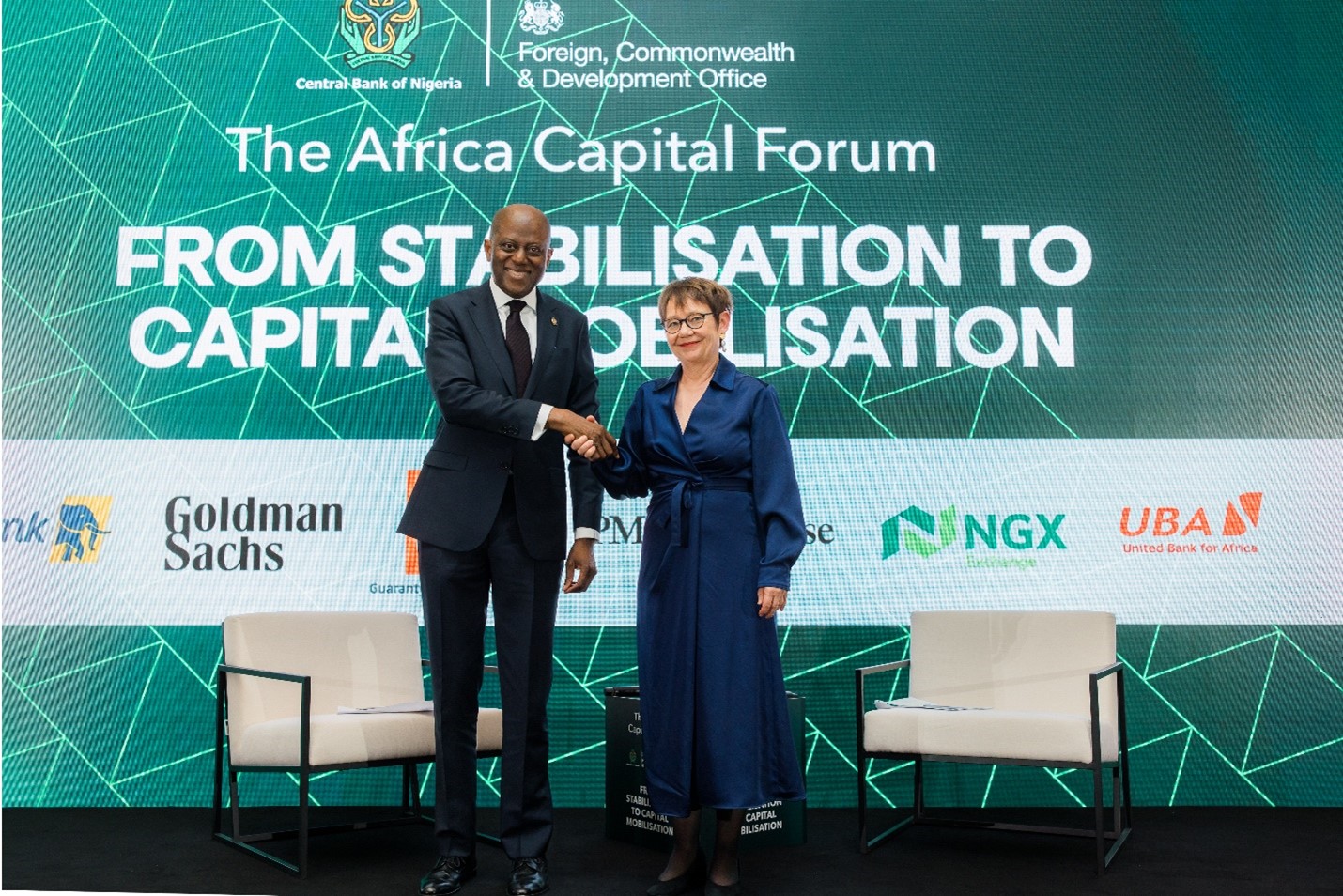
The Governor of the Central Bank of Nigeria (CBN), Mr. Olayemi Cardoso, has stated at the Africa Capital Forum in London that ongoing monetary and financial reforms have strengthened Nigeria’s resilience to external shocks and improved investor confidence.
Cardoso disclosed that foreign investors accounted for about 28 percent of inflows into the banking sector recapitalisation programme, adding that reforms have “created stronger capacity to withstand shocks.” Mr. Wale Edun, Honourable Minister of Finance and Coordinating Minister of the Economy, said that government requires partners to provide “sticky equity capital” to sustain growth.
Jonny Baxter, British Deputy High Commissioner to Nigeria, emphasised that the next phase should convert “renewed investor interest into long-term sustainable investments,” while Steve Gray of United Kingdom Export Finance noted that reforms are “providing transparency and building confidence.”
DECISION HIGHLIGHT
The CBN is shifting from stabilisation to capital mobilisation, positioning macroeconomic reforms as a platform to attract sustained foreign and domestic investment.
DECISION MEMO
The reform narrative presented at the Africa Capital Forum reflects a transition from crisis management to investment positioning. The CBN is asserting that macroeconomic stabilisation, inflation moderation, foreign exchange reforms, and banking recapitalisation have collectively restored a baseline level of confidence.
Cardoso’s claim that reforms have strengthened “capacity to withstand shocks” is supported by improvements in foreign reserves, exchange rate stability, and policy transparency. The reported 28 percent foreign participation in bank recapitalisation is a measurable signal of external confidence. However, this confidence remains conditional, it is early-stage capital, not yet long-duration commitment.
The distinction raised by Baxter is critical. Investor interest and capital deployment are not equivalent. Nigeria has historically attracted episodic inflows during reform cycles, but struggled to convert them into sustained investment pipelines. The challenge is not entry, it is retention.
Edun’s emphasis on “sticky equity capital” reflects this constraint. Short-term portfolio flows and opportunistic capital cannot finance long-term growth. Nigeria requires patient capital, yet the domestic environment, regulatory uncertainty, currency volatility, and policy reversals, has historically discouraged such commitments.
Gray’s observation that transparency is improving highlights one of the reform programme’s core achievements. The unification of the foreign exchange market and the introduction of clearer policy frameworks have reduced opacity. However, transparency alone does not eliminate risk. It only makes risk more visible.
Cardoso’s broader positioning of Nigeria as moving from stabilisation to capital mobilisation assumes that macroeconomic stability is sufficiently anchored. This assumption remains fragile. Inflation trends, exchange rate pressures, and fiscal constraints continue to present downside risks.
The digital finance agenda and payments system vision indicate forward-looking positioning, particularly in fintech and cross-border payments. Yet, these are secondary to the primary issue, whether the macroeconomic framework can sustain investor confidence beyond the initial reform cycle.
The presence of global institutions such as the European Bank for Reconstruction and Development (EBRD) reinforces external validation of Nigeria’s reform trajectory. However, such validation is typically contingent on continuity. Reform credibility in Nigeria has historically been undermined by policy reversals across political cycles.
The central tension is clear. Nigeria has improved its investment narrative. It has not yet conclusively improved its investment certainty.
DATA BOX
- Foreign participation in recapitalisation, 28 percent
- Foreign reserves, above $50 billion
- Inflation trend, decline from 34 percent to 15 percent (reported)
- Banks meeting recapitalisation requirements, 30+
- Forum theme, From Stabilisation to Capital Mobilisation
WHO WINS / WHO LOSES
Winners
Central Bank of Nigeria, reinforcing credibility through reform signalling
Foreign investors, accessing early-stage opportunities in a stabilising market
Domestic banks, benefiting from recapitalisation and improved confidence
Conditional winners
Nigerian economy, dependent on sustained capital inflows and reform continuity
Losers
Short-term speculative capital if policy discipline reduces arbitrage opportunities
Domestic sectors unable to attract investment despite macro reforms
POLICY SIGNALS
The reforms signal a shift toward transparency, policy coordination, and market-based mechanisms, particularly in foreign exchange management and banking regulation.
However, the emphasis on external capital mobilisation indicates continued reliance on foreign investment to drive growth.
INVESTOR SIGNAL
Nigeria is repositioning as a reform-driven investment destination with improving macroeconomic fundamentals. Early indicators, including foreign participation in recapitalisation, suggest renewed interest.
However, investors are likely to remain cautious, prioritising policy consistency, currency stability, and long-term regulatory clarity before committing significant capital.
RISK RADAR
Reform reversal risk across political cycles
Currency volatility affecting investor returns
Inflation persistence despite reported declines
Dependence on foreign capital for growth financing
Gap between investor interest and actual long-term capital deployment
The reform narrative has improved Nigeria’s positioning. The unresolved issue is conversion, turning confidence into sustained, long-term investment.
Discover more from StakeBridge Media
Subscribe to get the latest posts sent to your email.