

By Ayo Susan
The federal government has secured a Transnational Education partnership with Coventry University to establish a Lagos-based campus in Alaro City, delivering United Kingdom-equivalent degrees across undergraduate and postgraduate levels.
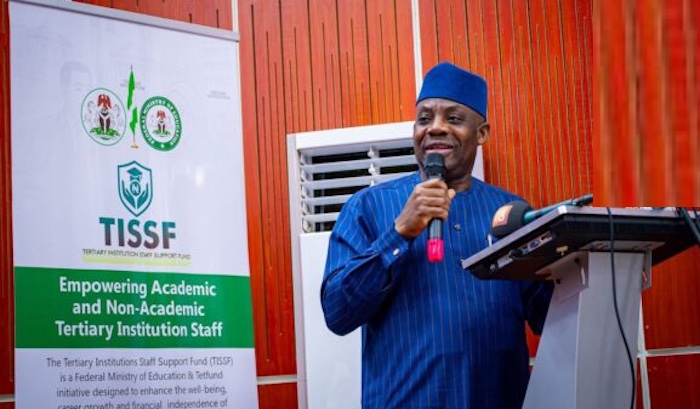
The Honourable Minister of Education, Mr. Tunji Alausa, recently stated that the initiative will expand access to “world-class UK education” locally and improve employability outcomes. The programme will cover Science, Technology, Engineering, Mathematics and Medicine, Business, and Technical and Vocational Education and Training, with admissions expected between the third and fourth quarters of 2026, subject to regulatory approvals.
The project is supported by the United Kingdom’s Department for Business and Trade and forms part of broader bilateral engagements during Bola Ahmed Tinubu’s state visit.
DECISION HIGHLIGHT
The federal government is adopting offshore university replication as a policy tool to address access, quality, and skills gaps in Nigeria’s higher education system.
DECISION MEMO
The Coventry University partnership reflects a pragmatic shift in education policy, importing quality rather than attempting to build it domestically within existing institutional constraints. Transnational Education models allow Nigeria to bypass structural inefficiencies in its university system, including underfunding, outdated curricula, and limited research capacity.
However, this approach introduces a substitution dynamic. Instead of reforming domestic universities at scale, the system risks creating parallel elite channels of education tied to foreign institutions. While Alausa’s claim that the model reduces the cost of studying abroad is valid, affordability remains relative. Access to such programmes may still be limited to upper-income segments unless pricing structures are aggressively localised.
Mr. Alausa’s assertion that parents can retain their children locally while accessing global education highlights a social benefit, but does not address systemic disparities within Nigeria’s public university network. The underlying challenge is not just access to degrees, but the uneven quality across the broader system.
The United Kingdom’s strategic positioning is equally clear. With a target to grow education exports to £40 billion annually by 2030, the shift toward offshore campuses reflects a recalibration from student importation to institutional export. Nigeria becomes both a market and a delivery platform.
The location of the campus in Alaro City, a private economic zone, is also instructive. It signals alignment with controlled, infrastructure-ready environments rather than integration into existing public university ecosystems. This reduces operational risk for the foreign institution but limits spillover effects into the wider education system.
The broader context of President Bola Ahmed Tinubu’s visit to the United Kingdom, which includes infrastructure and agricultural deals, suggests a pattern, Nigeria is increasingly opening domestic sectors to foreign institutional participation as a means of accelerating development outcomes. The risk is that this model prioritises immediate access over long-term domestic capacity building.
DATA BOX
- Delivery model, Transnational Education
- Location, Alaro City, Lagos State
- Programme scope, Bachelor’s and Master’s degrees
- Fields, STEMM, Business, Technical and Vocational Education and Training
- Admission timeline, Q3–Q4 2026 (subject to approval)
- United Kingdom education export target, £40 billion annually by 2030
WHO WINS / WHO LOSES
Winners
Coventry University, expanding global footprint and revenue base
Nigerian students with access to international-standard degrees locally
Private education ecosystems benefiting from foreign partnerships
Conditional winners
Nigerian economy, if skills development translates into productivity gains
Losers
Public universities, facing increased competition without equivalent funding or reform
Lower-income students excluded by cost barriers
POLICY SIGNALS
The partnership signals a shift toward internationalisation of Nigeria’s education system through foreign institutional entry. It also reflects reduced confidence in rapid domestic reform, with policy favouring external quality injection over internal restructuring.
INVESTOR SIGNAL
Nigeria’s education sector is opening to foreign institutional capital and partnerships, particularly in premium and technical segments. The market is large, but returns depend on pricing strategy and regulatory stability.
RISK RADAR
Affordability constraints limiting broad access
Dual-track education system widening inequality
Regulatory delays affecting project rollout
Limited integration with domestic academic institutions
Dependence on foreign providers for sustained quality delivery
The initiative expands access to global education, but also underscores a structural reality. Nigeria is importing educational quality rather than systemically producing it.
Discover more from StakeBridge Media
Subscribe to get the latest posts sent to your email.