

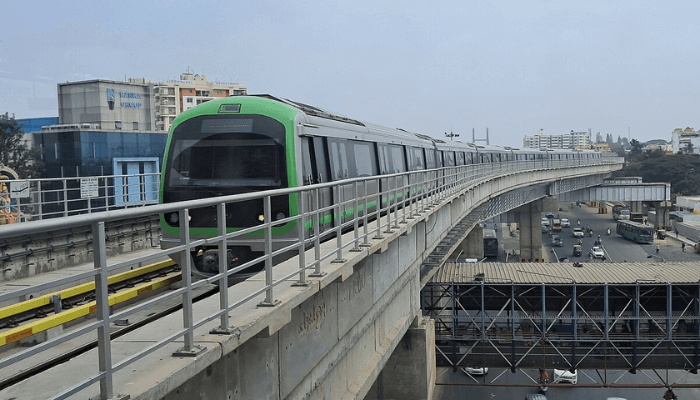
The federal government has proposed N102.3 billion as counterpart funding for the Lagos Green Line rail project in the 2026 budget, reinforcing federal participation in one of Nigeria’s most ambitious urban transport projects. The allocation appears in the 2026 Appropriation Bill under the Ministry of Transportation and is designated for Phase One of the Green Line.
The Lagos Green Line is a planned 68 – 70kilometre metro rail corridor running from the Lekki Free Trade Zone to Marina, designed to connect high-density commercial and residential districts including Victoria Island, Lekki, Ajah, and Sangotedo.
DECISION HIGHLIGHT
Decision Context:
Rapid urbanisation in Lagos, worsening traffic congestion along the Lekki corridor, and rising pressure to deliver mass transit solutions with shared federal–state financing.
Strategic Action:
Provision of federal counterpart funding through Ministry of Finance Incorporated (MOFI) to sustain structured financing arrangements for Phase One of the Lagos Green Line.
Funding Mechanism:
Transfer of N102.3 billion to the MOFI for equity participation and infrastructure financing coordination.
Strategic Objective:
Anchor federal commitment, crowd in complementary financing, and keep the Green Line project bankable ahead of physical construction.
DECISION MEMO
The N102.3 billion provision for the Lagos Green Line is less about track-laying in 2026 and more about maintaining financial credibility around the project. In Nigeria’s rail development history, many projects stall not at the engineering stage but at the financing and coordination layer. The continued appearance of the Green Line in consecutive budgets suggests an effort to avoid that fate.
Although the allocation is lower than the N146.14 billion provided in the 2025 budget, the persistence of federal counterpart funding signals that the project remains active within government’s medium-term infrastructure priorities. Routing the funds through MOFI further reinforces a preference for structured financing, rather than ad-hoc capital releases, especially for large urban rail systems with complex revenue and risk profiles.
The Green Line sits at the intersection of federal transport strategy and Lagos State’s urban mobility agenda. Its design reflects a long-term bet on mass transit as an economic enabler for the Lekki axis, home to Nigeria’s fastest-growing real estate, financial services, and industrial zones. However, the absence of construction as of January 2026 underscores a familiar execution risk: funding commitments advancing faster than on-ground delivery.
Beyond the Green Line, the 2026 rail budget reveals a broader federal posture focused on completion, optimisation, and preparatory work rather than aggressive greenfield expansion. Consultancy allocations, feasibility studies, rolling stock procurement, signalling systems, and security infrastructure dominate spending lines, suggesting a phase of consolidation and risk management across the rail sector.
In that context, the Green Line allocation functions as a signal of intent. It keeps the project alive in financial architecture, preserves investor confidence, and buys time for unresolved design, station spacing, and integration questions to be addressed before irreversible construction costs are incurred.
DATA BOX
- 2026 Green Line counterpart funding: N102.3bn
- 2025 Green Line counterpart funding: N146.14bn
- Planned Green Line length: ~68–70 km
- Estimated project cost: ~$3bn
- Planned stations: 17
- Projected capacity: 35,000 passengers/hour/direction
- Design speed: Up to 100 km/h
- Headway: ~3 minutes
- Phase One corridor: Lekki First Tollgate–Epe
- Phase Two corridor: Marina–Lekki (including on-water segment)
WHO WINS / WHO LOSES
Who Wins:
- Lagos commuters along the Lekki corridor if execution materialises
- Infrastructure financiers and advisers engaged early in structuring
- Construction and rail systems contractors positioned for eventual rollout
Who Loses:
- Daily road users facing continued congestion in the near term
- Businesses dependent on predictable commuter flows
- The project’s credibility if delays persist without clear timelines
POLICY SIGNALS
The Federal Government is prioritising structured, multi-year rail financing over rapid project announcements, signalling caution, sequencing, and fiscal discipline in transport infrastructure delivery.
INVESTOR SIGNAL
Repeated budgetary inclusion and MOFI-managed funding improve the Green Line’s long-term bankability, but execution risk remains elevated until physical construction milestones are reached.
RISK RADAR
- Prolonged delay between funding and construction
- Cost escalation due to inflation and FX pressures
- Design and station-density limitations affecting ridership
- Coordination risks between federal and state stakeholders
The N102.3 billion allocation keeps the Lagos Green Line financially relevant, but the next credibility test will not be in the budget books, it will be on the ground.
Discover more from StakeBridge Media
Subscribe to get the latest posts sent to your email.