

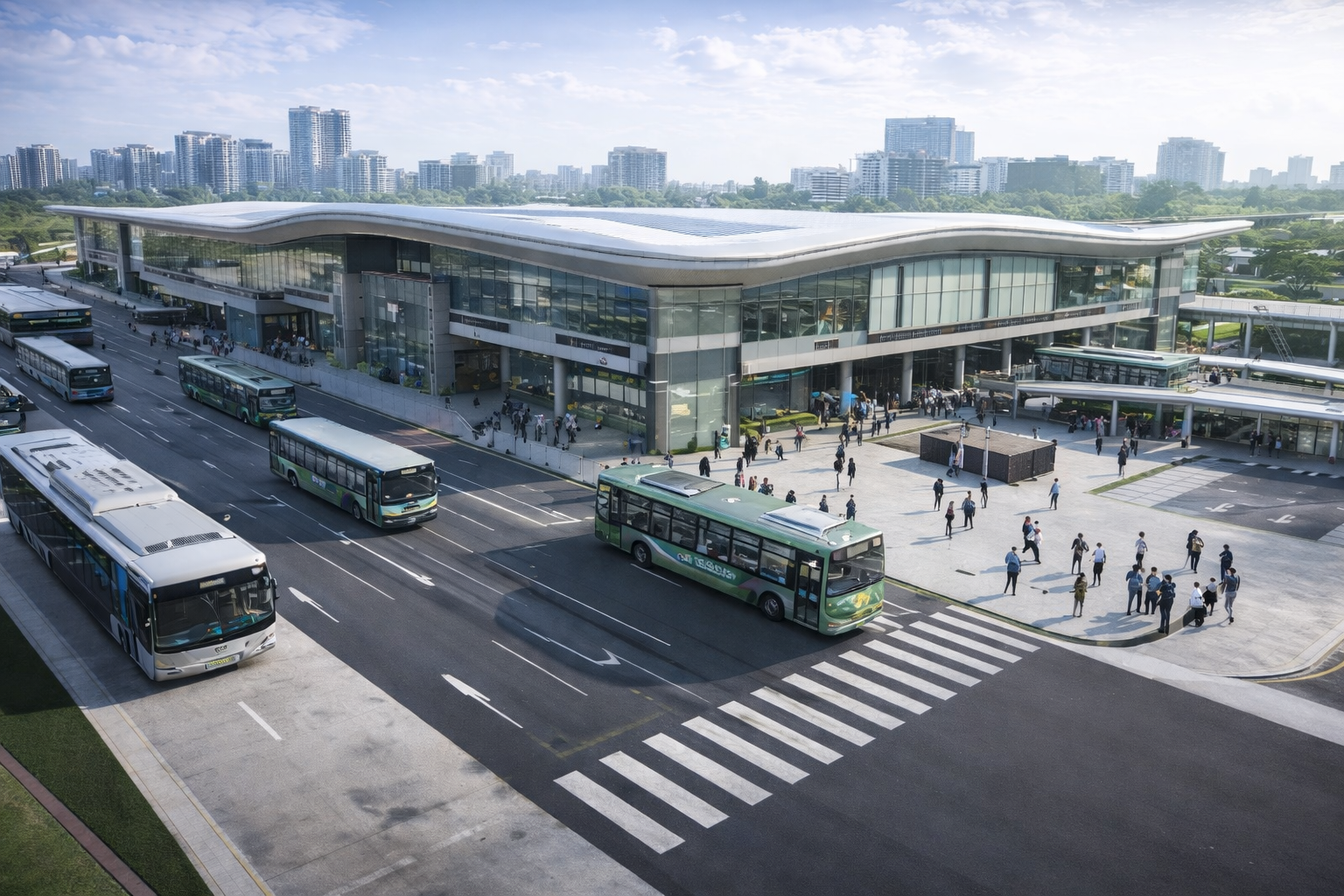
* A flagship bus terminal programme promises safer intercity travel and revenue hubs, while execution, maintenance, and long-term sustainability remain unresolved.
The federal government has proposed a N142 billion allocation for the construction of six national bus terminals in the 2026 budget, a N58.47 trillion spending plan currently before the National Assembly. The project appears in the 2026 Appropriation Bill under the Ministry of Transportation, which has a proposed allocation of about N352.1 billion for the fiscal year.
The bus terminal programme follows approval granted by the Federal Executive Council (FEC) in August 2025 and is positioned as a flagship public transportation initiative for 2026.
DECISION HIGHLIGHT
Decision Context:
Nigeria’s intercity transport system remains fragmented, informal, and safety-challenged, with limited standardised passenger infrastructure.
Budget Action:
N142 billion proposed for six national bus terminals in the 2026 Appropriation Bill.
Project Scope:
Construction of bus terminals and related transport facilities across all six geopolitical zones.
Strategic Objective:
Modernise public transportation infrastructure, improve commuter safety, and standardise intercity bus operations nationwide.
DECISION MEMO
The proposed N142 billion allocation signals a deliberate infrastructure-first approach to public transport reform. Rather than incremental upgrades, the Federal Government is opting for capital-intensive anchor assets that can reshape how intercity mobility is organised.
By embedding the project in the 2026 budget, the government is moving from concept to fiscal commitment. The terminals are designed as national reference points, facilities that consolidate operators, enforce safety standards, and formalise passenger flows. This is a structural intervention aimed at correcting inefficiencies that have long plagued Nigeria’s road transport ecosystem.
The geographic spread is equally strategic. Locating terminals in Abeokuta, Gombe, Kano, Lokoja, Onitsha, and Warri ensures political balance while anchoring transport nodes in commercial and transit-heavy corridors. Lokoja, for instance, sits at a critical north–south junction, while Onitsha and Warri link densely populated trade hubs.
Execution history also shapes interpretation. The contract award to Planet Projects Limited, developers of the Oshodi Transport Interchange, reflects a preference for proven delivery partners. Planet Projects’ earlier N51 billion Abuja terminal contract reinforces continuity in design philosophy and operational standards, reducing execution risk but also concentrating delivery responsibility.
The economic logic extends beyond commuter comfort. Well-designed terminals enable route optimisation, fare transparency, ancillary commercial activity, and potential private-sector participation through concessions. In effect, the terminals are intended to function as transport infrastructure and revenue-generating urban assets.
DATA BOX
- Total 2026 budget (proposed): N58.47 trillion
- Ministry of Transportation allocation: ~N352.1 billion
- Bus terminal project allocation: N142.03 billion
- Number of terminals: 6
- Project approval: August 2025 (FEC)
- Locations: Abeokuta, Gombe, Kano, Lokoja, Onitsha, Warri
WHO WINS / WHO LOSES
Who Wins:
- Intercity commuters benefiting from safer, standardised terminals
- Transport operators integrated into formal infrastructure
- Construction and services value chains linked to terminal development
Who Loses:
- Informal roadside operators displaced by terminal consolidation
- Cities without inclusion in the first rollout phase
POLICY SIGNALS
The proposal reinforces transport infrastructure as a core public investment priority rather than a regulatory afterthought. It also signals preference for capital projects that can support concessioning and private participation over time.
INVESTOR SIGNAL
For infrastructure investors and operators, the terminals point to future concession, advertising, retail, and services opportunities within public transport hubs. The concentration of spend suggests a pipeline for PPP-style engagements.
RISK RADAR
- Budget execution risk amid fiscal pressures
- Delays from procurement or site acquisition challenges
- Maintenance and operational sustainability post-construction
- Overcentralisation of contracts limiting competitive tension
The N142 billion bus terminal proposal is more than a line item. It is a statement that Nigeria’s transport reform agenda is shifting from informal adaptation to formal infrastructure, betting that concrete, if delivered on time, can change commuter behaviour and system economics alike.
Discover more from StakeBridge Media
Subscribe to get the latest posts sent to your email.