

- Ambition Is Set; Execution Will Decide If Promises Turn Real
Nigeria and Türkiye are attempting to move their relationship beyond goodwill and formal visits into something more tangible. The $5 billion trade ambition announced in Ankara sets a clear benchmark, but it also narrows the margin for excuses. By anchoring cooperation to a Joint Economy and Trade Committee, both governments are admitting that past engagement lacked staying power. What follows will matter more than what was signed. Policy consistency, credible pipelines, and private sector confidence will decide whether this ambition reshapes commerce or fades into diplomatic routine. Enam Obiosio writes…
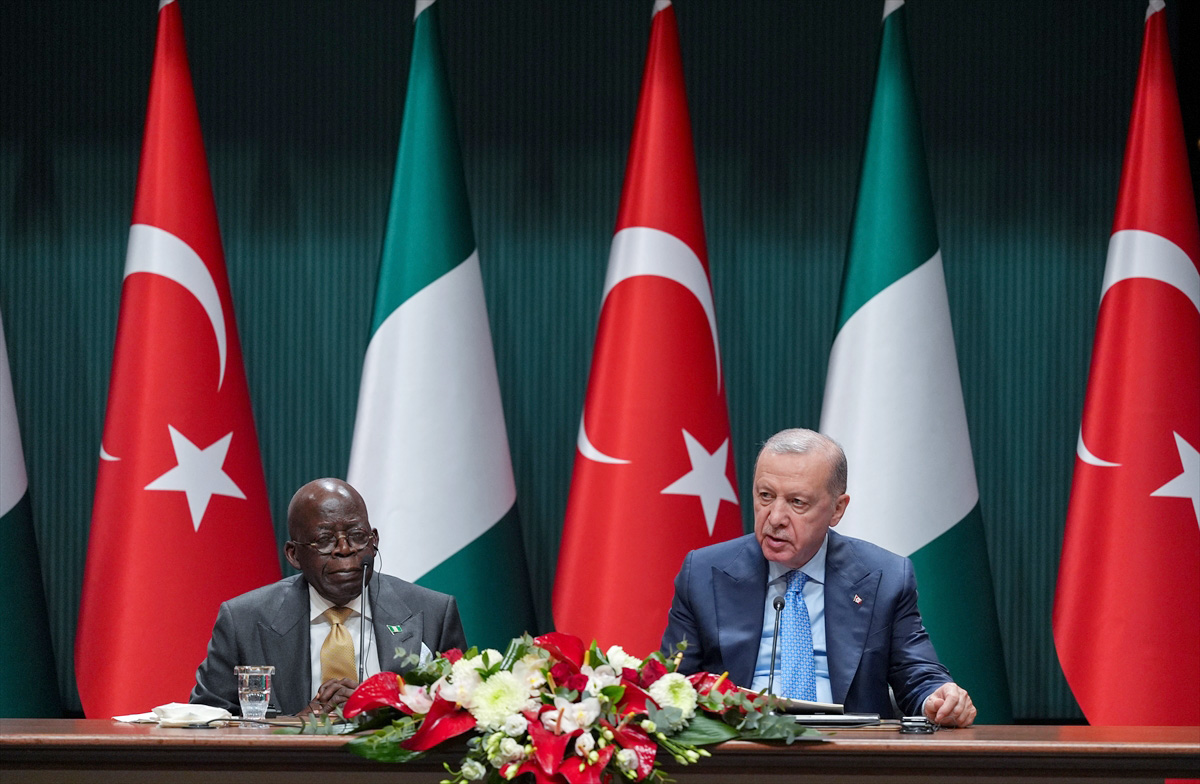
Nigeria and Türkiye have agreed to pursue a bilateral trade volume of $5billion, alongside the signing of nine cooperation agreements spanning defence, trade, energy, education, diaspora policy, and social development. The commitment was announced in Ankara during President Bola Ahmed Tinubu’s state visit, following talks with Turkish President, Recep Tayyip Erdoğan. Both leaders also endorsed the creation of a Joint Economy and Trade Committee as the primary institutional vehicle for scaling commercial ties.
DECISION HIGHLIGHT
Decision type: Bilateral trade and security cooperation expansion
Decision owners: Governments of Nigeria and Türkiye
Trade target: $5bn bilateral trade volume
Institutional mechanism: Joint Economy and Trade Committee
Agreements signed: Nine sectoral accords
Strategic sectors: Trade, defence, energy, education, diaspora policy
Headline implication: Ambitious targets hinge on institutional execution, not ceremonial agreements
DECISION MEMO
The $5billion trade target marks an escalation in Nigeria–Türkiye relations, but ambition alone is not the constraint. The real test is whether the newly signed frameworks can translate into bankable projects, predictable market access, and sustained private capital flows.
President Erdoğan framed the commitment as a function of untapped potential. “We see that we have significant potential in the fields of trade and investment,” he said, adding that the Joint Economy and Trade Committee would be ‘instrumental’ in supporting Turkish investments in Nigeria. The emphasis on institutional machinery suggests an acknowledgement that previous engagements lacked follow-through.
Energy cooperation sits at the centre of this recalibration. Erdoğan commended Nigeria’s ongoing energy reforms and expressed optimism about cooperation between Turkish Petroleum Corporation and Nigerian counterparts. This signals interest in upstream and midstream participation, but it also raises familiar questions around regulatory stability, fiscal terms, and security of assets.
Security cooperation was elevated from rhetoric to commitment. Erdoğan pledged support for Nigeria’s counterterrorism efforts, citing Türkiye’s experience in combating insurgency. “We stand by the friendly people of Nigeria in their fight against terrorism,” he said, pointing to closer cooperation in military training and intelligence sharing. While strategically significant, defence cooperation will be judged by operational outcomes rather than declarations.
President Tinubu’s intervention pivoted the conversation toward inclusion and market access. He stressed the need for “trade, business, no restrictions,” and asked how both countries could “build an inclusive economy” that integrates vulnerable populations. This framing places social inclusion alongside trade liberalisation, but it also complicates delivery if policy coherence is weak.
Nine agreements were signed, including defence cooperation, the establishment of the Joint Economy and Trade Committee, cooperation on halal quality infrastructure, higher education, media and communication, and institutional collaboration between both countries’ foreign affairs and social development ministries. The breadth is notable, but breadth without sequencing risks dilution.
From the private sector lens, Ifeanyi Onukwubiri, a member of the Nigeria–Türkiye Business Council and Chief Executive Officer of TMT Travels and Tours Limited, described the accords as a reset. He said the agreements “represent a strategic step towards expanding bilateral trade, improving market access and encouraging stronger private-sector collaboration.”
Onukwubiri argued that Nigerian firms could leverage Türkiye’s manufacturing, construction, and logistics strengths, while Turkish investors gain access to Nigeria’s consumer market. The opportunity is real, but so are the frictions, customs efficiency, FX repatriation, contract enforcement, and infrastructure bottlenecks will determine whether trade volumes scale.
The $5billion target therefore functions as a stress test. It will expose whether Nigeria can convert diplomatic alignment into predictable commercial outcomes, and whether Türkiye can move from episodic projects to sustained portfolio investment in Africa’s largest market.
DATA BOX
Bilateral trade target: $5bn
Agreements signed: 9
Key mechanism: Joint Economy and Trade Committee
Core sectors: Trade, defence, energy, education
Security focus: Counterterrorism cooperation, military training, intelligence sharing
WHO WINS / WHO LOSES
Winners: Exporters with scale, construction and energy firms, defence contractors, logistics providers.
Losers: Firms dependent on policy discretion, markets without customs and FX clarity, small exporters lacking financing.
POLICY SIGNALS
The creation of a Joint Economy and Trade Committee signals a shift toward institutionalising bilateral commerce. Success will depend on policy consistency, dispute resolution mechanisms, and measurable project pipelines.
INVESTOR SIGNAL
The agreements broaden the investable narrative, but capital will price execution risk. Investors should watch early wins in energy, infrastructure, and manufacturing to validate momentum.
RISK RADAR
Key risks include policy slippage, security volatility, FX and repatriation constraints, and overextension across too many sectors at once. Without disciplined sequencing and delivery, the $5bn target risks remaining aspirational rather than operational.
Discover more from StakeBridge Media
Subscribe to get the latest posts sent to your email.