

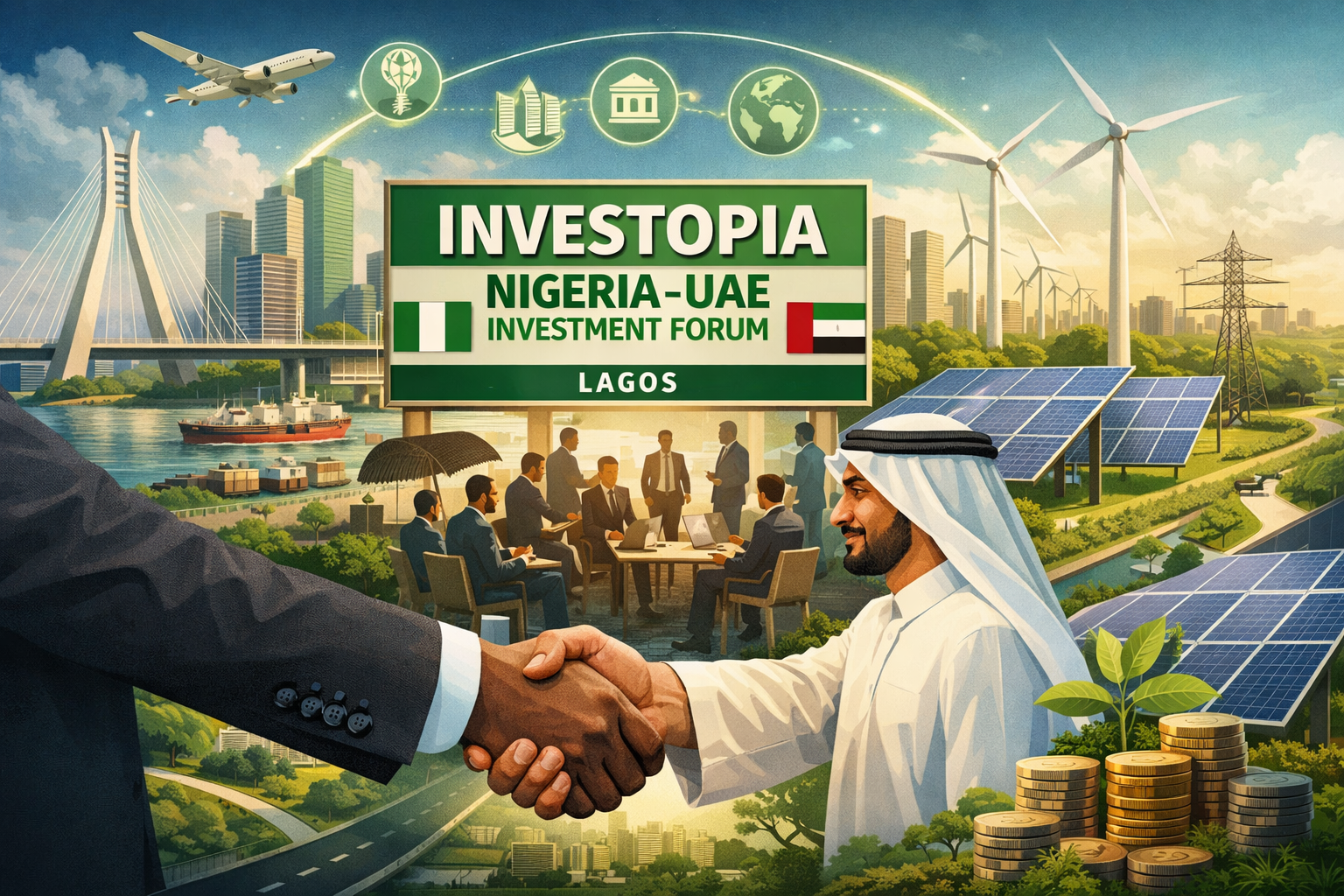
Nigeria’s plan to host Investopia in Lagos is a practical move aimed at one clear objective. It is to bring global investment capital closer to climate, energy, and infrastructure projects within the country. For years, many of these projects have struggled to move from policy statements to financial close. By hosting a major investment platform in Lagos and pairing it with a new trade and investment framework with the UAE, the government is attempting to narrow that gap. The message to investors is simple. Nigeria is putting its projects, reforms, and partners in the same room and expects capital commitments to follow. Enam Obiosio writes…
President Bola Ahmed Tinubu announced that Nigeria will co-host Investopia with the United Arab Emirates (UAE) in Lagos in February, positioning the country as a convening ground for global investors focused on sustainable and growth capital. The announcement was made at Abu Dhabi Sustainability Week, alongside the conclusion of a Comprehensive Economic Partnership Agreement (CEPA) between Nigeria and the UAE.
The CEPA is designed to deepen cooperation across renewable energy, infrastructure, logistics, digital trade, aviation, agriculture, and climate-smart development, reinforcing Nigeria’s push to translate reform momentum into investable projects.
DECISION HIGHLIGHT
Decision Context:
Nigeria is pursuing energy transition, industrial growth, and non-oil export expansion amid tight global capital conditions.
Policy Action:
Co-hosting Investopia in Lagos and concluding a CEPA with the UAE.
Capital Focus:
Mobilisation of large-scale private and blended finance into climate, energy, and infrastructure projects.
Strategic Objective:
Position Nigeria as a credible destination for sustainable capital by aligning trade access, investment platforms, and domestic reforms.
DECISION MEMO
This move is less about event hosting and more about capital architecture. By bringing Investopia to Lagos, Nigeria is attempting to shorten the distance between global capital pools and domestic projects that have historically struggled to reach financial close.
The CEPA provides the structural backbone. It expands market access and investment cooperation at the same time Nigeria is recalibrating its internal frameworks to absorb long-tenor capital. The emphasis on renewable energy, logistics, and digital trade reflects sectors where Nigeria’s scale meets global investor appetite.
Tinubu’s message to investors was explicit. Nigeria is not merely seeking funds; it is advocating for a redesign of how those funds flow. The call to move away from sovereign guarantee requirements toward blended finance and first-loss capital mechanisms signals an attempt to de-risk projects without over-leveraging the public balance sheet. This framing aligns Nigeria with global climate finance conversations while addressing local fiscal constraints.
Policy readiness is central to the pitch. The launch of a National Carbon Market Activation Policy and a National Carbon Registry aims to convert climate ambition into measurable, tradable outcomes. Meanwhile, the Electricity Act 2023 decentralises power generation and distribution, unlocking sub-national and private participation in electricity access.
Investopia therefore functions as a bridge. It connects Nigeria’s reform narrative, its trade partnership with the UAE, and a pipeline of bankable projects into a single investor proposition. The success metric will not be attendance, but whether commitments move from panels into term sheets.
DATA BOX
- Investopia co-hosting: February, Lagos
- Target annual climate and green industrial finance: up to $30 billion
- Distributed renewable energy fund: $500 million (NSIA-backed)
- World Bank clean power programme: $750 million
- People targeted for expanded electricity access: 17.5 million
- Non-oil export growth: 21%
- Net-zero target: 2060
WHO WINS / WHO LOSES
Who Wins:
- Renewable energy and infrastructure developers with bankable projects
- Investors seeking scale exposure in emerging green markets
- Export-oriented sectors benefiting from improved trade and logistics links
Who Loses:
- Projects unable to meet transparency and governance thresholds
- Sectors dependent on sovereign guarantees rather than risk-sharing structures
POLICY SIGNALS
Nigeria is signalling a shift from subsidy-heavy development to market-enabled investment, prioritising regulatory clarity, decentralisation, and carbon market infrastructure to attract private capital.
INVESTOR SIGNAL
The combination of CEPA, Investopia, and domestic reforms reduces entry friction. Investors are being offered clearer rules, diversified exit options, and platforms to co-invest alongside development finance.
RISK RADAR
- Execution risk in converting commitments into disbursements
- Currency and policy consistency challenges
- Capacity constraints in project preparation and delivery
- Global risk aversion tightening climate finance flows
Co-hosting Investopia is Nigeria’s attempt to move from advocacy to allocation. If capital follows the conversation, the country could turn reform momentum into a durable investment cycle rather than a one-off diplomatic win.
Discover more from StakeBridge Media
Subscribe to get the latest posts sent to your email.