

By Enam Obiosio
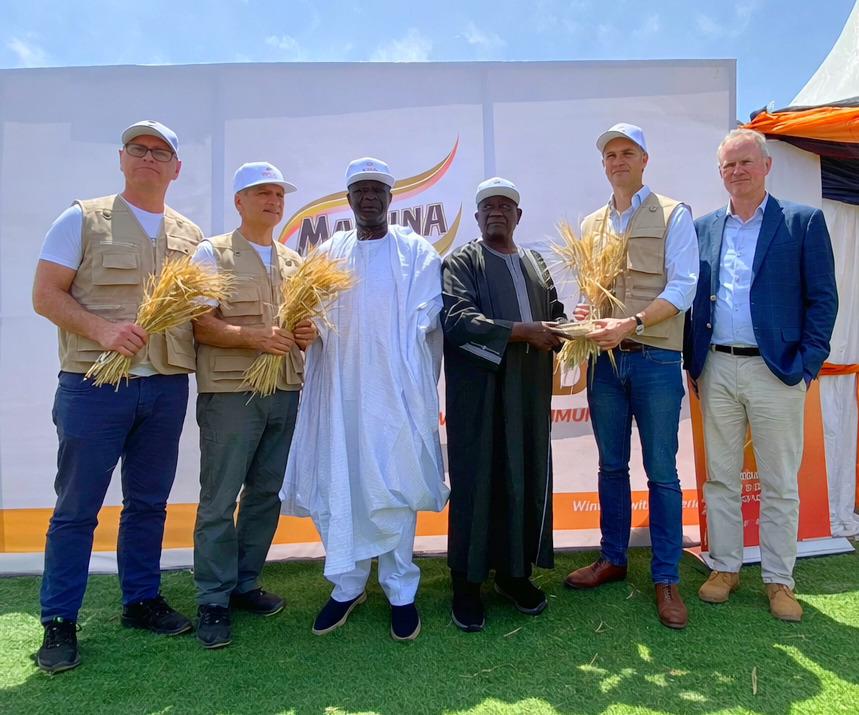
Nigerian Breweries Plc has publicly demonstrated the agronomic feasibility of growing barley in Nigeria, using its Maltina Barley Field Day in Ringim, Jigawa State, to present the first practical results of domestic cultivation.
The exercise showcased barley grown by more than 1,000 smallholder farmers under the company’s Maltina Barley Programme. Expected output from the current cycle exceeds 1,000 tons, a figure that proves crop adaptability but remains far below the national requirement.
Nigeria’s brewing sector currently imports about 200,000 tons of malted barley annually, a dependency that drains more than $150 million from the domestic economy each year.
Thibaut Boidin, Managing Director and Chief Executive Officer of Nigerian Breweries Plc, said that the programme is intended to build a local agricultural supply chain for the brewing industry.
“Our ambition is clear: to develop a barley value chain that is rooted in Nigerian soil, powered by Nigerian farmers, and capable of meeting the quality standards required by industry,” Boidin said.
Boidin added that achieving scale would require broader institutional support beyond private sector initiatives.
“This ambition cannot be achieved by the private sector alone,” Boidin stated.
Federico Agressi, Supply Chain Director of Nigerian Breweries Plc, emphasised that the effort would require coordinated support from multiple actors within the agricultural ecosystem.
“Building a sustainable commercial barley value chain in Nigeria is a long journey,” Agressi said, noting that farmers, seed companies, financiers, aggregators and government institutions must all participate in the process.
DECISION HIGHLIGHT
Nigerian Breweries Plc has validated the technical feasibility of domestic barley cultivation but is urging coordinated government and ecosystem intervention to move production from pilot scale to industrial supply levels.
DECISION MEMO
The Maltina Barley Field Day represents more than an agricultural demonstration. It is an industrial supply chain experiment designed to test whether Nigeria can substitute imported barley with locally cultivated alternatives.
Barley is a critical raw material in brewing, particularly for malt production. Nigeria’s dependence on imports exposes the brewing industry to foreign exchange volatility and global commodity price fluctuations. For manufacturers such as Nigerian Breweries Plc, the economic incentive for local cultivation is therefore strategic rather than symbolic.
Boidin’s remarks indicate that the company views domestic barley as a long-term supply security strategy rather than an immediate cost-saving measure.
However, the gap between demonstration and industrial scale remains substantial. The current pilot yield of slightly above 1,000 tons represents only a marginal fraction of the roughly 200,000 tons imported annually by the brewing industry.
Scaling production to meaningful levels will require several structural interventions, including improved seed systems, irrigation expansion, farmer financing and guaranteed offtake arrangements.
Agressi suggested that the challenge is not agronomic feasibility but ecosystem readiness. He said that the transition to a commercial barley value chain will require participation from seed companies, agricultural input providers, financing partners and government institutions.
Beyond farming, policy alignment will also be required to manage the transition between imports and domestic production. Nigerian Breweries Plc has argued that import allowances should remain in place during the early development stage of the local supply chain to prevent disruptions to brewing operations while local output gradually expands.
Agronomic groundwork for scale has already been laid through research partnerships. After several years of research and development collaboration with the Lake Chad Research Institute and Secobra Research, three barley varieties, Traveler, Explorer and Prunella, were officially registered in Nigeria in 2024.
Further analysis conducted with IDH and Dalberg has identified more than 400,000 hectares of farmland across Northern Nigeria that could support barley cultivation under suitable conditions.
The implication is clear. Nigeria possesses the agro-climatic potential to produce barley domestically, but converting that potential into an industrial supply chain requires policy coherence and sustained investment.
DATA BOX
Annual barley imports by Nigerian brewing sector: 200,000 tons
Estimated annual foreign exchange outflow: Over $150 million
Farmers participating in Maltina Barley Programme: Over 1,000
Expected pilot harvest output: Over 1,000 tons
Registered barley varieties in Nigeria: Traveler, Explorer, Prunella
Potential farmland for barley cultivation in Northern Nigeria: Over 400,000 hectares
WHO WINS / WHO LOSES
Winners
Northern Nigerian farmers could gain a new commercial crop with structured offtake from industrial buyers. Agricultural input providers, seed companies and rural aggregators may benefit from an expanded value chain around barley production.
Brewing companies stand to reduce long-term foreign exchange exposure if local supply eventually replaces imports.
Potential Losers
Global barley exporters currently supplying Nigerian brewers may gradually lose market share if domestic production becomes viable.
Domestic brewers could also face short-term cost pressures if local production remains limited while policy restrictions on imports tighten prematurely.
POLICY SIGNALS
The initiative reflects a broader policy push toward backward integration in manufacturing supply chains. Nigeria has pursued similar strategies in sectors such as sugar, cement and rice.
However, the call for continued import allowances signals recognition that abrupt protectionist measures could destabilize industries dependent on imported raw materials.
The emerging policy balance therefore lies between encouraging domestic agriculture and maintaining industrial continuity.
INVESTOR SIGNAL
The project signals growing corporate interest in integrating agriculture into industrial supply chains within Nigeria.
Investors in agricultural logistics, seed development, irrigation systems and rural financing may find opportunities if barley cultivation expands toward commercial scale.
The identified 400,000 hectares of suitable land also suggests the possibility of large-scale contract farming or agro-industrial clusters in Northern Nigeria.
RISK RADAR
Several risks could constrain the transition from pilot cultivation to industrial supply.
Agricultural productivity risks remain significant, particularly given climate variability across Northern Nigeria. Access to irrigation, improved seed distribution and farmer financing will determine whether yields can approach commercial thresholds.
Policy inconsistency also poses a risk. If import restrictions are imposed before domestic supply reaches viable scale, brewing companies may face raw material shortages or increased production costs.
Finally, logistics and aggregation challenges could undermine supply chain efficiency, particularly in transporting harvested barley from dispersed farming communities to industrial processing facilities.
Discover more from StakeBridge Media
Subscribe to get the latest posts sent to your email.