

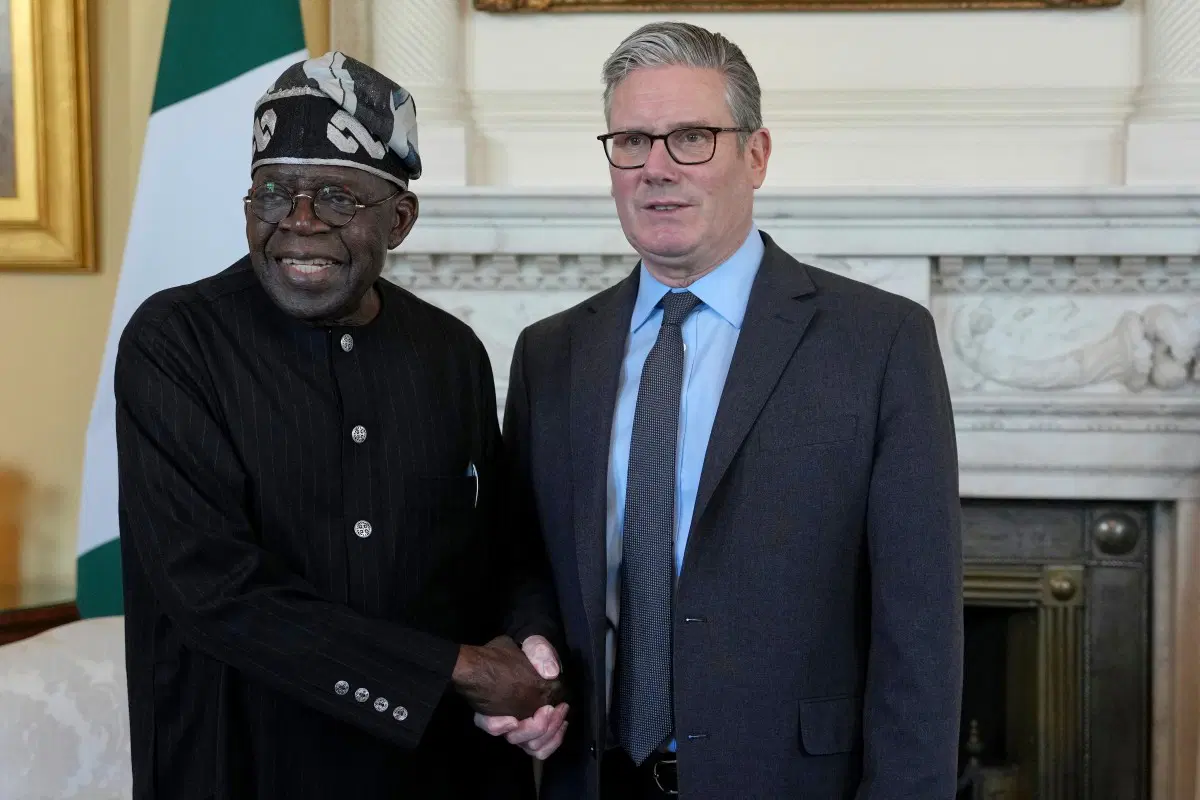
- Financing involves the Nigerian Ports Authority (NPA), the Federal Ministry of Finance, and United Kingdom Export Finance
- Targeting upgrades to critical maritime infrastructure
The recent engagement between President Bola Ahmed Tinubu and UK Prime Minister Keir Starmer reflects a critical moment in Nigeria’s ongoing effort to address its infrastructure deficit through external partnerships. The £746 million ports rehabilitation deal extends beyond bilateral diplomacy, pointing to a deeper pattern in how the country finances large-scale projects. As Nigeria seeks to improve trade efficiency and reposition its maritime gateways, the agreement underscores both the urgency of reform and the continued dependence on foreign capital, framing the key questions around sustainability, value capture, and long-term economic resilience, as Enam Obiosio examines…
President Bola Ahmed Tinubu recently held bilateral talks with Keir Starmer, Prime Minister of the United Kingdom, in London, culminating in a £746 million export finance agreement for the rehabilitation of Lagos Port Complex and Tin Can Island Port Complex.
The financing involves the Nigerian Ports Authority (NPA), the Federal Ministry of Finance, and United Kingdom Export Finance, targeting upgrades to critical maritime infrastructure.
President Tinubu stated that Nigeria is undergoing “very strong reform of the economy” and called for expanded trade relationships, while Starmer described the engagement as an opportunity “to take that to another level with the agreements… on exports.”
DECISION HIGHLIGHT
Nigeria is leveraging export credit financing from the United Kingdom to modernise port infrastructure, reinforcing a model where external capital underwrites domestic infrastructure gaps.
DECISION MEMO
The £746 million ports deal reflects a familiar pattern in Nigeria’s infrastructure financing, external capital as a substitute for domestic fiscal capacity. While the transaction addresses an urgent need, port inefficiency remains one of Nigeria’s most binding trade constraints, it also reinforces structural dependence on foreign-backed financing mechanisms.
President Tinubu’s framing of economic reform and expanded trade partnerships signals intent, but the reliance on United Kingdom Export Finance indicates limited internal capacity to fund large-scale infrastructure independently. Export credit structures are not neutral, they often tie financing to foreign contractors, equipment, and services, potentially limiting domestic value capture.
Starmer’s emphasis on scaling export agreements reflects the United Kingdom’s strategic positioning, facilitating capital deployment that supports both Nigerian infrastructure and British commercial interests. This dual objective is typical of export finance arrangements, where development outcomes and national economic interests are intertwined.
The inclusion of the NPA and Federal Ministry of Finance suggests institutional alignment, but execution risk remains significant. Nigeria’s port system has historically suffered from congestion, inefficiency, and governance bottlenecks. Infrastructure upgrades alone do not resolve operational inefficiencies, regulatory fragmentation, or logistics chain disruptions.
The assertion of Honourable Minister of Marine and Blue Economy, Mr. Adegboyega Oyetola, that the project will strengthen Nigeria’s position as a maritime hub is directionally correct, but contingent on complementary reforms in customs processes, inland transport connectivity, and port governance. Without these, physical upgrades risk being absorbed into an inefficient system.
Tinubu’s linkage of economic challenges to broader issues such as climate-driven conflict introduces a wider macro context, but does not materially alter the financing structure of the deal. The core issue remains, Nigeria is importing capital to fix infrastructure that underpins its trade competitiveness.
DATA BOX
- Financing size, £746 million
- Infrastructure targets, Lagos Port Complex, Tin Can Island Port Complex
- Financing source, United Kingdom Export Finance
- Nigerian institutions involved, Nigerian Ports Authority (NPA), Federal Ministry of Finance
- Strategic objective, port modernisation and trade facilitation
WHO WINS / WHO LOSES
Winners
United Kingdom exporters and contractors linked to the financing structure
Nigerian Ports Authority, with upgraded infrastructure capacity
Trade-dependent businesses benefiting from potential efficiency gains
Conditional winners
Nigerian economy, dependent on whether upgrades translate into reduced port congestion and lower trade costs
Losers
Domestic contractors if project execution is externally dominated
Importers and exporters if structural inefficiencies persist despite upgrades
POLICY SIGNALS
The deal signals continued reliance on bilateral export credit frameworks to finance infrastructure. It also reflects a policy preference for externally anchored partnerships over domestically financed capital projects.
There is limited evidence of a parallel strategy to strengthen internal revenue mobilisation for infrastructure funding.
INVESTOR SIGNAL
Nigeria remains open to large-scale infrastructure investment, particularly through sovereign-backed and export credit structures. However, investor participation is still mediated through government-to-government frameworks rather than purely market-driven financing.
RISK RADAR
Execution risk within historically inefficient port systems
Dependence on foreign financing structures with tied conditions
Limited domestic value capture from externally financed projects
Policy inconsistency affecting long-term infrastructure outcomes
Macroeconomic volatility impacting repayment and fiscal sustainability
The agreement advances infrastructure capacity, but also reinforces a structural reality. Nigeria is modernising critical assets through external capital, not internal financial strength.
Discover more from StakeBridge Media
Subscribe to get the latest posts sent to your email.