

By Hannah Yemisi
- $500m SPIN Project To Boost Jobs, Irrigation, Food Security In Nigeria
The World Bank Group has endorsed Nigeria’s recent economic reforms and unveiled a strategic framework aimed at translating policy stabilisation into job creation, food security and long-term economic growth.
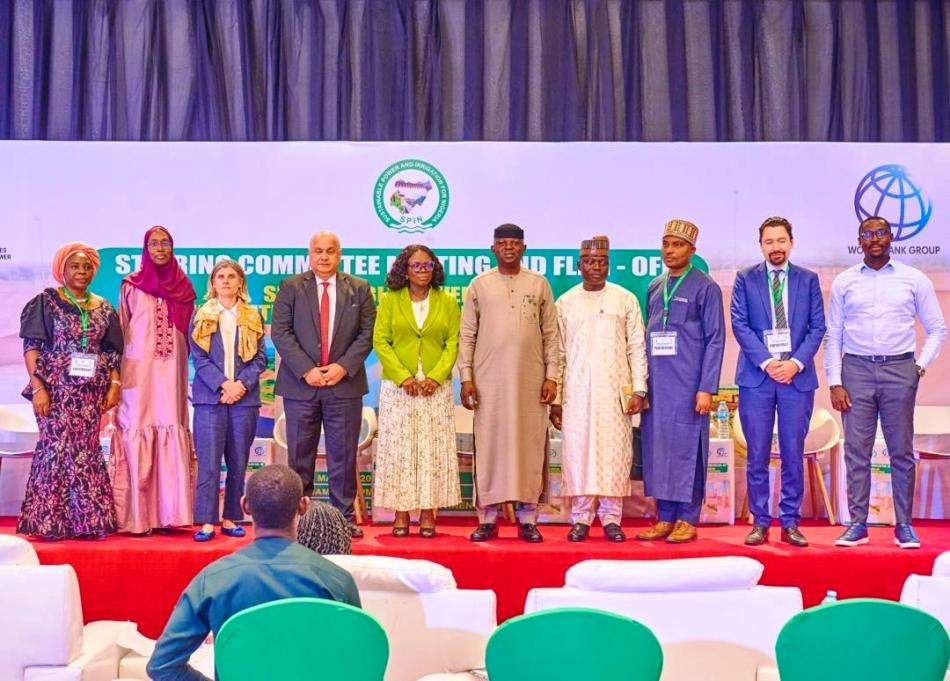
Matthew Verghis, Country Director of the World Bank Group in Nigeria, recently disclosed this during the launch of the Sustainable Power and Irrigation for Nigeria (SPIN) project in Abuja.
Verghis said the reforms undertaken in recent years have helped stabilise Nigeria’s macroeconomic environment and created the foundation for a new growth trajectory.
“Reforms implemented in recent years have created a strong foundation for economic transformation,” Verghis said.
Saroj Kumar Jha, Global Director for Water at the World Bank Group, said the new irrigation initiative draws lessons from water management programmes implemented in countries such as India, Indonesia and Vietnam.
Joseph Terlumun Utsev, Minister of Water Resources and Sanitation, said that the project supports the administration’s development priorities.
Utsev also said that the initiative aligns with the Renewed Hope Agenda and aims to strengthen irrigation, dam safety and hydropower generation.
DECISION HIGHLIGHT
The World Bank Group is preparing a new Country Partnership Framework for Nigeria covering 2026 to 2032, shifting its development engagement toward job creation, water security, food security and energy infrastructure.
The strategy emphasises stronger collaboration with state governments and increased mobilisation of private sector investment to complement limited public financing.
DECISION MEMO
The World Bank Group’s new strategic positioning in Nigeria reflects a broader recalibration of development financing priorities.
After a period focused largely on macroeconomic stabilisation and fiscal reforms, international development partners are now signalling that Nigeria’s next policy challenge lies in translating reforms into measurable economic outcomes.
Verghis noted that recent reforms have stabilised key economic fundamentals, but the real test will be whether these gains produce employment opportunities and inclusive growth.
According to Verghis, the new Country Partnership Framework currently under preparation will guide the World Bank Group’s engagement with Nigeria between 2026 and 2032, with a strong emphasis on job creation.
Verghis said water security, food production and energy infrastructure will form the core pillars of the new strategy.
The launch of the Sustainable Power and Irrigation for Nigeria project illustrates how the development institution intends to operationalise this approach.
The initiative builds on the Transforming Irrigation Management in Nigeria (TRIMING) Project, which is expected to reach more than 1.7 million beneficiaries and expand irrigation across 14,000 hectares of farmland.
Verghis explained that the new project will deepen irrigation investments while integrating agricultural value chains in order to attract private sector participation.
Jha emphasised that Nigeria’s water infrastructure remains underutilised despite the presence of hundreds of dams across the country.
According to Jha, many of Nigeria’s more than 400 dams suffer from siltation and weak maintenance systems, limiting their capacity to support irrigation and water management.
Jha stressed that stronger water users’ associations will be necessary to ensure long term sustainability of irrigation infrastructure.
Utsev said that the federal government has formally launched the US$500 million Sustainable Power and Irrigation for Nigeria project, designed to modernise irrigation systems, strengthen dam safety and expand hydropower generation.
Utsev further said that the initiative is intended to support year-round farming and strengthen Nigeria’s resilience to climate related agricultural disruptions.
Beyond irrigation infrastructure, the strategy reflects a wider development logic. The World Bank Group increasingly sees agricultural productivity, water management and energy supply as interconnected pillars required to unlock employment growth in Nigeria’s rural economy.
The institution is also signalling that future development programmes will increasingly depend on mobilising private capital, given the fiscal constraints facing the Nigerian government.
DATA BOX
Development Programme: Sustainable Power and Irrigation for Nigeria (SPIN)
Project Value: 500 million dollars
Country Partnership Framework Timeline: 2026–2032
Previous Programme: Transforming Irrigation Management in Nigeria (TRIMING)
TRIMING Project Reach: 1.7 million beneficiaries
Land Under Irrigation Expansion: 14,000 hectares
Estimated Number of Dams in Nigeria: Over 400
Strategic Focus Areas:
Water security
Food security
Energy infrastructure
Job creation
WHO WINS / WHO LOSES
Winners
Farmers and agribusiness operators may benefit from improved irrigation infrastructure and expanded agricultural productivity.
Private sector investors in agricultural value chains and water infrastructure may gain new investment opportunities.
State governments are likely to play a more central role in development project implementation.
Losers
Regions lacking irrigation infrastructure or state level implementation capacity may benefit less from the programme.
Existing water infrastructure operators may face higher governance expectations under strengthened management frameworks.
POLICY SIGNALS
The World Bank Group’s strategy signals international confidence in Nigeria’s ongoing economic reforms while emphasising the need for tangible development outcomes.
The focus on water infrastructure, agriculture and energy suggests a policy shift toward productive sector investments rather than purely fiscal stabilisation measures.
The approach also indicates stronger decentralised engagement with state governments.
INVESTOR SIGNAL
For investors, the programme highlights emerging opportunities across irrigation infrastructure, agricultural value chains, water management technologies and rural energy systems.
The World Bank Group’s emphasis on private sector participation suggests that future development projects will increasingly involve blended finance structures.
RISK RADAR
Three structural risks remain evident.
First is implementation risk, particularly given Nigeria’s history of delayed infrastructure projects.
Second is maintenance risk, as existing water infrastructure has suffered from weak operational oversight.
Third is institutional coordination risk, where federal and state government agencies must work together effectively to deliver project outcomes.
The SPIN project ultimately reflects a development strategy that seeks to convert macroeconomic reform into productive sector growth, but its success will depend heavily on execution capacity and sustained institutional coordination.
Discover more from StakeBridge Media
Subscribe to get the latest posts sent to your email.