

By Jeremiah Obeche
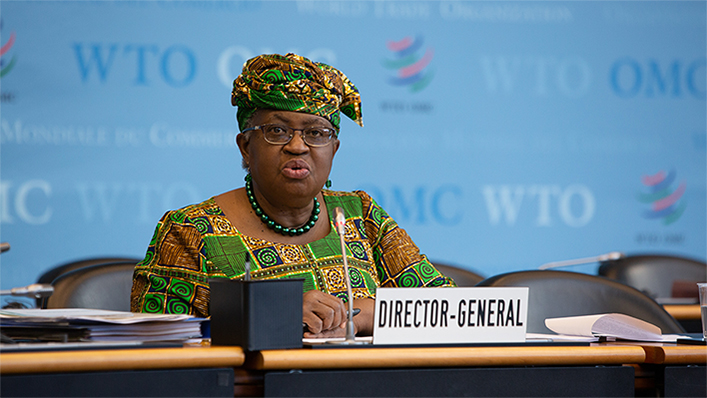
The Director-General (DG) of World Trade Organisation (WTO), Dr. Ngozi Okonjo-Iweala, has called for a comprehensive overhaul of global trade rules, warning that the multilateral system “we used to know” has effectively collapsed.
Speaking recently at a ministerial gathering in Yaoundé, Okonjo-Iweala highlighted structural weaknesses, including a paralysed dispute settlement mechanism and stalled negotiations, urging members to prioritise decision-making efficiency and transparency over legacy frameworks.
“The world order… has irrevocably changed. We will not get it back,” Okonjo-Iweala said.
Jamieson Greer, United States Trade Representative, pushed for “honest and frank” reform discussions, criticising the system for enabling “severe and sustained imbalances.”
Chris Bryant, United Kingdom trade minister, warned of systemic breakdown if reforms fail, noting the risk of a “disorderly collapse” and parallel rule-making regimes.
DECISION HIGHLIGHT
The WTO is being forced to transition from a consensus-driven multilateral system to a more flexible, fragmented architecture anchored on plurilateral and bilateral arrangements.
This marks a structural departure from uniform global trade governance.
DECISION MEMO
The reform debate reflects a deeper reality, the erosion of multilateralism as the organising principle of global trade.
Okonjo-Iweala’s position is not a reformist appeal but an acknowledgment of systemic obsolescence. The consensus-based model, once central to legitimacy, has become a constraint, enabling veto power by individual states and stalling critical negotiations.
Greer’s critique reframes the issue from inefficiency to inequity. The United States’ position suggests that the existing framework has failed to enforce reciprocity, thereby legitimising unilateral corrective measures such as tariffs. This effectively challenges the foundational neutrality of the system.
Bryant’s warning introduces a more immediate risk, institutional irrelevance. If member states increasingly resort to self-defined rules or exclusive agreements, the WTO risks becoming a nominal body, detached from actual trade governance.
The emerging alternative, plurilateralism, allows subsets of countries to advance agreements without full consensus. While operationally efficient, this model undermines the Most-Favoured Nation principle, which currently governs roughly 72 percent of global trade.
The divergence among major economies reinforces this fragmentation. The European Union and China support structured reform pathways, albeit with differing motivations, while the United States resists rigid frameworks in favour of strategic flexibility. India’s resistance to e-commerce duty extensions highlights how domestic fiscal considerations can override multilateral commitments.
Wang Wentao, China’s Commerce Minister, warned that weakening Most-Favoured Nation rules could open a “Pandora’s Box,” effectively dismantling uniform tariff application.
The implication is a shift from rules-based predictability to negotiated variability. Trade relations become contingent, not standardised.
For developing economies, particularly in Africa, this introduces dual exposure, marginalisation from elite trade blocs and vulnerability to externally imposed terms in bilateral arrangements.
DATA BOX
- Share of global trade under Most-Favoured Nation principle: 72%
- WTO dispute settlement system: Functionally paralysed
- Reform format under debate: Plurilateral vs consensus-based
- Meeting duration: Four days (Yaoundé)
WHO WINS / WHO LOSES
Winners:
- Major economies with bargaining leverage in bilateral or plurilateral deals
- Trade blocs capable of setting independent regulatory standards
- Strategic sectors benefiting from selective trade protections
Losers:
- Smaller and developing economies reliant on uniform global rules
- Export-dependent countries exposed to fragmented tariff regimes
- Multilateral institutions facing declining authority
POLICY SIGNALS
The shift indicates a move away from universalism toward selective cooperation, where trade rules are increasingly negotiated among aligned partners rather than universally applied.
It also signals declining tolerance for procedural rigidity, particularly consensus requirements that hinder timely decision-making.
INVESTOR SIGNAL
Investors should anticipate increased policy unpredictability in global trade flows, with rising importance of geopolitical alignment in market access decisions.
Supply chains may reconfigure along bloc lines, favouring jurisdictions with stable bilateral or regional agreements over multilateral exposure.
Trade policy risk is becoming a central variable in capital allocation decisions.
RISK RADAR
- Systemic Fragmentation: Parallel trade regimes weakening global coherence
- Rule Erosion: Decline of Most-Favoured Nation principle and uniform tariff systems
- Geopolitical Risk Transmission: Conflicts influencing trade policy alignment
- Institutional Irrelevance: WTO losing enforcement authority
- Developing Economy Marginalisation: Reduced influence in fragmented negotiations
The WTO is not undergoing incremental reform, it is confronting structural displacement. The outcome will determine whether global trade remains rules-based or transitions into a network of negotiated, and potentially unequal, arrangements.
Discover more from StakeBridge Media
Subscribe to get the latest posts sent to your email.