

By Olumide Johnson
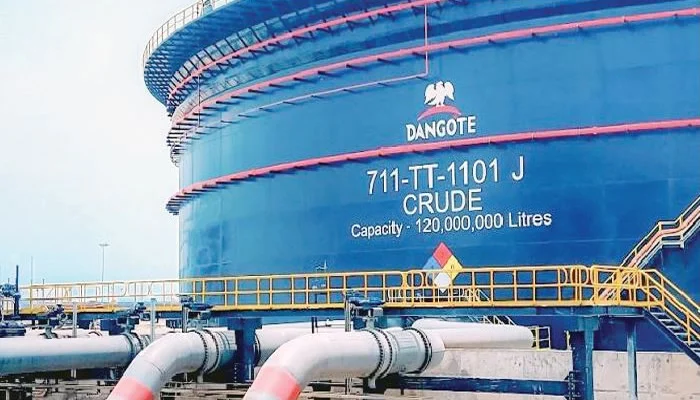
Nigeria’s downstream fuel market is facing another price shock after Dangote Petroleum Refinery raised its Premium Motor Spirit (PMS) gantry price by 6.7 percent, adding fresh pressure to transportation, food distribution, household budgets and business operating costs.
The refinery increased its PMS price to N1,350 per litre from N1,265, effective September 12, 2026, against a backdrop of elevated international crude prices, higher freight costs and geopolitical disruptions.
DEVELOPMENT:
Dangote Refinery notified customers of the new price and directed those with existing loading arrangements to return their Automated Truck Certificates for repricing before loading could resume.
“Dear valued customer, please find below the revised DPRP PMS gantry and coastal price, which is effective September 12th, 2026,” the refinery said.
It added: “You are advised to return all ATCs for repricing and a new volume contract will be issued for immediate loading resumption.”
The increase is expected to push pump prices higher, particularly in inland markets where transportation from coastal supply centres adds substantial logistics costs.
Petroleumprice.ng CEO, Olatide Jeremiah, said that the increase reflected international market pressures.
“Oil price and freight rate spikes are universal challenges for refineries, except where the Federal Government intervenes. Gantry and pump prices will ultimately be determined by the impact of the Middle East crisis.”
He stated: “The upward review of petrol prices to N1,350 per litre by the Dangote Refinery is expected as oil prices approach $110 per barrel.”
DATA:
The Industry Competency Centre’s latest Energy Bulletin puts the seven-day average Brent crude price at $98.74 per barrel and Bonny Light at $104.65, while the seven-day average exchange rate stood at N1,323.12 per dollar.
Average domestic petrol price was N1,308.33 per litre, while diesel averaged N1,855.97. With coastal ex-depot petrol prices between N1,265.50 and N1,285, inland prices could climb substantially.
Industry estimates put Abuja petrol prices around N1,400-N1,500 per litre, with Kano, Kaduna and Jos potentially reaching N1,450-N1,600 depending on supply and logistics. Diesel could reach N2,100-N2,400 per litre or higher inland.
OGSPAN Vice President Lawal Kamaldeen said the latest N85 increase brought Dangote Refinery’s cumulative increase since August 21 to N185 per litre, approximately 15.9 percent.
SIGNIFICANCE:
Fuel is an economy-wide input. Higher petrol and diesel prices feed directly into logistics, agriculture, manufacturing, retail and household transportation, creating a second-round inflationary effect.
Kamaldeen said: “Petrol remains a major input for transportation, distribution, agriculture, small businesses and general economic activity in Nigeria. An increase in the wholesale price will inevitably create pressure across the downstream petroleum value chain.”
Executive Director of Spaces for Change, Victoria Ibezim-Ohaeri, warned that the shock could further weaken household purchasing power.
“Nigeria’s headline inflation rate currently stands at 15.43%, while food inflation is 20.31%, according to the National Bureau of Statistics (NBS).”
She said that prolonged pressure could force businesses to raise prices, absorb lower margins, postpone investment or reduce employment.
NEXT MOVE:
The immediate variables are crude prices, the naira-dollar exchange rate, freight costs and the duration of geopolitical disruptions.
Government intervention is also emerging as a policy question. Kamaldeen proposed targeted support for domestic refining, including competitive crude allocation, possible reviews of taxes and levies, and a time-bound framework tied to actual production.
Ibezim-Ohaeri urged targeted household and transport support while calling for stronger electricity, gas, renewable energy and logistics systems.
OUR LENS:
Nigeria’s deregulated fuel market is exposing the economy to global energy volatility before domestic productivity has developed enough buffers to absorb it.
The danger is not simply a N85 increase at the refinery gate. It is the transmission mechanism from crude oil to petrol, petrol to transport, transport to food and logistics, and ultimately transport and energy costs into household purchasing power.
As Jeremiah warned: “Pump prices could hit N1,500 per litre in major cities across Nigeria if the crisis persists.”
The policy challenge is therefore moving beyond fuel pricing. Nigeria must build an economy less vulnerable to every movement in global oil prices.
Olumide Johnson is a journalist, reporting on energy, business, markets, policy and developments shaping Nigeria’s economy.
Discover more from StakeBridge Media
Subscribe to get the latest posts sent to your email.