

By Jennete Ugo Anya
Nigeria has used the BRICS Leaders’ Summit in New Delhi to reaffirm its support for the World Trade Organisation (WTO) and the multilateral trading system, at a moment when geopolitical tensions, trade fragmentation and competing economic blocs are reshaping the global economy.
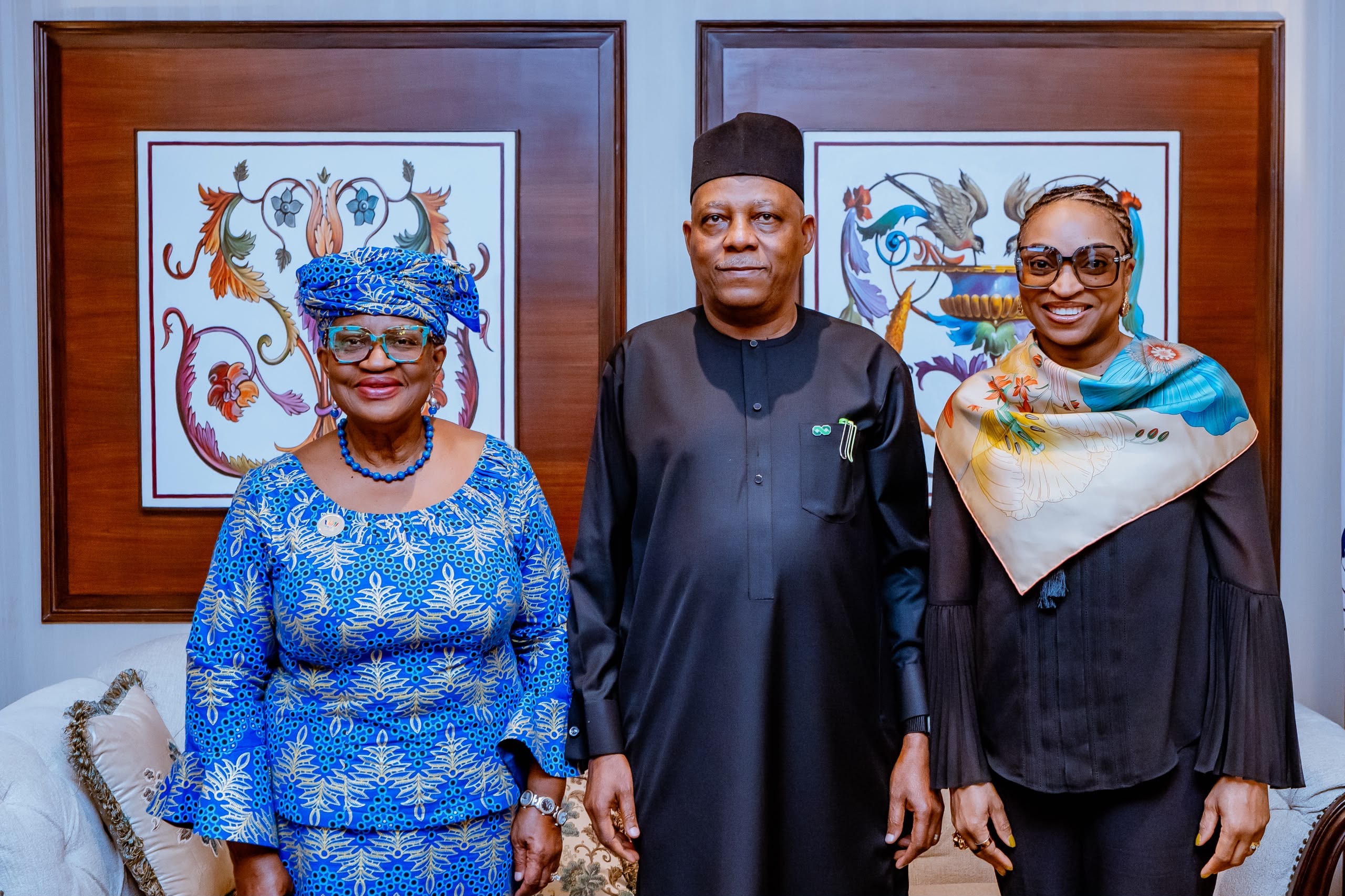
Vice President Kashim Shettima made the position clear during a meeting with the Director-General of WTO, Dr. Ngozi Okonjo-Iweala, on the sidelines of the September 12-13 summit. The message is significant because Nigeria is participating as a BRICS partner country while simultaneously insisting that deeper economic partnerships should not come at the expense of an open, rules-based global trading system.
DEVELOPMENT:
Shettima told Okonjo-Iweala that Nigeria would continue supporting the WTO in strengthening multilateralism and promoting cooperation rather than isolation.
“I believe the world is greater than one nation. We will continue to support the WTO in championing the cause of multilateralism. We are essentially one human family and interconnected. You cannot divorce yourself from the global community,” he said.
The Vice President also positioned migration as an economic asset, arguing that the movement of people across borders can drive development, innovation and growth.
“Nations are built by immigrants. Even cities are built by people who came from outside, not just by the locals. That goes to show that we have so much to gain from global migration,” he said.
He cited Nigeria’s diaspora as evidence, noting their achievements in education, enterprise and professional life. Shettima also commended Okonjo-Iweala for her leadership of the WTO, telling her: “You are doing a very wonderful job at the WTO, but you still have a lot to contribute to humanity.”
DATA:
The strongest quantitative signal is Nigeria’s diaspora performance. Shettima cited a Pew Research Center analysis of 2024 US Census Bureau data showing that 67 percent of Nigerian-born Black immigrants aged 25 and above in the United States held at least a bachelor’s degree, the highest proportion among the major Black immigrant groups examined.
Nigeria is also engaging the emerging BRICS architecture as a partner country, giving it an additional platform for trade, investment and diplomatic engagement.
SIGNIFICANCE:
For investors, exporters and policymakers, Nigeria’s position points to a dual-track strategy. Abuja wants access to emerging-market capital and partnerships through BRICS, while retaining the WTO framework that underpins predictable international commerce.
That balancing act matters. Nigeria’s investment proposition depends not only on attracting capital, but on remaining connected to global markets, supply chains, technology and skills.
NEXT MOVE:
Shettima is expected to use his BRICS address to present Nigeria’s partnership and investment opportunities, particularly in agriculture, technology and other non-oil sectors.
The summit’s discussions on trade, energy, supply-chain resilience and stronger developing-country representation in institutions such as the IMF and World Bank will also indicate how far Nigeria can convert diplomatic positioning into economic opportunity.
OUR LENS:
Nigeria is signalling that it does not want to choose between the established multilateral order and the emerging architecture of the Global South.
The more consequential question is whether Abuja can turn that diplomatic flexibility into commercial leverage. Supporting the WTO, participating in BRICS and championing migration all point to the same underlying proposition: Nigeria’s economic future depends on remaining globally connected.
The real test, therefore, is not whether Nigeria can speak convincingly about multilateralism. It is whether it can use multiple global platforms to secure more trade, investment, technology, jobs and productive capacity at home.
Jennete Ugo Anya is a journalist and researcher with interests across Nigeria’s economy, public policy, business, development and strategic communications.
Discover more from StakeBridge Media
Subscribe to get the latest posts sent to your email.