

By Olumide Johnson
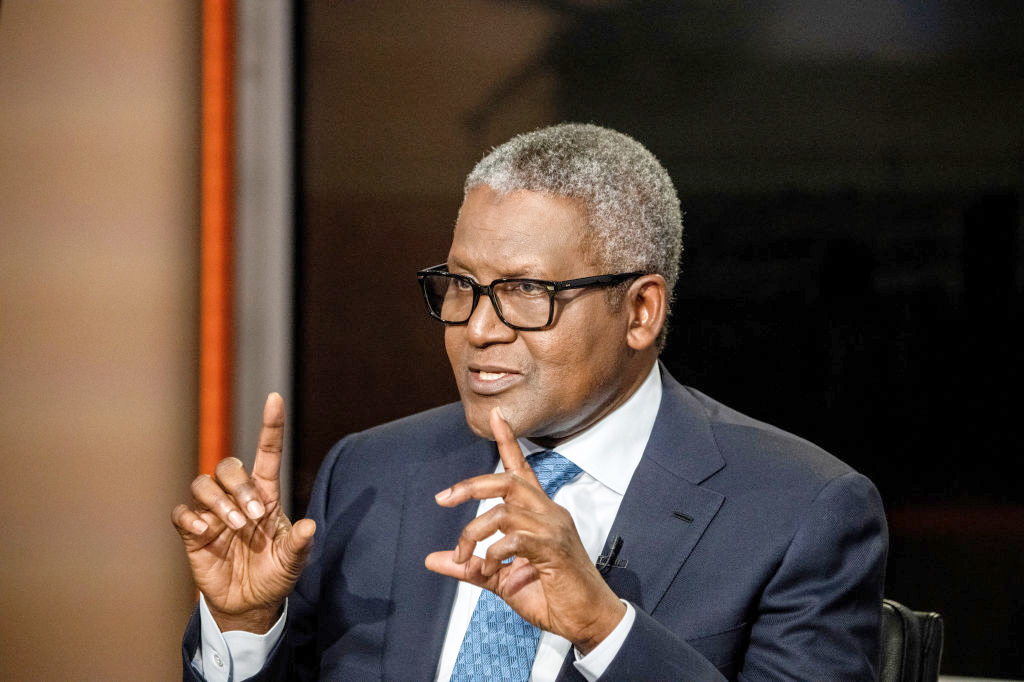
Alhaji Aliko Dangote says his conglomerate plans to invest more than $10 billion in power over the next three to four years, potentially redirecting funds from other businesses, including steel, towards electricity generation and related infrastructure.
Dangote made the disclosure in an interview with Al Jazeera, identifying unreliable electricity and inconsistent government policies as major constraints on African investment and industrialisation.
DEVELOPMENT:
Dangote said that the proposed investment reflects his view that electricity is fundamental to industrial growth.
“And I’m telling you in the next three to four years, there will be a major transformation in Africa, and that’s why we’re looking at power. We are going to invest in power. There are one or two businesses that we might cancel, like steel, and we will put the money in power. We want to invest over $10 billion alone in power.”
He also said that more than 600 million Africans remain without electricity.
“We Africans should not really allow over 600 million of our people to remain in darkness.”
Dangote also linked electricity to political and economic outcomes, saying: “Power is key; we will never create growth without power. That’s why they say power is growth. When I say power, I mean electricity is growth.”
DATA:
The proposed $10 billion-plus commitment would make power a major investment pillar for the Dangote Group, potentially redirecting capital from other industrial projects.
Dangote’s broader argument is based on the relationship between electricity availability, industrial production, job creation and Africa’s dependence on imports.
He warned: “One day we will not have money to import what we are consuming. So how can we remain an import continent? It has to change.”
SIGNIFICANCE:
The announcement places private capital at the centre of Nigeria’s electricity challenge.
Dangote’s criticism is directed at two persistent constraints: policy uncertainty and inadequate power supply.
“The problem really is, it takes two to tango. I think in the past, there’s been a lot of flip-flops in government policies. Government policies were changing every day, and then, the lack of electricity is also there.”
For investors, the proposed allocation raises questions about the structure of the investment, generation capacity targeted, financing model, regulatory framework and expected returns.
Dangote also rejected concerns that his expansion amounts to monopoly, arguing that investment opportunities remain open.
“There’s nothing that the government gave us and say, ‘this is only for Dangote’.”
NEXT MOVE:
The immediate issues are whether the proposed $10 billion commitment becomes a defined investment programme, which power assets or projects will receive funding, and whether government policy provides sufficient certainty for long-term private investment.
The scale, financing and execution timetable will determine its eventual impact on Nigeria’s power market.
OUR LENS:
Dangote’s announcement goes beyond a corporate investment plan. It represents a private-sector argument that Africa’s industrialisation challenge cannot be separated from its energy deficit.
His proposed capital reallocation also illustrates how infrastructure constraints can influence corporate investment decisions.
Dangote put the issue bluntly: “If there’s no industrialisation, how do you create jobs? You can’t.”
He also framed local investment as essential to retaining value within Africa: “But that change can only happen when Africans believe in Africa, and they invest in Africa.”
His message ultimately combines capital deployment with local value creation, arguing that Africa must process more of its own raw materials rather than remain dependent on imported finished goods. As he put it: “They must produce on our own continent.”
Olumide Johnson is a journalist, reporting on energy, maritime, business, and developments shaping Nigeria’s economy.
Discover more from StakeBridge Media
Subscribe to get the latest posts sent to your email.