

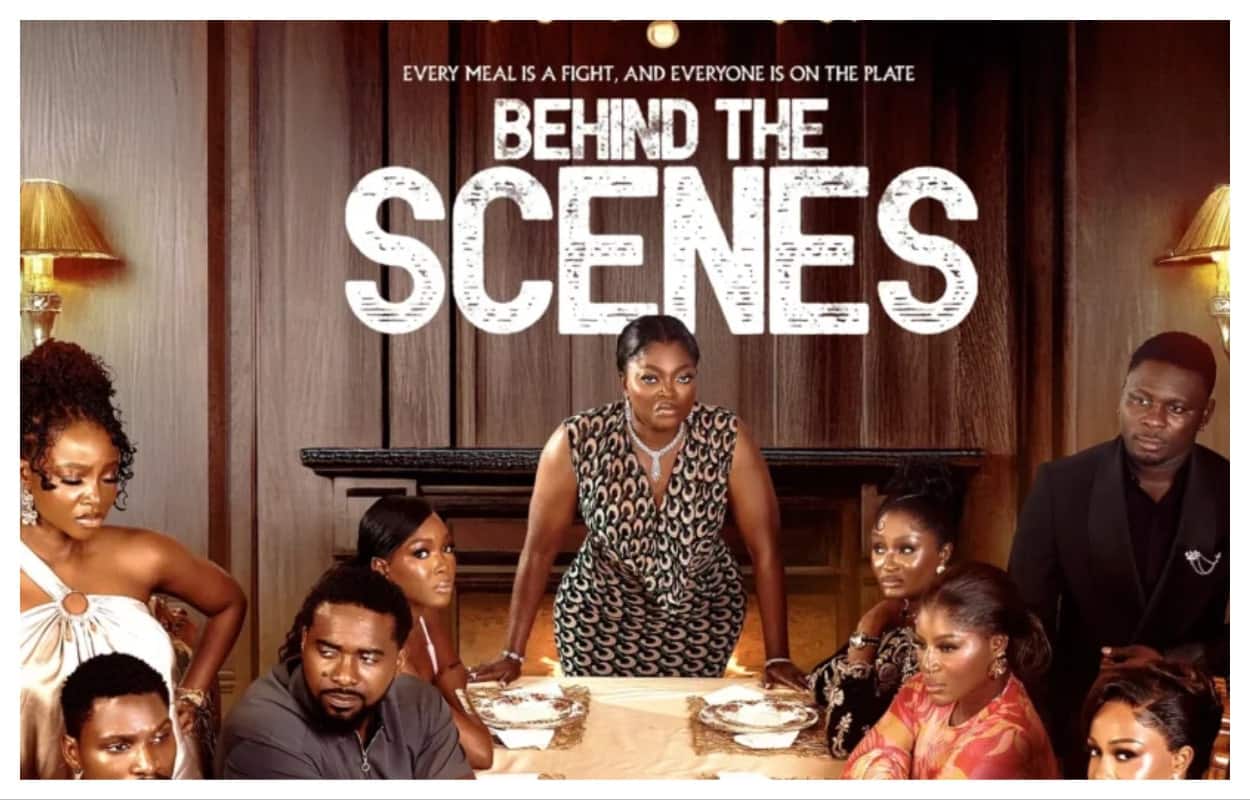
Nigeria’s cinema market crossed another psychological threshold after the National Film and Video Censors Board (NFVCB) confirmed that Behind The Scenes had generated over N2.4 billion at the domestic box office. Beyond the headline, the figure reframes Nollywood’s commercial credibility, shifting the conversation from artistic relevance to revenue predictability. At this level, box office performance stops being anecdotal success and starts functioning as market data.
The signal is not abstract. It speaks directly to banks, exhibitors, advertisers, streaming platforms, and policymakers assessing whether Nigerian cinema can sustain institutional capital.
DECISION HIGHLIGHT
Decision type: Market validation through domestic box office performance
Creative lead: Funke Akindele
Asset class: Feature film, theatrical-first distribution
Revenue signal: N2.4 billion domestic gross
Comparator logic: Franchise economics and repeat-demand behaviour
Market implication: Nollywood transitions from speculative creative sector to bankable entertainment industry
DECISION MEMO
N2.4 billion matters not because it is unprecedented, but because it is repeatable. That distinction is critical. Nollywood has produced box office successes before, but Behind The Scenes confirms that the industry is beginning to develop predictable revenue anchors rather than one-off hits.
A useful analytical lens is comparison, not between genres or cultures, but between market structures. In 2024, Inside Out 2 emerged as one of the strongest post-pandemic global box office performers. On the surface, comparing a Nigerian comedy-drama to a Hollywood animated sequel appears uneven. Financially, however, both outcomes are driven by the same logic: audience trust in a proven creative brand.
The difference is scale, not principle. Behind The Scenes generated its N2.4 billion almost entirely from domestic cinemas within a severely constrained exhibition ecosystem. Nigeria operates with fewer than 300 cinema screens for a population exceeding 200 million. By contrast, Inside Out 2 benefited from tens of thousands of screens globally, saturation releases, and global marketing machinery.
Despite these asymmetries, both films demonstrate revenue efficiency relative to their environments. Nigerian ticket prices are significantly lower than those in North America or Europe, and consumer purchasing power is under sustained inflationary pressure. Yet Behind The Scenes sustained attendance week after week. That endurance signals repeat viewing and strong word-of-mouth, the same dynamics that carried Inside Out 2 beyond its opening weekend.
From a capital perspective, cost structure matters. Hollywood productions routinely exceed $150 million in production budgets, excluding marketing. Profitability therefore depends on massive global turnout. Nollywood operates on a leaner cost curve. Production budgets are lower, marketing is targeted, and break-even thresholds are reached earlier. As a result, N2.4 billion in gross receipts can represent a higher return multiple on invested capital than a billion-dollar Hollywood gross.
This distinction is crucial for lenders and private investors evaluating risk-adjusted returns. Inside Out 2 represents scale-driven profitability, underwritten by institutions like Pixar and Disney. Behind The Scenes represents efficiency-driven profitability, more relevant to emerging markets where capital is scarce and payback periods matter.
Audience psychology also converges across markets. Inside Out 2 monetised emotional continuity and nostalgia. Behind The Scenes monetised cultural familiarity, humour, and social realism. In both cases, audiences paid for emotional certainty. For investors, that reduces volatility. Predictable emotional outcomes translate into more predictable revenue curves.
Distribution strategy sharpens the contrast. Hollywood monetises across theatrical, streaming, merchandise, and licensing in tightly integrated windows. Nollywood remains largely theatrical-first, with streaming value unlocked later. That sequencing elevates the importance of box office performance in Nigeria. A strong theatrical run directly strengthens downstream licensing negotiations and valuation discussions.
Repeatedly, Funke Akindele’s films are now behaving like franchises without being sequels. Her name has become a demand proxy. That is not celebrity culture, it is market logic. Predictability is what capital follows.
DATA BOX
Reported domestic box office: N2.4 billion
Primary revenue source: Nigerian theatrical releases
Estimated cinema screens in Nigeria: <300
Population base: >200 million
Hollywood comparator benchmark: >$1 billion global gross (Inside Out 2)
WHO WINS / WHO LOSES
Winners:
• Cinema exhibitors with reliable high-traffic titles
• Financial institutions reassessing creative industry risk
• Advertisers and brands seeking mass domestic reach
• Creative professionals benefiting from repeatable commercial models
Losers:
• Narratives framing Nollywood as structurally unbankable
• Informal financing models dependent on opaque accounting
• Experimental projects lacking audience-market fit
POLICY SIGNALS
The performance reinforces the case for treating the creative economy as an industrial sector rather than a cultural subsidy. Infrastructure, screen expansion, data transparency, and financing frameworks now have empirical justification, not sentiment.
INVESTOR SIGNAL
Nollywood is demonstrating efficiency-led profitability. With disciplined budgets and identifiable demand anchors, Nigerian cinema offers earlier break-even points and stronger return multiples relative to invested capital. This shifts the sector closer to structured finance eligibility.
RISK RADAR
• Limited cinema infrastructure constrains revenue ceilings
• Data opacity could undermine investor confidence
• Rising production costs may compress margins if not managed
• Overreliance on a narrow pool of bankable names
Bottom line: N2.4 billion is not a cultural curiosity. It is financial evidence. Inside Out 2 reflects maturity backed by global capital. Behind The Scenes reflects momentum built on efficiency and trust. One shows what scale looks like. The other shows that Nollywood’s logic is already sound, even before scale arrives.
Discover more from StakeBridge Media
Subscribe to get the latest posts sent to your email.