


By Ovio Peters
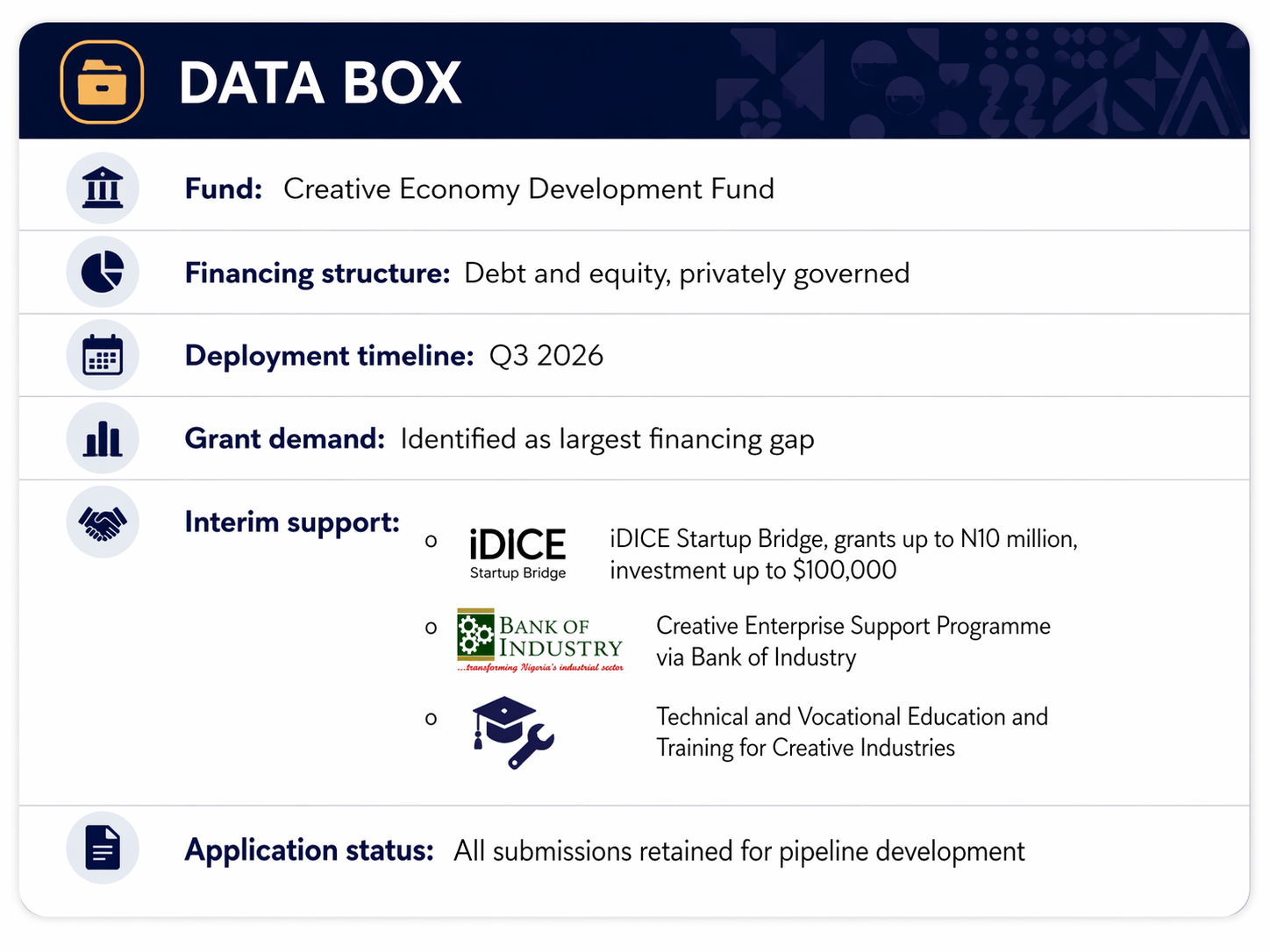
The Honourable Minister of Art, Culture, Tourism and the Creative Economy, Hannatu Musawa, has recently stated that the Creative Economy Development Fund (CEDF) received strong application volumes. The submissions have generated market intelligence now shaping fund design, confirming demand for debt and equity financing while revealing grants as the largest unmet need. This is with capital deployment scheduled for Q3 2026 through a privately governed financing structure.
DECISION HIGHLIGHT
The government is structuring the CEDF as a blended financing platform, combining market-based instruments with emerging grant support mechanisms.
DECISION MEMO
The Fund is being recalibrated from a financing initiative into a market-informed capital allocation system. Musawa stated that application data is directly influencing fund configuration, noting that “every application gave us a clearer picture of what this sector needs.”
The Fund’s core architecture prioritises debt and equity instruments under private sector governance, signalling a shift towards commercially disciplined capital deployment. This aligns with broader efforts to position the creative sector within formal investment frameworks rather than grant-dependent ecosystems.
However, the application feedback introduces a structural tension. While the Fund is designed around repayable capital, Musawa acknowledged that “grants are the largest single financing need,” indicating a mismatch between market design and immediate sector liquidity realities. The parallel development of grant solutions suggests a hybrid model is emerging.
The retention of all applications and phased communication strategy reflects pipeline-building rather than immediate disbursement, indicating a deliberate sequencing of capital deployment. Interim programmes, including iDICE Startup Bridge and sector-specific training initiatives, provide short-term support while the core Fund structure is finalised.
The model therefore balances long-term capital formation with short-term intervention, though execution will depend on aligning financing instruments with enterprise readiness.
WHO WINS / WHO LOSES
Creative enterprises gain structured access to financing and support programmes. Early-stage founders benefit from interim grants and training pathways. Investors gain entry into a formalised creative sector pipeline. Businesses dependent solely on grant funding face adjustment to blended financing models.
POLICY SIGNALS
The government is transitioning the creative sector towards investment-led growth, reducing reliance on grants while acknowledging the need for targeted support. There is a clear move towards private sector-led governance of public financing initiatives.
INVESTOR SIGNAL
The Fund signals the emergence of a structured creative economy investment pipeline, improving visibility for capital deployment. However, investor participation will depend on the maturity and bankability of underlying enterprises.
RISK RADAR
Execution risk remains high in aligning financing instruments with sector needs. Structural risk persists from the gap between grant demand and debt capacity. Deployment risk may arise if Q3 timelines slip. Market readiness risk could limit absorption of repayable capital.
Discover more from StakeBridge Media
Subscribe to get the latest posts sent to your email.