

By Johnson Emmanuel
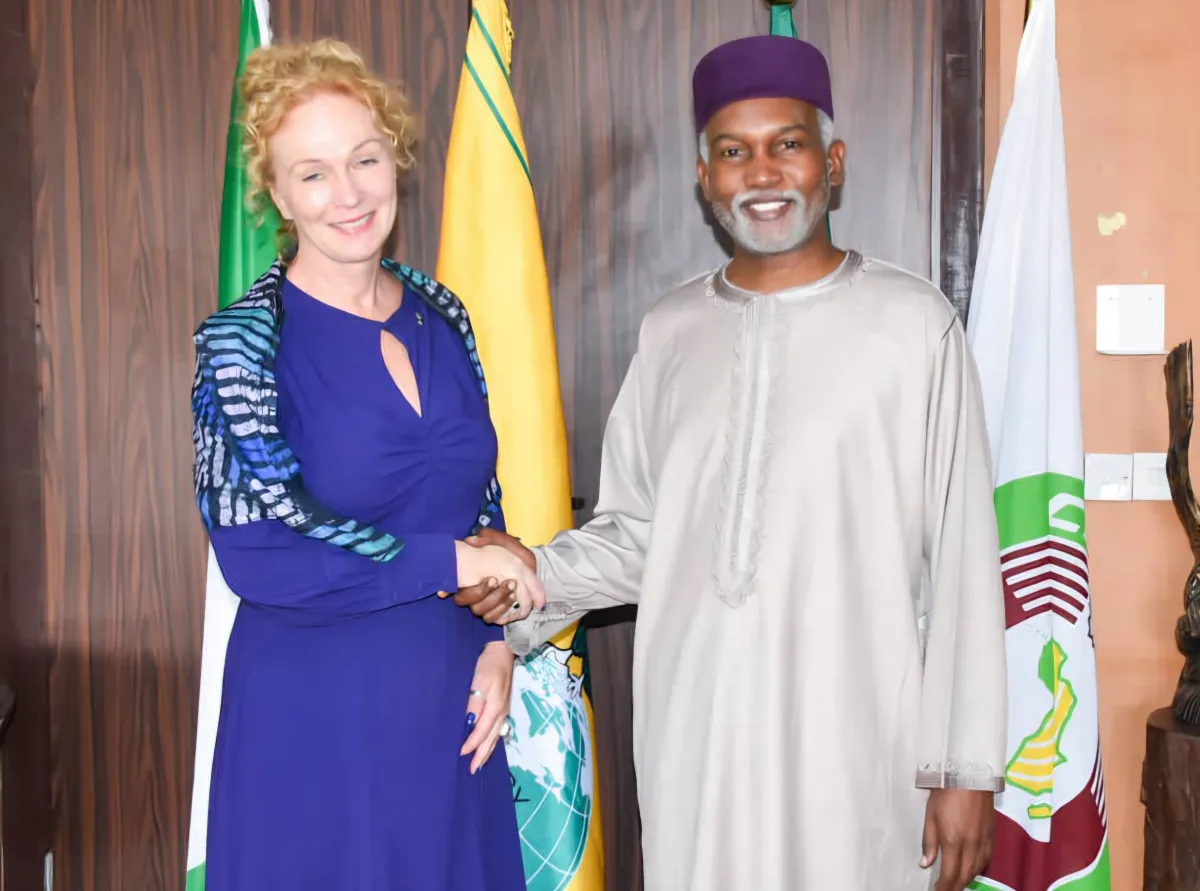
Nigeria and Sweden have reaffirmed bilateral cooperation across trade, innovation, energy, and creative industries following a recent high-level meeting in Abuja between Yusuf Maitama Tuggar, Honourable Minister of Foreign Affairs of Nigeria, and Anna Westerholm, Ambassador of Sweden to Nigeria.
Westerholm described relations as “cordial and built on strong goodwill,” while signalling Sweden’s readiness to deepen engagement, particularly in digital infrastructure and green economy transition. Tuggar reiterated Nigeria’s commitment to regional stability and economic integration.
The discussions also covered regional security, Economic Community of West African States dynamics, and expanding private sector participation in trade frameworks.
DECISION HIGHLIGHT
Nigeria and Sweden are broadening bilateral engagement into a multi-sector partnership spanning trade, technology, energy transition, and regional security cooperation.
DECISION MEMO
The engagement reflects an expansion in diplomatic scope, but not necessarily depth. Nigeria–Sweden relations are being repositioned from conventional bilateral ties to a multi-dimensional partnership, covering economic, technological, and geopolitical domains.
However, the breadth of engagement introduces a recurring risk, overextension without execution clarity. Trade, innovation, energy, and creative industries each require distinct policy frameworks, financing structures, and institutional coordination. Expanding across all simultaneously raises questions about prioritisation and delivery capacity.
Westerholm’s emphasis on Nigeria’s transition to a green and digital economy aligns with Sweden’s comparative advantage. Sweden operates as a high-efficiency, innovation-driven economy, while Nigeria remains constrained by infrastructure deficits and regulatory fragmentation. The partnership therefore reflects complementarity, but also asymmetry. Sweden brings systems, Nigeria brings scale.
Tuggar’s focus on regional cooperation and Economic Community of West African States engagement introduces a geopolitical layer. Nigeria’s role in West Africa remains central, but increasingly complex, particularly with the emergence of the Alliance of Sahel States. The inclusion of regional stability in bilateral discussions suggests that economic cooperation is being framed alongside security considerations.
The establishment of a Swedish trade office in Lagos is one of the few concrete deliverables. It signals a move from dialogue to commercial presence, yet remains an entry-level intervention. Trade offices facilitate engagement but do not guarantee investment flows or project execution.
The reference to Nigeria’s creative sector, particularly Afrobeats, highlights soft power as an economic entry point. However, similar to previous partnerships, the challenge lies in converting cultural relevance into structured industry value, particularly through intellectual property systems and monetisation frameworks.
The Economic Community of West African States Trade Liberalisation Scheme, cited by Tuggar, underscores an existing regional framework. Yet, the acknowledgement that private sector participation remains limited reinforces a persistent issue, policy frameworks exist, but utilisation remains weak.
The overall pattern is consistent. Diplomatic alignment is expanding, but implementation remains contingent on domestic institutional capacity and private sector activation.
DATA BOX
- Engagement level, ministerial bilateral meeting
- Core sectors, trade, innovation, energy, creative industries
- Swedish presence, trade office established in Lagos
- Regional focus, Economic Community of West African States, Sahel security
- Policy framework referenced, Economic Community of West African States Trade Liberalisation Scheme
WHO WINS / WHO LOSES
Winners
Sweden, expanding commercial and strategic presence in Africa’s largest economy
Nigeria, gaining access to technological expertise and innovation frameworks
Private sector actors positioned to leverage bilateral opportunities
Conditional winners
Creative and technology sectors, dependent on structured implementation
Losers
Policy frameworks without execution pathways
Domestic industries unable to integrate into formal trade and innovation systems
POLICY SIGNALS
The partnership signals a shift toward integrated diplomacy, combining economic, technological, and security cooperation. It also reflects increasing reliance on bilateral partnerships to complement regional frameworks.
INVESTOR SIGNAL
Nigeria remains attractive as a large-scale market with sectoral opportunities in technology, energy, and creative industries. However, investment viability depends on execution capacity and regulatory consistency rather than diplomatic alignment alone.
RISK RADAR
Overextension across multiple sectors without prioritisation
Institutional capacity constraints affecting implementation
Weak private sector participation in existing trade frameworks
Geopolitical instability in West Africa affecting long-term cooperation
Limited conversion of diplomatic agreements into bankable projects
The engagement expands the scope of cooperation. The constraint remains unchanged, translating diplomatic intent into measurable economic outcomes.
Discover more from StakeBridge Media
Subscribe to get the latest posts sent to your email.