

By Johnson Emmanuel
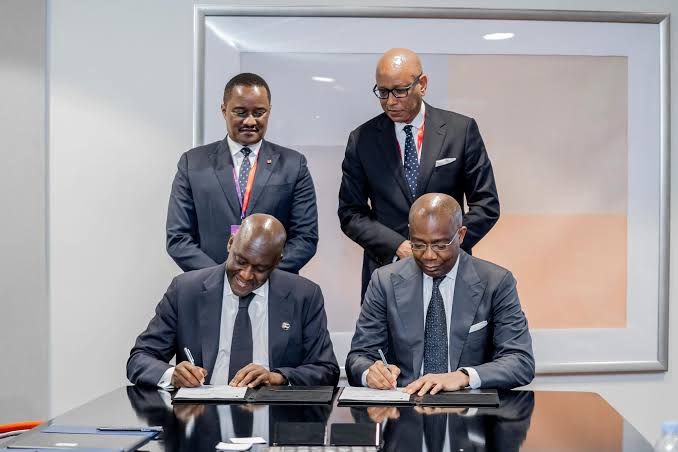
The International Finance Corporation (IFC) and Access Bank Plc recently signed a framework agreement worth approximately $500 million equivalent in Kigali, Rwanda, to expand local currency financing across multiple African markets, targeting micro, small and medium enterprises, agribusiness, housing, and infrastructure.
The agreement was executed by Makhtar Diop, Managing Director of the IFC, and Aigboje Aig-Imoukhuede, Chairman of Access Holdings Plc, as part of broader efforts to deepen African local currency capital markets and reduce exposure to foreign exchange volatility.
Under the arrangement, financing will be deployed across Nigeria, Angola, Botswana, Central African Economic and Monetary Community markets, Democratic Republic of Congo, Ghana, Tanzania, West African Economic and Monetary Union markets, Uganda, and Zambia.
Aig-Imoukhuede said that the partnership would “support the deployment of funding at scale to MSMEs, infrastructure, agribusiness, housing, and other high-impact sectors, while helping to strengthen domestic financial markets and advance economic resilience across Africa.”
Diop stated: “African businesses grow stronger when financing is aligned with the currencies in which they operate and earn.”
DECISION HIGHLIGHT
The IFC and Access Bank Plc are attempting to structurally reduce Africa’s dependence on dollar-denominated financing by expanding long-term local currency funding architecture.
DECISION MEMO
The framework reflects a growing continental shift toward currency-aligned development finance amid persistent exchange-rate instability, dollar shortages, and rising external borrowing costs across African economies.
Historically, much of Africa’s private-sector financing has remained heavily dollar-linked despite businesses generating revenues primarily in local currencies. This mismatch has amplified repayment pressures during currency depreciation cycles, weakened balance sheets, and increased systemic financial vulnerability.
By focusing on local currency financing, the IFC and Access Bank Plc are effectively repositioning financial stability as a core development objective rather than merely a monetary policy concern.
The partnership also signals increasing recognition that African capital-market development cannot rely exclusively on sovereign borrowing or external hard-currency inflows. Deepening domestic currency liquidity and long-term lending capacity is becoming increasingly central to economic resilience.
Access Bank’s regional footprint gives the framework operational scale across fragmented African banking environments, while the International Finance Corporation provides development-finance credibility and balance-sheet strength capable of lowering perceived market risk.
The inclusion of infrastructure, housing, agribusiness, and MSMEs further suggests that the initiative is designed to support productive-sector expansion rather than short-term financial intermediation alone.
However, local currency financing frameworks remain exposed to inflation volatility, shallow domestic debt markets, policy inconsistency, and uneven monetary credibility across participating jurisdictions.
DATA BOX
- Institutions:
- International Finance Corporation
- Access Bank Plc
- Framework Size: Approximately $500 million equivalent
- Signing Location: Kigali, Rwanda
- Core Financing Focus:
- MSMEs
- Agribusiness
- Housing
- Infrastructure
- Target Markets:
- Nigeria
- Angola
- Botswana
- CEMAC region
- Democratic Republic of Congo
- Ghana
- Tanzania
- UEMOA region
- Uganda
- Zambia
- Strategic Objective: Expansion of local currency financing and financial-market resilience
- Primary Economic Rationale: Reduction of foreign exchange exposure and exchange-rate risk
WHO WINS / WHO LOSES
Who Wins
- MSMEs requiring currency-aligned financing
- Infrastructure and housing developers
- Agribusiness operators exposed to foreign exchange pressures
- Domestic financial markets seeking longer-term liquidity depth
Who Loses
- Dollar-dependent lending structures facing reduced dominance
- Businesses reliant on speculative foreign exchange positioning
- Financial systems lacking monetary discipline or inflation stability
POLICY SIGNALS
The framework signals accelerating institutional support for local currency capital-market development across Africa. It also reflects broader policy momentum toward reducing external vulnerability tied to dollar financing dependence.
The participation of the International Finance Corporation further indicates rising multilateral preference for private-sector-led domestic financial deepening.
INVESTOR SIGNAL
The agreement improves confidence around the long-term institutionalisation of African local currency financing markets. Investors may interpret the initiative as evidence of stronger regional banking integration and increased support for productive-sector lending.
The framework may also improve opportunities in blended finance, local debt-market expansion, and infrastructure financing structures insulated from excessive currency mismatch risks.
RISK RADAR
- Inflation volatility across participating markets
- Local currency depreciation risks
- Weak domestic debt-market depth in certain jurisdictions
- Regulatory inconsistencies across regional banking systems
- Liquidity constraints affecting long-term lending sustainability
- Credit-default risks within MSME portfolios
- Monetary policy instability impacting pricing frameworks
Discover more from StakeBridge Media
Subscribe to get the latest posts sent to your email.