

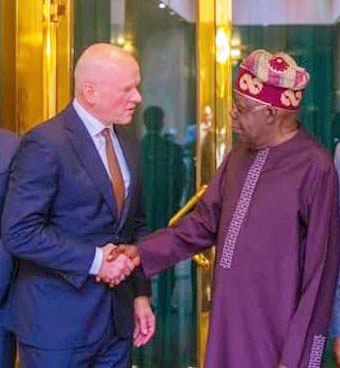
As Nigeria seeks to reposition itself as Africa’s leading digital economy, a strategic convergence is emerging between public policy and private capital. President Bola Ahmed Tinubu is betting that economic reforms, youth demographics and formalisation of small businesses can create the next wave of national productivity, while Michael Miebach, Global Chief Executive Officer of Mastercard, is committing global technology, digital infrastructure and foreign exchange inflows to support that ambition. Their meeting at the Presidential Villa was therefore more than a courtesy visit. It reflected a broader alignment between government policy and multinational investment around digital inclusion, financial infrastructure and enterprise development, with implications extending well beyond payments into the future architecture of Nigeria’s economy. Enam Obiosio writes.
President Tinubu recently reaffirmed Nigeria’s commitment to building a technology-driven economy by assuring Mastercard Incorporated that the country’s youthful population represents a globally competitive workforce capable of driving digital transformation. Receiving a delegation led by Michael Miebach, Global Chief Executive Officer of Mastercard, at the State House, Abuja, the President welcomed the company’s proposal to support millions of Nigerian businesses with digital capabilities while expanding financial inclusion, payment infrastructure and cybersecurity. During the meeting, Mastercard disclosed that it currently facilitates approximately US$2 billion in annual foreign exchange inflows into Nigeria while preventing nearly US$200 million in financial fraud. Both parties also highlighted opportunities created by Nigeria’s ongoing fiscal, monetary and digital reforms, particularly around small businesses, youth employment and the formalisation of the informal economy.
DECISION HIGHLIGHT
The engagement signals an emerging public-private partnership in which government reforms provide the policy framework while global technology firms supply digital infrastructure, capital, security and enterprise capabilities required to accelerate Nigeria’s transition into a formal, technology-enabled economy.
DECISION MEMO
Nigeria’s digital economy strategy is increasingly moving beyond expanding internet access towards building an integrated economic ecosystem where payments, enterprise formalisation, digital identity, credit, financial inclusion and technology skills reinforce one another. The meeting between President Tinubu and Mastercard illustrates that evolution.
For government, digitalisation is becoming an economic reform instrument rather than simply a technology agenda. Formalising businesses, expanding digital payments and improving access to financial services are increasingly viewed as mechanisms for broadening the tax base, improving productivity and integrating millions of informal enterprises into the formal economy.
President Tinubu framed Nigeria’s youthful population as the country’s principal competitive advantage. “The most important asset is our youth.”
Recognising Mastercard’s growing engagement with young entrepreneurs, Tinubu added: “What you have been doing with our young population is commendable, and we will continue to support that in every form.”
He also linked payment infrastructure directly to enterprise development. “Payment plans and platforms are very necessary for the inclusion of small and medium-scale businesses.”
He further argued that the formalisation of Nigeria’s extensive informal sector would accelerate digital transition, investment, employment and economic growth. “I am glad that you are very familiar with the terrain. I can classify you as a Nigerian. Mastercard has a very big reputation in financial management, and opportunities are spreading in Nigeria.”
From Mastercard’s perspective, Nigeria represents more than a large consumer market. It is increasingly viewed as Africa’s principal digital growth platform.
Miebach disclosed that Mastercard currently contributes approximately US$2 billion annually in foreign exchange inflows while preventing nearly US$200 million in fraudulent financial activities. “In Nigeria, we are preventing US$200 million in fraud and bringing in US$2 billion in foreign exchange. We are helping the SME sector thrive and, of course, partner with your banks.”
Having established Mastercard’s Nigerian operations in 2011, Miebach described the country’s economic momentum as increasingly visible within global investment circles.
“We have a business here since 2011, and we have seen the country grow, and we have seen the country lead. We have seen your obviously clear alignment of fiscal and monetary policy that you have driven. In our world systems, there is a lot of momentum in Nigeria.”
He continued: “I was the one who set up the Mastercard business in Nigeria in 2011. I was in Lagos, and hired the employee number one. So it is a little bit like coming home.”
Rather than focusing solely on payment services, Mastercard outlined a broader economic proposition centred on enterprise productivity. “We recognise the moment that we are in. We want to drive the intra-African digital economy.”
According to Miebach, millions of Nigerian businesses require structured digital capability rather than access alone. “Many small businesses would like to have a digital part of their business, and they don’t know how to do that. We have a three-year programme for small businesses. A technical workshop has been planned for this, so it is not just talk but action and impact.”
He also pledged continued investment in cybersecurity, resilience, trust and a Cyber Centre of Excellence capable of addressing artificial intelligence risks, cyber threats and emerging digital vulnerabilities.
The federal government sees this private-sector commitment as complementary to ongoing structural reforms.
Mr. Taiwo Oyedele, the Honourable Minister of Finance and Coordinating Minister of the Economy, argued that digitisation, fiscal reform and enterprise formalisation are already reshaping Nigeria’s business landscape.
“We aim to enhance and empower at least three million youths in Nigeria. We are creating opportunities for work within the digital economy, the formalisation of the very large informal sector that we have in Nigeria.”
Perhaps the strongest indicator of behavioural change lies in enterprise registration. “One of the major reforms by Mr President in fiscal and tax matters has led to more than 10,000 informal businesses applying for registration every day over the past few months.”
Oyedele added that the reforms extend beyond taxation into the broader credit economy, covering mortgages, consumer finance, auto loans, student finance and small business credit, while noting that five of Africa’s nine fintech unicorns are Nigerian.
Taken together, the government’s policy direction and Mastercard’s investment strategy reveal an emerging economic model where digital infrastructure is becoming productive infrastructure. Rather than treating payments, financial inclusion, cybersecurity and enterprise formalisation as separate policy objectives, both sides are increasingly integrating them into a single framework for expanding productivity, attracting investment and strengthening Nigeria’s competitiveness within Africa’s digital economy.
DATA BOX
Government priorities
- Youth digital empowerment.
- SME digitisation.
- Financial inclusion.
- Informal sector formalisation.
- Credit economy expansion.
- Government digitalisation.
Mastercard commitments
- US$2 billion annual foreign exchange inflows.
- US$200 million in fraud prevention.
- Three-year SME digital capability programme.
- Cyber Centre of Excellence.
- Digital security and resilience investments.
Key government metrics
- Target: 3 million youths to be empowered.
- More than 10,000 informal businesses registering daily.
- Nigeria hosts five of Africa’s nine fintech unicorns.
WHO WINS / WHO LOSES
Winners
- Nigerian SMEs adopting digital commerce.
- Young Nigerians acquiring technology skills.
- Fintech companies and payment providers.
- Banks supporting digital financial services.
- Foreign investors seeking Africa’s largest digital growth market.
- Consumers benefiting from safer digital payments.
Potential Losers
- Cash-dependent informal businesses delaying digital adoption.
- Enterprises unable to compete in increasingly technology-enabled markets.
- Financial criminals facing stronger fraud detection systems.
POLICY SIGNALS
The meeting demonstrates that Nigeria’s economic reforms are increasingly centred on digital productivity rather than conventional financial inclusion alone. Government policy is integrating fiscal reform, enterprise formalisation, digital infrastructure, youth employment and financial technology into a single growth strategy. The emphasis has shifted from expanding access to building productive digital participation capable of supporting long-term economic transformation.
INVESTOR SIGNAL
The convergence between President Tinubu’s reform agenda and Mastercard’s long-term investment commitment strengthens Nigeria’s investment narrative in digital finance. Continued foreign exchange inflows, expanding SME digitisation, rapid business formalisation and deeper cybersecurity capabilities collectively improve the country’s attractiveness for investment across financial technology, payments, digital infrastructure, enterprise software, consumer finance and cross-border commerce. The meeting also reinforces Nigeria’s ambition to become the principal hub for the intra-African digital economy.
RISK RADAR
Successful execution will depend on sustaining macroeconomic stability, accelerating broadband infrastructure, improving electricity reliability and expanding digital literacy beyond major urban centres. Regulatory consistency, cybersecurity resilience and affordable access to digital finance will determine whether enterprise digitisation translates into higher productivity and stronger long-term investment outcomes. Without continued implementation, the opportunity presented by Nigeria’s youthful population and expanding technology ecosystem may not fully translate into inclusive economic growth.
Discover more from StakeBridge Media
Subscribe to get the latest posts sent to your email.