

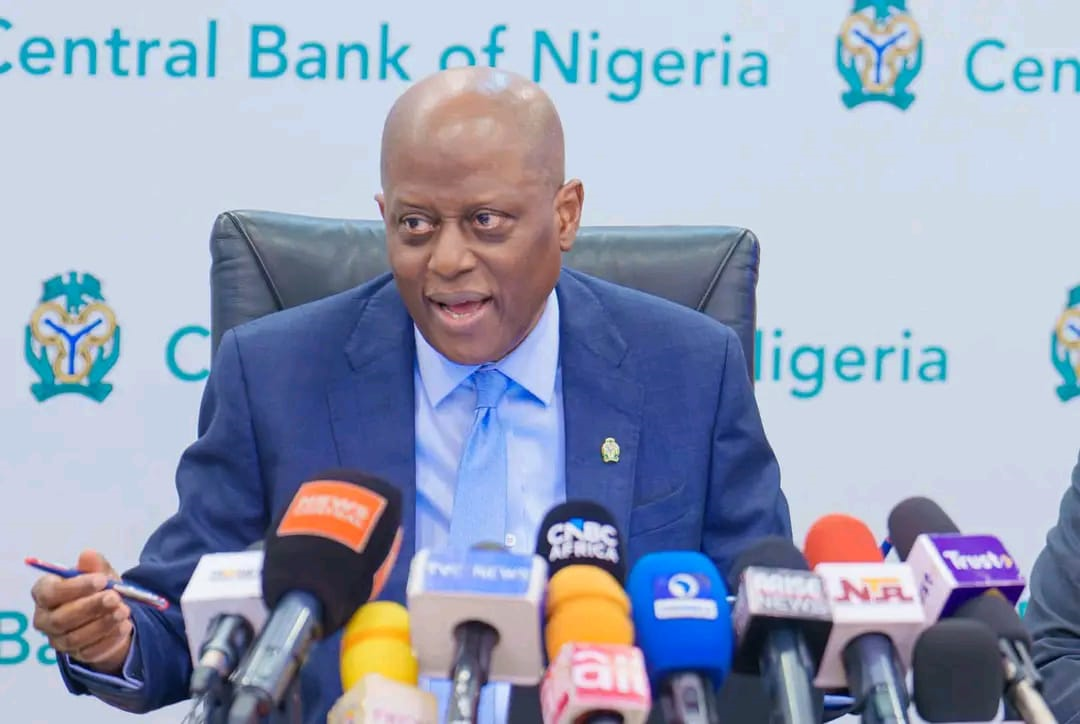
The Central Bank of Nigeria (CBN), led by Mr. Olayemi Cardoso, is simultaneously reshaping Nigeria’s financial system from two strategic fronts. While one policy direction is lowering sovereign borrowing costs through abundant market liquidity, another is tightening regulatory discipline through stronger consumer protection and enforcement. Together, the developments suggest a central bank pursuing financial stability beyond monetary policy alone, balancing liquidity management with market integrity, investor confidence and banking sector accountability. In this analysis, Enam Obiosio argues that the convergence of these measures reveals the Central Bank of Nigeria’s evolving regulatory priorities and their far-reaching implications for investors, banks and the wider economy.
The CBN lowered the stop rate on its 364-day Treasury Bill to 17.35 percent from 17.66 percent at last Wednesday’s Primary Market Auction after investors submitted N3.62 trillion in bids against N700 billion offered across three maturities. The strongest demand came for the one-year bill, which attracted N3.38 trillion in subscriptions, almost seven times the offer size.
Separately, the apex bank disclosed in its 2025 Annual Report that bank customers lodged 23,129 complaints against financial institutions during the year, an increase of 10.53 percent over 2024. The regulator ordered refunds totalling N19.12 billion and US$329.3 million, while imposing N1.69 billion in penalties for regulatory breaches, delayed complaint resolution and non-compliance with supervisory directives.
DECISION HIGHLIGHT
The CBN is simultaneously lowering the government’s domestic financing cost while raising regulatory accountability for financial institutions, signalling a broader strategy that combines monetary management with stronger market governance.
DECISION MEMO
Viewed independently, the treasury bill auction and the consumer protection report appear unrelated. Together, however, they reveal a common policy direction: strengthening confidence across Nigeria’s financial system.
The Treasury Bill auction demonstrates that domestic liquidity remains sufficiently robust for the federal government to finance itself at gradually lower yields despite expanding issuance. Investor appetite continues to concentrate around longer-tenor securities, allowing the Central Bank of Nigeria to reduce the one-year stop rate even as subscriptions reached record levels.
The latest auction extends a clear trend. The 364-day instrument attracted N1.86 trillion in subscriptions on July 8, N2.87 trillion on July 15 and N3.38 trillion at the latest auction, suggesting institutional investors remain willing to lock in longer-duration government securities despite declining nominal yields.
For policymakers, this creates greater flexibility in managing liquidity while containing domestic borrowing costs. For investors, it reinforces confidence that Nigeria’s fixed-income market continues to attract deep institutional participation.
At the same time, the CBN is strengthening another pillar of financial stability: trust in the banking system.
According to the 2025 Annual Report, “The bank received a total of 23,129 complaints from consumers of financial services in 2025, a rise of 10.53 percent above the 20,925 in 2024. The trend reflected increased awareness and improved confidence in the Bank’s consumer complaint resolution process.”
The report added: “A total of 18,824 complaints were resolved, indicating a 9.36 percent increase over the 17,213 complaints resolved in 2024.” The regulator also substantially increased customer restitution.
According to the report, “Based on the resolved complaints, the sums of N19.12 billion and 329.3 million US dollars were refunded in 2025, compared with N9.66 billion and 0.67 million US dollars in 2024.”
Enforcement was equally strengthened. The CBN stated: “During the review period, the bank imposed 11 penalties on financial institutions totalling N1.26 billion for infractions ranging from regulatory breaches and failure to respond to regulatory queries.”
It further disclosed: “In addition, the bank imposed 21 penalties on financial institutions to the tune of N430 million for infractions ranging from delays in resolving customer complaints to failure to comply with the Bank’s directives.”
Taken together, the two developments indicate that the CBN is pursuing a broader definition of financial stability. Market liquidity is being managed to sustain orderly government financing and investor participation, while supervisory enforcement is being intensified to strengthen consumer confidence and institutional discipline. The combination points to a regulatory framework that increasingly treats market efficiency and public trust as complementary rather than separate policy objectives.
DATA BOX
Treasury Bill Auction
- Total offer: N700 billion
- Total subscriptions: N3.62 trillion
- Total allotment: N1.25 trillion
- 364-day subscriptions: N3.38 trillion
- 364-day allotment: Over N1.02 trillion
- 364-day stop rate: 17.35 percent, from 17.66 percent
- 91-day stop rate: 16.30 percent
- 182-day stop rate: 16.50 percent
- Third-quarter Treasury Bill programme: N5.8 trillion
Consumer Protection
- Customer complaints: 23,129
- Complaints resolved: 18,824
- Refunds ordered: N19.12 billion
- Foreign currency refunds: 329.3 million US dollars
- Total penalties imposed: N1.69 billion
- Local currency claims: N40.61 billion
- Foreign currency claims: 344.2 million US dollars
WHO WINS / WHO LOSES
Winners
- Federal Government through lower domestic funding costs
- Institutional fixed-income investors
- Bank customers benefiting from stronger regulatory protection
- Financial institutions with robust compliance and governance systems
Losers
- Banks with weak consumer protection frameworks
- Investors expecting higher Treasury Bill yields
- Institutions exposed to heightened regulatory sanctions
POLICY SIGNALS
- Domestic liquidity remains strong despite elevated government borrowing.
- Consumer protection has become a core pillar of banking supervision.
- Regulatory enforcement is increasingly backed by financial restitution and sanctions.
- The CBN is integrating monetary management with financial sector governance.
INVESTOR SIGNAL
The combined developments reinforce confidence in Nigeria’s financial architecture. Strong demand for government securities confirms deep domestic liquidity, while stricter consumer protection enhances institutional credibility. Investors should view the two developments as evidence that the CBN is seeking to improve both market efficiency and regulatory confidence, two conditions that underpin sustainable capital market development.
RISK RADAR
- Future inflationary pressures reversing the downward yield trend
- Crowding out of private-sector credit if sovereign borrowing remains elevated
- Rising compliance costs for financial institutions
- Persistent operational weaknesses among banks attracting regulatory sanctions
- Liquidity tightening if fiscal financing requirements increase significantly
Discover more from StakeBridge Media
Subscribe to get the latest posts sent to your email.