

By Olumide Johnson
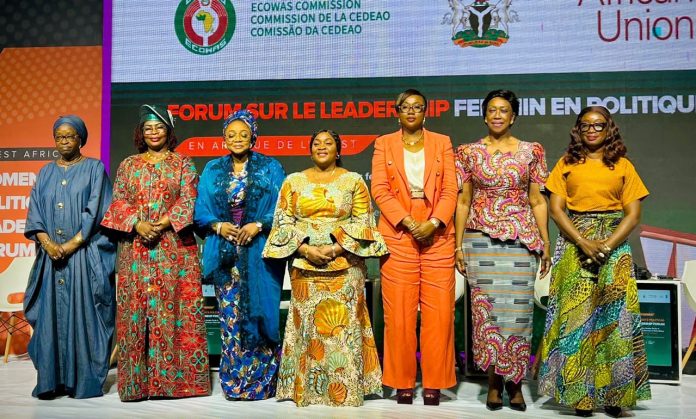
The Economic Community of West African States (ECOWAS) recently opened the West Africa Women’s Political Leadership Forum in Abuja with a call for accelerated constitutional, legal and institutional reforms to increase women’s participation in governance across member states. The two-day forum brought together ministers, parliamentarians, regional institutions, development partners and civil society organisations to develop an implementation framework for gender parity commitments. Damtien Tchintchibidja, Vice-President of the Economic Community of West African States Commission, Ahunna Eziakonwa, Assistant Secretary-General of the United Nations and Assistant Administrator of the United Nations Development Programme, Jide Okeke, Regional Programme Director for Africa at the United Nations Development Programme, Chantal Fanny, President of the Economic Community of West African States Female Parliamentarians Association, and Imaan Sulaiman-Ibrahim, Nigeria’s Minister of Women Affairs, urged governments to move beyond declarations towards measurable reforms.
DECISION HIGHLIGHT
The ECOWAS is shifting the regional gender agenda from political commitments to enforceable governance reforms, measurable implementation and institutional accountability.
DECISION MEMO
The Abuja forum reflects growing recognition that gender parity has become a governance and development issue rather than solely a social inclusion objective. Despite decades of regional commitments, women’s representation in political leadership remains significantly below continental and global averages, prompting calls for structural reforms rather than renewed declarations.
Vice-President of the Economic Community of West African States Commission, Damtien Tchintchibidja, said: “The strength of our democracies, the quality of our governance and the future of our development depend on the ability of all citizens, women and men alike, to participate fully in shaping the destiny of our region.”
Noting that women occupy only 18.5 percent of parliamentary seats across West Africa, she urged member states to strengthen constitutional and legal frameworks, reform political party nomination processes, improve women’s access to political financing and address restrictive social norms.
Assistant Secretary-General of the United Nations and Assistant Administrator of the United Nations Development Programme, Ahunna Eziakonwa, argued that political participation remains constrained by entrenched financial, institutional and cultural barriers.
She said: “Greater representation of women in political leadership is associated with stronger democratic legitimacy, more inclusive policies, improved peace and better development outcomes.”
Eziakonwa also announced that the United Nations Development Programme, working with the African Women Leaders Network and the African Union, would establish the African Academy for Women’s Political Leadership in Kigali to strengthen leadership capacity across the continent.
Regional Programme Director for Africa at the United Nations Development Programme, Jide Okeke, warned that West Africa’s 18.5 percent female parliamentary representation remains the lowest in Africa and that, at the current pace, the region is unlikely to attain gender parity before 2131, almost a century beyond the 2035 regional target.
President of the Economic Community of West African States Female Parliamentarians Association, Chantal Fanny, stressed that policy implementation must now become the central priority.
She stated: “A declaration is never an end in itself. It is a starting point. It is now up to us to translate political commitments into laws, laws into public policies, public policies into concrete actions and actions into tangible results.”
Nigeria’s Minister of Women Affairs, Imaan Sulaiman-Ibrahim, described women’s political leadership as “a strategic imperative for democratic consolidation, peace, security and sustainable development,” reaffirming Nigeria’s commitment to the 35 percent affirmative action benchmark.
Collectively, the interventions indicate that regional institutions increasingly view gender parity as an institutional reform agenda requiring measurable legal, financial and political changes rather than voluntary commitments alone.
DATA BOX
- Forum: West Africa Women’s Political Leadership Forum
- Venue: Abuja
- Regional female parliamentary representation: 18.5 percent
- African average: 25 percent
- Global average: 26.5 percent
- ECOWAS gender parity target: 2035
- Projected parity at current pace: 2131
- Nigeria’s affirmative action benchmark: 35 percent
- Women’s representation in Nigeria:
- Federal Executive Council: 17 to 20 percent
- Senior Federal Civil Service: More than 30 percent
- Judiciary: About 33 percent
- Expected outcome: Abuja Regional Action Plan
WHO WINS / WHO LOSES
Winners
- Women seeking greater political representation
- Democratic institutions pursuing broader inclusiveness
- Political systems strengthened through more representative governance
- Development partners supporting governance reforms
Losers
- Institutional barriers limiting women’s political participation
- Political systems dependent on exclusionary nomination practices
POLICY SIGNALS
- Gender parity is increasingly being framed as a governance reform priority.
- Regional institutions are shifting from advocacy to implementation and accountability.
- Electoral, legal and political financing reforms are becoming central to the gender agenda.
INVESTOR SIGNAL
The forum reinforces the link between inclusive governance and institutional quality. Progress towards broader political participation could strengthen governance indicators, policy stability and long-term development outcomes, factors increasingly considered by development finance institutions and governance-focused investors.
RISK RADAR
- Slow implementation of agreed reforms by member states
- Persistent cultural and institutional barriers
- Limited political financing for female candidates
- Weak enforcement of affirmative action commitments
- Delays in implementing the Abuja Regional Action Plan
Discover more from StakeBridge Media
Subscribe to get the latest posts sent to your email.