

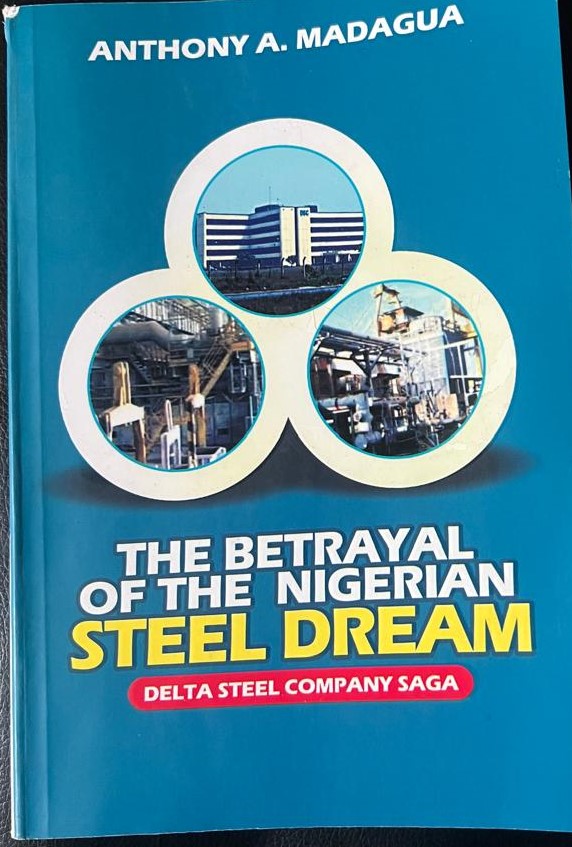
By Enam Obiosio
Title: The Betrayal of the Nigerian Steel Dream: Delta Steel Company Saga
Author: Anthony A. Madagua
Publisher: Bosem Publishers Nigeria Limited
Pages: 267
Year: 2015 Revised Edition
Some books narrate events. Others preserve institutional memory. ‘The Betrayal of the Nigerian Steel Dream: Delta Steel Company Saga’ by Anthony A. Madagua accomplishes both. Across ten expansive chapters, the author reconstructs the rise, decline and unrealised promise of Nigeria’s integrated steel programme while advancing a compelling argument that the country’s industrial underdevelopment is inseparable from the fate of Delta Steel Company. The result is a work that blends memoir, industrial history, engineering documentation and public policy into a substantial contribution to Nigeria’s development literature.
The book’s greatest strength lies in its ambition. Rather than merely recounting the story of Delta Steel Company, Madagua asks a broader national question: why has Nigeria, despite abundant natural resources and decades of public investment, struggled to establish a durable industrial base? His answer is consistent throughout the book. The decline of Delta Steel symbolises a deeper failure of long-term industrial planning, policy consistency and institutional discipline. That central argument provides coherence from the opening chapter to the concluding recommendations.
The narrative opens not with machinery or metallurgy but with the personal reflections of a technocrat seeking an audience with President Olusegun Obasanjo following his removal from office. This autobiographical beginning gives the book both emotional depth and historical authenticity. Rather than writing as a detached academic, Madagua writes as a participant whose professional life became closely intertwined with one of Nigeria’s most ambitious industrial projects. His firsthand experience enriches the narrative with institutional knowledge that few external observers could provide.
That insider perspective becomes one of the book’s defining strengths. Madagua reconstructs, with remarkable detail, the chronology of Nigeria’s steel policy, technological decisions, management transitions, production records, rehabilitation efforts and privatisation process. The historical chapters demonstrate extensive familiarity with engineering practice, government policy and industrial management. They are supported by years of accumulated documentation rather than retrospective speculation.
Particularly impressive is the discussion of technology selection. Madagua patiently explains why Nigeria adopted the Midrex direct reduction process for Delta Steel while Ajaokuta Steel Company embraced blast furnace technology. He argues convincingly that Nigeria’s abundant natural gas made direct reduction economically rational and strategically sound. Subsequent global acceptance of direct reduction technology lends additional weight to his contention that the country’s early planners demonstrated greater technological foresight than they have often been credited with.
One of the book’s most important contributions is its rejection of simplistic explanations for Nigeria’s industrial decline. Rather than attributing the collapse of Delta Steel solely to corruption or inadequate funding, Madagua identifies an interconnected web of structural weaknesses, including unreliable electricity, inconsistent government policy, weak maintenance culture, politicised appointments, fragmented management, inadequate corporate governance, abandoned infrastructure and the absence of sustained industrial planning. His analysis reminds readers that industrialisation depends on coordinated national systems rather than isolated flagship projects.
The examination of successive management administrations is equally valuable. Madagua evaluates different leadership periods against production performance, organisational culture, staff welfare, infrastructure development and strategic direction. Naturally, his account devotes greater detail to the years during which he led the organisation, documenting plant rehabilitation, organisational reforms and operational initiatives with considerable evidence. Readers may occasionally wish for broader engagement with alternative interpretations, but the author’s proximity to the events also provides rare institutional insights that significantly enhance the historical record.
Similarly, the discussion of privatisation benefits from the perspective of someone directly involved in the process. Madagua presents a carefully argued critique of how privatisation was implemented, questioning both policy choices and execution. Whether readers agree with every conclusion or not, the book makes an important contribution by documenting operational realities that are often overlooked in broader economic debates. It encourages a more nuanced discussion about the governance of strategic industries and the conditions necessary for successful industrial reform.
The concluding chapters elevate the work beyond corporate history into comparative political economy. Drawing lessons from countries including Turkey, India, Iran and South Africa, Madagua argues that sustained industrialisation has rarely occurred without a strong domestic steel industry. Steel, in his analysis, is not simply another manufacturing activity but the strategic foundation linking defence, transport, construction, engineering, mining and technological capability. Whether one accepts this proposition entirely or not, the comparative framework significantly enriches the discussion and encourages policymakers to think beyond immediate commercial returns towards long-term industrial capability.
The book’s technical depth is both one of its greatest strengths and one of its few challenges. Engineers, economists and industrial policy specialists will appreciate the detailed discussions of production systems, plant configuration, logistics, raw materials and operational processes. General readers may occasionally find some technical sections demanding, and modest editorial tightening could have improved narrative flow without sacrificing substance. Even so, the technical detail reinforces the work’s authority and documentary value.
The prose combines documentary precision with personal reflection. Historical sections are anchored by dates, figures and administrative records, while autobiographical passages reveal the author’s enduring commitment to the institution he helped build. That combination gives the book both analytical substance and human dimension, making it more engaging than a conventional industrial history.
The book’s significance extends well beyond steel. At its core, it asks whether Nigeria possesses the institutional discipline required to sustain complex national projects across successive administrations. Delta Steel becomes less a story about metallurgy than a metaphor for governance itself. The recurring themes of policy discontinuity, leadership instability, weak accountability and the abandonment of long-term planning resonate across virtually every sector of the Nigerian economy. In that sense, the “betrayal” captured in the title speaks not only to a company but also to a national development philosophy.
Few contemporary Nigerian books attempt such an ambitious synthesis of industrial history, engineering management, economic policy and personal experience. Fewer still assemble decades of institutional knowledge into a coherent argument for national industrial renewal. Whether readers agree with every conclusion or not, ‘The Betrayal of the Nigerian Steel Dream’ deserves serious attention because it raises enduring questions about industrial strategy, governance and economic transformation.
As both historical testimony and industrial policy intervention, this book makes an important contribution to Nigeria’s development literature. It occasionally revisits certain arguments and reflects the author’s deeply held convictions, but these qualities do little to diminish its value as a rich historical record and thoughtful policy contribution. It is intellectually stimulating, technically authoritative and historically significant. Above all, it reminds readers that nations do not become industrial powers by accident. They do so through consistent vision, institutional discipline and political commitment, the very qualities that Madagua persuasively argues Nigeria must rediscover if its industrial ambitions are ever to be fully realised.
Discover more from StakeBridge Media
Subscribe to get the latest posts sent to your email.