

By Enam Obiosio
A provocative work revisits one of Nigeria’s longest-running economic arguments, challenging decades of orthodox thinking with historical evidence drawn from the world’s most successful industrial economies.
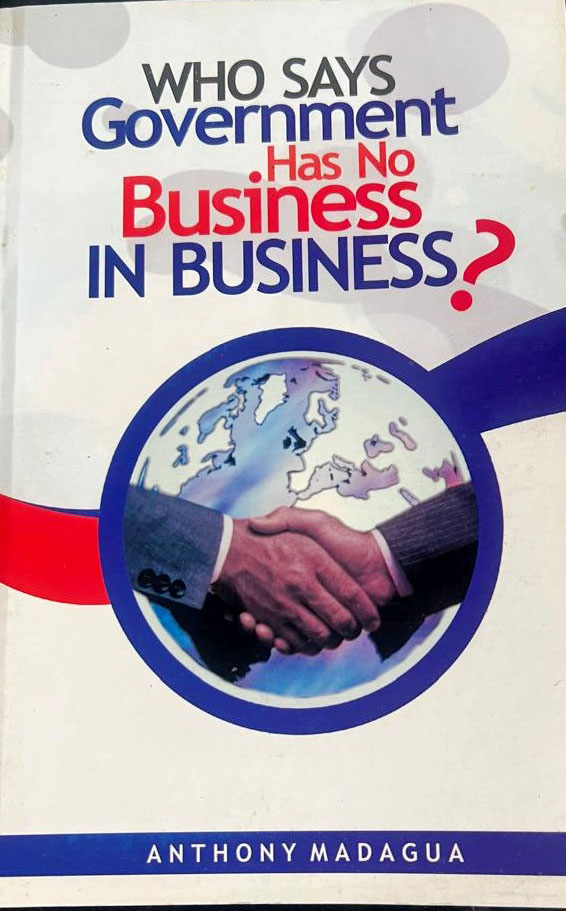
Book Title: Who Says Government Has No Business in Business?
Author: Anthony Madagua
Publisher: Bosem Publishers Nigeria Ltd.
Year: 2015
Pages: 152
At a time when governments across the world are rediscovering industrial policy, strategic investment and economic nationalism, Who Says Government Has No Business in Business? arrives as more than a book. It is an intervention in one of Nigeria’s most enduring economic debates.
For more than three decades, the notion that “government has no business in business” has shaped Nigeria’s privatisation, commercialisation and market liberalisation policies. The assumption was straightforward: government should withdraw from productive enterprise and allow private capital to drive economic growth.
Anthony Madagua challenges that orthodoxy with a simple but profound question: what if history tells a different story?
Across ten chapters, the author argues that virtually every nation that successfully industrialised, from Britain and Germany to Japan, South Korea, Singapore, China, India and even the United States, relied on deliberate government intervention at critical stages of development. His central argument is clear. Nigeria’s problem is not that government has participated in business; it is that government has often done so inefficiently, without the institutions, discipline and accountability that made state intervention successful elsewhere.
That distinction elevates the book beyond an ideological defence of state ownership into a broader discussion about development, leadership and national purpose.
One of the book’s greatest strengths is its historical perspective. Rather than beginning with Nigeria’s economic failures, Madagua traces the evolution of industrial economies, demonstrating that prosperity rarely emerged through market forces alone. Governments invested heavily in infrastructure, strategic industries, technology and manufacturing before private enterprise matured sufficiently to sustain growth independently.
History, therefore, becomes evidence rather than nostalgia.
His examination of East Asia is particularly persuasive. Singapore’s Government-Linked Corporations, South Korea’s state-led industrial strategy and China’s strategic management of state-owned enterprises are presented as practical responses to national realities rather than ideological commitments. The message is unmistakable: successful economies built institutions that combined market efficiency with purposeful government leadership.
Equally compelling is the author’s insistence that no nation copied another’s development model wholesale. Britain industrialised differently from Germany; Japan followed a different path from South Korea; China differed from Singapore. Every country adapted its strategy to its own political, economic and social circumstances. Nigeria, he argues, must do the same instead of importing economic doctrines without considering local realities.
The discussion becomes more introspective when the focus shifts to Nigeria. Here, Madagua contends that underdevelopment is not simply the consequence of poor policies but also of weak institutions, declining civic values and the absence of visionary leadership. Corruption, capital flight, infrastructure decay and industrial stagnation are portrayed as interconnected symptoms of a deeper governance crisis.
The author’s proposed remedy is the emergence of what economists describe as a developmental state, one capable of planning, coordinating and supporting strategic industries while creating conditions for private enterprise to flourish. Manufacturing, steel, energy, mining and transport occupy central positions in this framework because they provide the productive base upon which competitive economies are built.
This philosophy reaches its strongest expression in the latter chapters, where international examples reinforce the argument. Singapore’s Government-Linked Corporations, India’s public enterprises, China’s globally competitive state-owned companies and even the United States government’s rescue of General Motors during the global financial crisis are cited as evidence that state participation in business remains an accepted instrument of economic policy.
The book’s greatest achievement is perhaps its rejection of ideological absolutism. Rather than framing development as a choice between state ownership and free markets, Madagua argues that the more important question is whether government intervention creates value, strengthens productive capacity and serves national interests.
In many respects, recent global developments have strengthened this position. Supply chain disruptions, geopolitical competition and energy security concerns have prompted many advanced economies to revive industrial policies that once appeared outdated. Governments are again investing directly in strategic sectors, supporting domestic industries and pursuing economic resilience.
In this regard, history appears to have moved closer to the author’s thesis. Yet the book is not without limitations.
Its principal weakness lies in occasionally presenting government intervention as the dominant explanation for industrial success while giving comparatively less attention to the institutional qualities that made intervention effective. Singapore’s Government-Linked Corporations succeeded not simply because they were government-owned, but because they were professionally managed, commercially disciplined and protected from excessive political interference. South Korea’s industrial success depended as much on competent bureaucracy and export discipline as on government ownership. China’s state-owned enterprises similarly operate within demanding performance frameworks. Ownership alone did not produce success. Capability did.
A more sustained examination of governance quality, institutional capacity and corporate accountability would have strengthened the author’s argument considerably.
Similarly, while the shortcomings of Nigeria’s privatisation programme are convincingly examined, the discussion sometimes underplays sectors where private participation has delivered measurable improvements. A more balanced engagement with competing schools of economic thought would have enhanced the book’s analytical depth without weakening its central thesis.
Even so, these limitations do not diminish the importance of the work. Its enduring value lies in forcing readers to confront difficult but necessary questions. Can industrialisation occur without deliberate state coordination? Can manufacturing flourish without long-term planning? Can strategic industries be left entirely to market forces? Can economic sovereignty be achieved while relying overwhelmingly on imported productive capacity? These are practical questions, not ideological ones.
Madagua deserves considerable credit for placing them at the centre of national discourse. His writing remains accessible without sacrificing intellectual ambition, making the book valuable to policymakers, economists, business leaders, students and general readers alike. Even where he occasionally overstates his conclusions, he succeeds in stimulating a conversation that Nigeria urgently needs.
Ultimately, this is not merely a book about state ownership. It is a book about state purpose.
Its central message is that prosperity is seldom accidental. Nations become wealthy because they deliberately build productive capacity, nurture strategic industries, strengthen institutions and align leadership with long-term national objectives. Whether those institutions are publicly owned, privately owned or jointly owned matters less than whether they create sustainable value for society.
Readers may disagree with some of Madagua’s conclusions or question aspects of his evidence. Yet they will find it difficult to dismiss the seriousness of the issues he raises. At a time when governments across the world are rethinking industrial strategy and economic resilience, Who Says Government Has No Business in Business? reads less like a defence of yesterday’s economic philosophy than a timely invitation to reconsider the foundations of tomorrow’s development.
Discover more from StakeBridge Media
Subscribe to get the latest posts sent to your email.