

By Olumide Johnson
The Nigerian Ports Authority (NPA) recently secured commitments from the Nigeria Police Force, the Lagos State Government, freight forwarders, transport unions and other stakeholders to eliminate illegal checkpoints and extortion points along the Apapa and Tin Can Island port corridors. At a high-level meeting in Lagos, Managing Director of the NPA, Dr. Abubakar Dantsoho, said that investigations had identified unauthorised roadblocks, illegal collections and overlapping security jurisdictions outside the port gates as major impediments to cargo movement. Assistant Inspector-General of Police, Maritime Command, Okunade Ronke, affirmed that neither the Maritime Police nor the Lagos State Police Command authorised such checkpoints, warning that any officer operating them was acting illegally.
DECISION HIGHLIGHT
The NPA is extending its reform agenda beyond port terminals by building an inter-agency enforcement framework to dismantle illegal corridor operations that increase logistics costs and weaken trade efficiency.
DECISION MEMO
The latest initiative demonstrates a shift in the Authority’s operational philosophy. Rather than measuring port performance solely by activities within terminal boundaries, the NPA is increasingly treating the surrounding transport corridors as part of the national port ecosystem.
That approach recognises that cargo efficiency depends as much on governance outside the gates as on infrastructure inside them. Illegal checkpoints, fragmented enforcement responsibilities and informal revenue collection have long eroded the benefits of operational improvements within the ports themselves.
Dantsoho argued that the authority had isolated these governance failures as priority obstacles requiring coordinated institutional action. “We have problems along the port corridor in Apapa and Tin Can Island. Now, we have established that there are issues around expulsion along the corridor. That is outside the port,” he said, adding that activities around Berger and Mile 2 also undermine corridor efficiency.
He identified overlapping security responsibilities as another structural weakness. “The second issue is the issue of overlap, jurisdictional overlap… in some instances, there are clashes, overlaps.”
The meeting produced a unified position from security agencies. According to Dantsoho, “The AIG Maritime Police has clearly stated that they do not send anybody to go and form roadblocks or checkpoints on the corridor. Equally, the Lagos Police Command has said the same thing.”
Okunade reinforced that position, stating: “We have never posted officers to any checkpoint around the port environment,” and urged stakeholders to report any officer falsely claiming deployment for investigation and disciplinary action.
Looking beyond enforcement, Dantsoho said that the objective is to improve Nigeria’s competitiveness, noting, “Our emphasis will be that we are going to function, and then function better in our practices, so we can do better than our neighboring countries.” He also observed that “our port system inside the ports have recently been confirmed as one of the most improved in the world by the World Bank,” attributing the progress to ongoing Federal Government reforms.
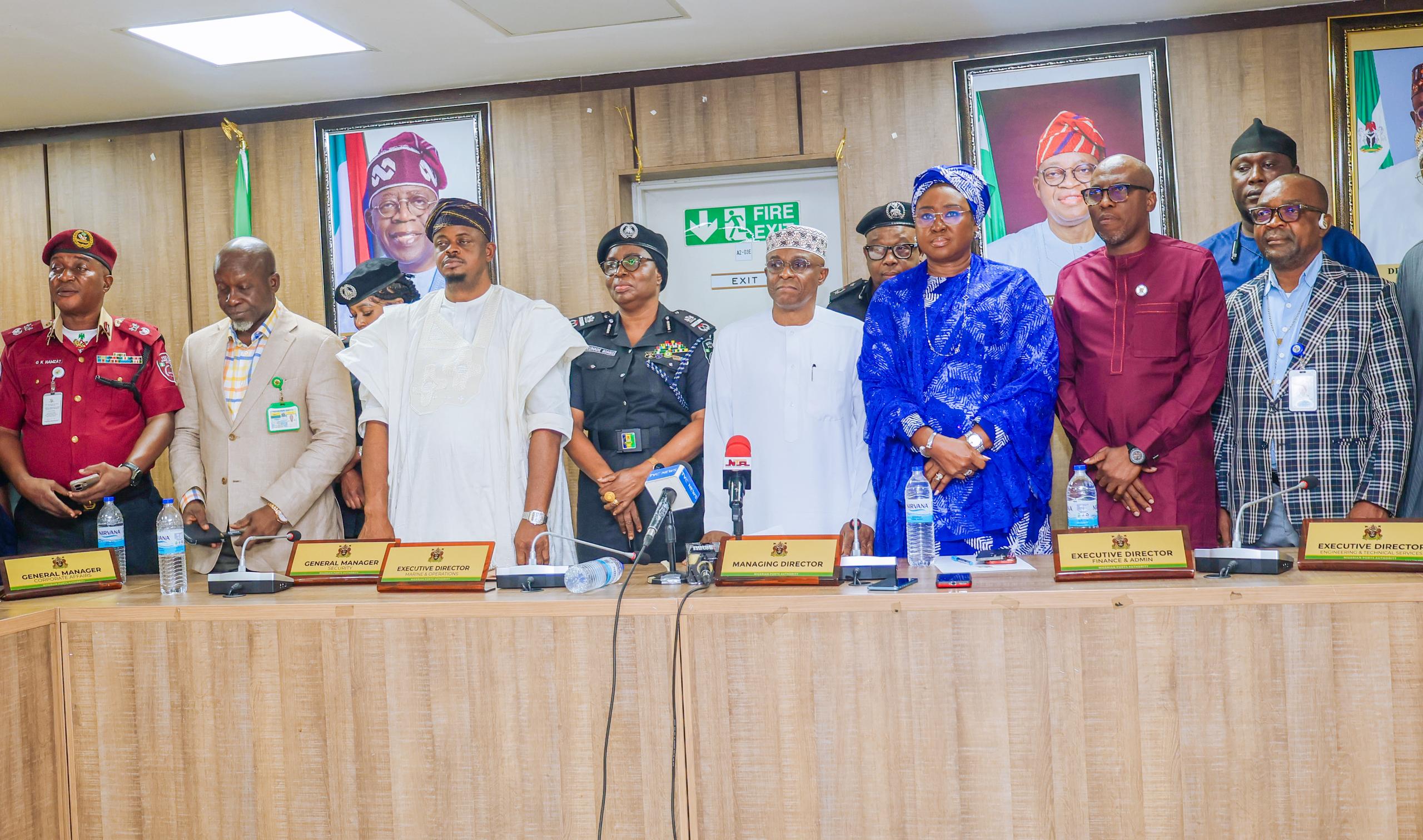
Caption: Dr. Abubakar Dantsoho, Managing Director/CEO NPA (4th right); AIG Nurat Okunade, Asst. Inspector General of Police (Maritime) (4th left); Mr. Ojowuro Olasunkanmi, Rep. Commissioner of Transport Lagos (2nd right); Mrs Vivian Richard-Edet, Executive Director F& A NPA (3rd right); Engr. Olalekan Badmus, Executive Director M&O (3rd left); Dr. Godfrey Nwosu, Secretary-General National Association of Government Approved Freight Forwarders (NAGAFF) (1st right); Mr. Anthony Edosomwan, General Manager Security NPA (2nd left), and Corp Commander Ganiyu Hamzat, FRSC Sector Commander Lagos (1st left), on Tuesday 23rd June, 2026, during Port Stakeholders Meeting convened by the NPA to address issues of Jurisdictional Overlaps and extortion along Tincan and Apapa Ports access roads.
DATA BOX
- Lead agency: Nigerian Ports Authority
- Focus corridors: Apapa and Tin Can Island, Lagos
- Key challenges identified: Illegal checkpoints, extortion, jurisdictional overlap, cargo delays
- Enforcement mechanism: Joint multi-agency coordination framework
- Supporting institutions: Nigeria Police Force, Lagos State Government, freight forwarders, transport unions and other stakeholders
- Additional measure: Standing committee to oversee implementation and monitoring
- Strategic objective: Improve cargo evacuation, reduce logistics costs and strengthen regional port competitiveness
- External reference: World Bank recognition of improvements within Nigeria’s port operations, as cited by the NPA
WHO WINS / WHO LOSES
Winners
- Nigerian Ports Authority through stronger corridor governance.
- Importers, exporters and logistics operators through more predictable cargo movement.
- Freight forwarders and transporters through reduced exposure to illegal collections.
- Nigeria’s maritime sector through improved trade facilitation.
Losers
- Illegal checkpoint operators and extortion networks.
- Individuals exploiting fragmented security mandates for unauthorised enforcement.
POLICY SIGNALS
The Nigerian Ports Authority is redefining port reform to include governance of the entire logistics value chain. The strategy places institutional coordination, rather than isolated enforcement actions, at the centre of improving trade efficiency.
INVESTOR SIGNAL
The initiative indicates that government reforms are increasingly targeting non-infrastructure bottlenecks affecting supply chain performance. Sustained enforcement could improve cargo predictability, reduce logistics costs and strengthen investor confidence in Nigeria’s maritime and manufacturing sectors.
RISK RADAR
The effectiveness of the framework will depend on continuous inter-agency cooperation, consistent enforcement, institutional accountability and the ability to prevent illegal checkpoints from re-emerging after the initial crackdown.
Discover more from StakeBridge Media
Subscribe to get the latest posts sent to your email.