

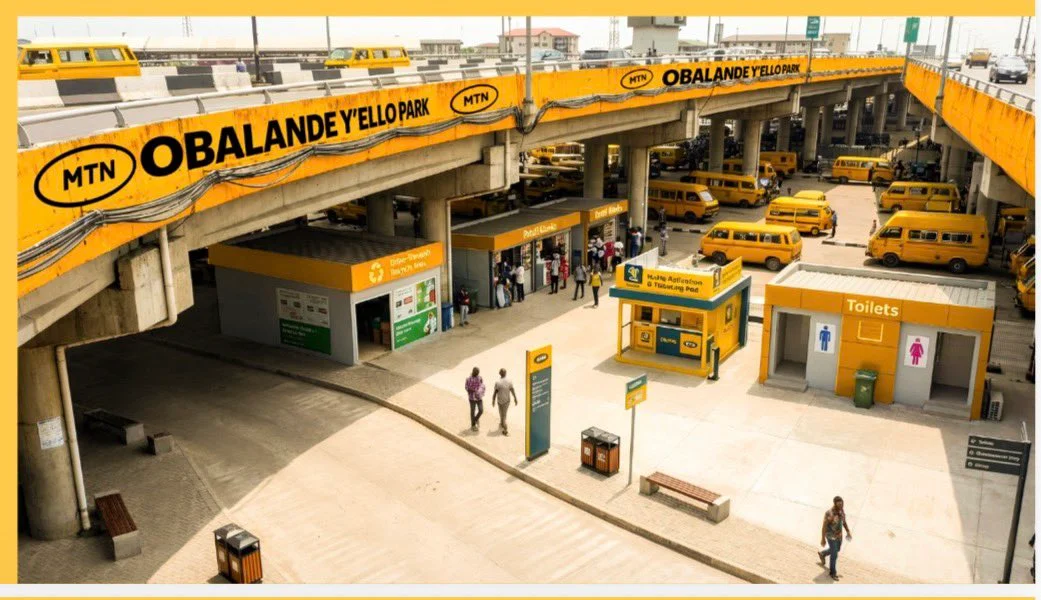
The Lagos State Government has announced a partnership with MTN Nigeria to redevelop the Obalende under-bridge into a modern transport hub, known as Y’ELLO Bus Park, aimed at improving mobility, safety, and environmental management in one of Lagos’ busiest corridors. The initiative seeks to convert a previously congested and unsanitary space into a structured, secure, and community-focused facility, providing both commuters and residents with functional public amenities.
Officials said the project prioritises safety, sanitation, and urban design while aligning with Lagos’ broader climate and public-space policies. “This redevelopment will convert what was once a notorious and degraded space into a functional, secure, and community-centred facility,” said Tokunbo Wahab, Commissioner for Environment and Water Resources, in a post on X. The facility will include an organised bus terminal, kiosks, over 60 public toilet fixtures, a recycling drop-off station, and a road camp for LAWMA sweepers and security agencies.
In addition to commuter and community benefits, the project integrates environmental management measures. A biodigester system will handle wastewater sustainably, while solar-powered lighting and CCTV coverage aim to improve night-time visibility and enhance public safety. The initiative also includes tree planting to improve air quality and contribute to urban aesthetics.
DECISION HIGHLIGHT
Decision authority: Lagos State Government
Lead institutions: Ministry of Environment and Water Resources, MTN Nigeria
Policy focus: Urban mobility, public-space redevelopment, environmental sustainability
Instrument: Public-private partnership
Primary impact: Redevelopment of under-bridge into a structured transport facility
Secondary effect: Enhanced commuter safety, sanitation, and urban aesthetics
DECISION MEMO
For years, the Obalende under-bridge suffered from congestion, unregulated commercial activity, and poor sanitation, creating hazards for commuters and residents. The Y’ELLO Bus Park project addresses these challenges by creating a regulated transport hub with dedicated facilities for passengers, vendors, waste management, and law enforcement.
The development demonstrates how public-private partnerships (PPP) can transform neglected urban spaces while integrating mobility, environmental, and safety objectives. Structured amenities, solar energy, and waste management systems will improve operational efficiency and sustainability, setting a model for similar urban projects across Lagos.
DATA BOX
Project: Y’ELLO Bus Park, Obalende under-bridge
Announcement date: January 27, 2026
Key partners: Lagos State Government, MTN Nigeria
Planned amenities: Regulated bus terminals, kiosks, public toilets, recycling station, solar-powered lighting, security posts
Environmental interventions: Biodigester system, solar panels, tree planting
Expected impact: Safer, cleaner, and more organised commuter experience; improved environmental management; enhanced public-space aesthetics
WHO WINS / WHO LOSES
Commuters benefit from a safer and more organised transport environment. Residents gain access to better sanitation and improved public amenities. The Lagos State Government strengthens its record in urban renewal, while MTN demonstrates civic engagement through infrastructure investment.
Informal operators displaced by the redevelopment may face adjustments, but planned kiosks and commercial facilities are intended to mitigate economic disruption.
POLICY SIGNALS
The project signals Lagos’ commitment to reclaiming and modernising public spaces using collaborative models. It demonstrates the integration of transport planning, urban safety, and environmental sustainability in a single project and sets a precedent for future urban redevelopment initiatives.
INVESTOR SIGNAL
The collaboration highlights opportunities for private-sector participation in civic infrastructure. Clear government backing, combined with measurable community benefits, provides a replicable model for future public-private partnerships in urban development.
RISK RADAR
Potential risks include construction delays, operational mismanagement, or underutilisation of facilities. Sustained success will depend on maintenance, stakeholder coordination, and enforcement of safety, sanitation, and regulatory standards.
Overall, the Y’ELLO Bus Park project positions Obalende as a benchmark for structured urban transport facilities. By combining commuter convenience, public safety, and environmental responsibility, it transforms a previously neglected area into a modern, functional, and community-oriented hub, reinforcing Lagos’ vision for a cleaner, safer, and more resilient city.
Discover more from StakeBridge Media
Subscribe to get the latest posts sent to your email.