

By Olumide Johnson
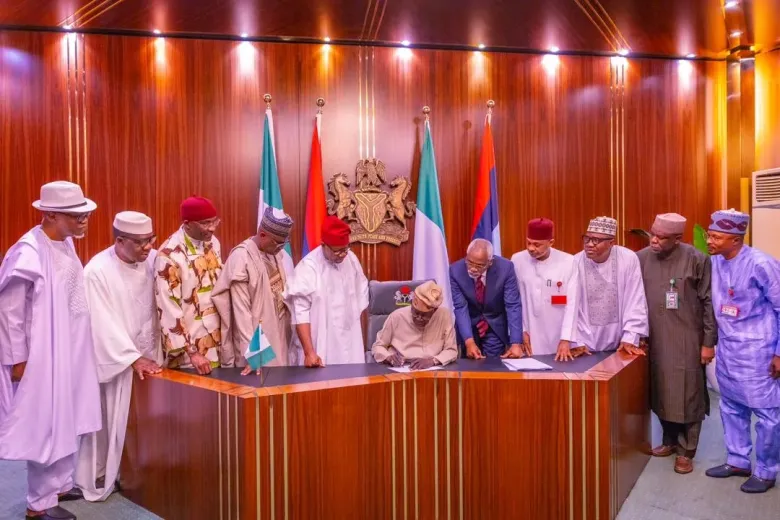
President Bola Tinubu signed Executive Order 9 of 2026, formally titled ‘Presidential Executive Order to Safeguard Federation Oil and Gas Revenues and Provide Regulatory Clarity, 2026.’
The Order suspends the Nigerian National Petroleum Company Limited (NNPCL) from the collection of management fees and frontier exploration allocations under the Petroleum Industry Act (PIA) framework and directs full remittance of oil and gas revenues to the Federation Account.
The Presidency states the action is grounded in constitutional authority and revenue realignment.
The official document explains: “The Executive Order reinforces the provisions of the 1999 Constitution of the Federal Republic of Nigeria, which vest ownership of mineral resources in the Federation and require that all revenues derived from those resources be paid into the Federation Account for appropriation in accordance with established constitutional and statutory rules.”
It further argues the measure became necessary due to declining inflows into the Federation Account despite improved production and favourable market conditions.
DECISION HIGHLIGHT
The Presidency has moved to reverse revenue retention structures created under the Petroleum Industry Act, restoring gross remittance before deductions.
DECISION MEMO
This Executive Order is not administrative housekeeping. It is a structural confrontation with the fiscal architecture introduced by the PIA.
Under the PIA framework, NNPCL retained 30% of Federation oil revenues as a management fee on Profit Oil and Profit Gas derived from Production Sharing, Profit Sharing, and Risk Service Contracts. In addition, the company retained 20 percent of its profits for working capital and future investments. A further 30 percent of profit oil and gas was allocated to the Frontier Exploration Fund.
The Order effectively challenges the layering of these retention mechanisms.
The Presidency states: “Given the existing 20% retention, the additional 30% management fee is considered unjustified by the Federal Government, as the retained earnings are already sufficient to support the functions NNPCL performs under these contracts.”
The interpretative implication is clear. What was framed as operational flexibility has been reclassified as excessive pre-distribution retention.
This move reasserts constitutional supremacy over statutory commercial structuring. Section 44(3) of the Constitution vests ownership and derivative rights of mineral resources in the Government of the Federation. The Executive Order interprets this to mean revenue must first flow to the Federation before corporate allocations are executed.
In effect, the Presidency is saying oil revenue belongs to the sovereign balance sheet before it belongs to the operator’s ledger.
The Frontier Exploration Fund becomes particularly significant in this context. The document notes that a fund of that scale devoted to speculative exploration risks accumulating large idle balances and encouraging inefficient spending at a time when public finances are strained.
This is a fiscal reprioritisation disguised as regulatory clarification.
The Order also halts gas flare penalty payments into the Midstream and Downstream Gas Infrastructure Fund and clarifies regulatory delineation between upstream and midstream authorities. That suggests the Presidency views fiscal opacity as partly rooted in overlapping mandates and layered retention vehicles.
Structurally, this is an attempt to collapse parallel revenue channels back into a single constitutional pipeline.
The underlying political logic is equally direct. Improved production and favourable prices should increase Federation inflows. If they do not, the leak is structural, not geological.
DATA BOX
NNPCL retention under PIA:
• 30% management fee on Profit Oil and Profit Gas
• 20% profit retention for working capital and future investments
• 30% allocation to Frontier Exploration Fund
2025 Financials:
• Total revenue: N60.5 trillion
• Profit after tax: N5.76 trillion
• Statutory remittances: N14.706 trillion
Executive Order legal basis:
• Section 5 of the Constitution
• Section 44(3) of the Constitution
WHO WINS / WHO LOSES
Winners:
• Federation Account beneficiaries, federal, state, and local governments
• Budget planners seeking predictable inflows
• Fiscal transparency advocates
Losers:
• NNPCL’s discretionary retention autonomy
• Frontier exploration financing flexibility
• Off-budget fiscal channels created under PIA arrangements
POLICY SIGNALS
- Constitutional primacy now overrides commercial structuring where revenue ownership is concerned.
- The Presidency is prepared to reinterpret the PIA through executive authority pending legislative amendment.
- Fiscal consolidation takes precedence over sectoral reinvestment autonomy.
This also signals a broader doctrine, production reform must be matched by remittance reform.
INVESTOR SIGNAL
For upstream investors, the signal is mixed.
On one hand, direct remittance enhances sovereign transparency and strengthens Federation fiscal credibility. Clearer revenue accounting improves macro confidence and sovereign risk perception.
On the other hand, altering cost recovery and retention mechanisms through executive order introduces regulatory recalibration risk. Investors will assess whether future commercial structures remain predictable or subject to political reinterpretation.
The stabilising effect will depend on whether legislative amendments codify the new framework or leave it contingent on executive discretion.
RISK RADAR
Legal Risk:
Potential conflict between the Executive Order and existing PIA provisions until statutory amendments are enacted.
Operational Risk:
NNPCL funding flexibility for frontier and capital projects may tighten, affecting long-term upstream expansion.
Political Risk:
States may welcome increased remittance, but internal sector actors may resist loss of autonomy.
Execution Risk:
Inter-agency coordination must prevent administrative bottlenecks that delay remittances.
This Executive Order marks a rebalancing moment in Nigeria’s oil governance. It reframes oil revenue not as commercial throughput but as constitutional property.
Whether this correction produces fiscal clarity or operational friction will depend on execution discipline and legislative follow-through.
The core principle, however, has been asserted without ambiguity: oil belongs to the Federation before it belongs to the operator.
Discover more from StakeBridge Media
Subscribe to get the latest posts sent to your email.