

By Olumide Johnson
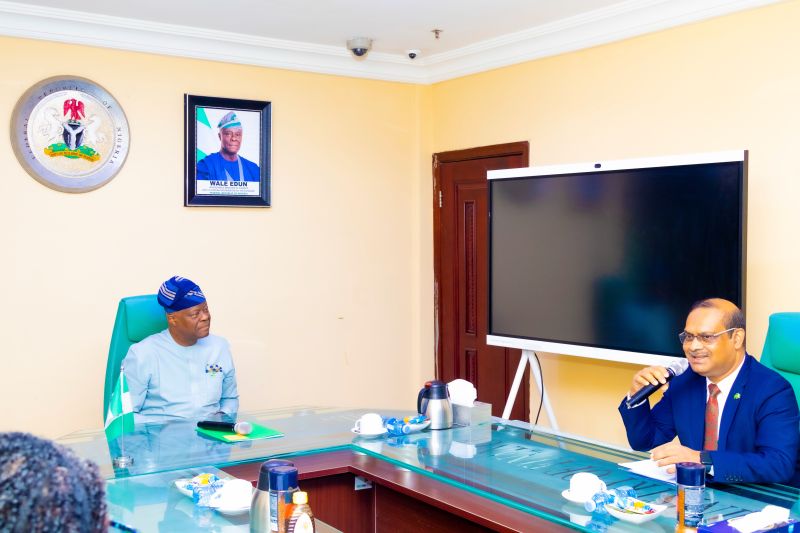
The Honourable Minister of Finance and Coordinating Minister of the Economy, Mr. Wale Edun, recently engaged with Miah MD Mainul Kabir, High Commissioner of Bangladesh to Nigeria, to deepen bilateral trade and investment relations. Both parties agreed to advance cooperation across key sectors and pursue formal agreements to strengthen economic ties.
DECISION HIGHLIGHT
- Bilateral trade expansion beyond current levels
- Focus on garments, agriculture, maritime, pharmaceuticals, and energy
- Commitment to double taxation and investment protection agreements
- Emphasis on private sector-led investment flows
DECISION MEMO
The engagement reflects a deliberate attempt to reposition Nigeria’s bilateral trade relationships from transactional exchange to structured investment partnerships. Edun’s framing of the relationship as a pathway to “unlock greater value” indicates a shift towards value-added cooperation rather than volume-driven trade.
The doubling of trade to approximately $100 million remains modest in absolute terms, suggesting that the relationship is still underdeveloped relative to potential. The current policy direction seeks to address this gap by targeting sectors where Bangladesh has demonstrated comparative advantage, particularly in garments and light manufacturing, while aligning with Nigeria’s industrialisation objectives.
Kabir’s identification of Nigeria as a strategic partner signals Bangladesh’s outward expansion into African markets, positioning Nigeria as an entry point. This introduces a reciprocal dynamic, Nigeria seeks capital and expertise, while Bangladesh seeks market access and production scale.
The proposed double taxation and investment protection agreements are central to this transition. These instruments reduce regulatory uncertainty and improve investor confidence, but their effectiveness depends on enforcement credibility and administrative efficiency. Without these, agreements risk remaining formalities rather than operational enablers.
Sectoral focus on agriculture and maritime also reflects an attempt to integrate supply chains and logistics infrastructure into the partnership. However, execution risks remain high given Nigeria’s persistent infrastructure deficits and regulatory bottlenecks.
Overall, the engagement signals intent to institutionalise bilateral economic cooperation, but its success will depend on the translation of diplomatic commitments into enforceable frameworks and bankable projects.
DATA BOX
- Bilateral trade value: approximately $100 million
- Trade growth: more than doubled in recent period
- Target sectors: garments, agriculture, maritime, pharmaceuticals, energy
WHO WINS / WHO LOSES
Wins:
- Nigerian manufacturing and agricultural sectors through potential investment inflows
- Bangladeshi firms seeking market expansion into Africa
- Governments, through increased trade and investment activity
Loses:
- Domestic industries unable to compete with imported expertise and products
- Informal trade operators affected by formalisation of trade frameworks
- Businesses constrained by regulatory inefficiencies
POLICY SIGNALS
- Increasing focus on bilateral economic diplomacy
- Movement towards formal investment protection and tax coordination frameworks
- Alignment of trade policy with industrialisation objectives
INVESTOR SIGNAL
- Emerging opportunities in manufacturing, agriculture, and logistics
- Improved investment climate contingent on agreement implementation
- Continued need to assess regulatory and infrastructure risks
RISK RADAR
- Limited scale of current trade base
- Weak enforcement of bilateral agreements
- Infrastructure and logistics constraints
- Regulatory bottlenecks affecting ease of doing business
- Exposure to currency and macroeconomic volatility
Discover more from StakeBridge Media
Subscribe to get the latest posts sent to your email.