

By Johnson Emmanuel
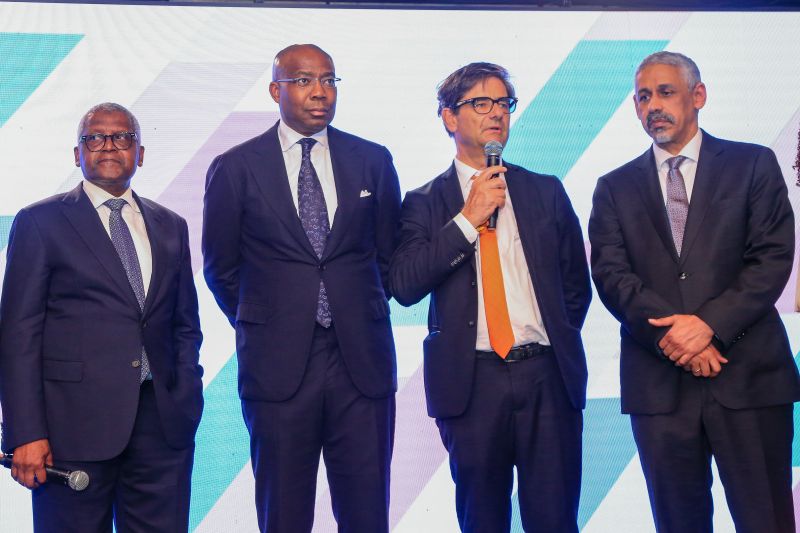
The Chairman of Access Holdings Plc, Mr. Aigboje Aig-Imoukhuede, recently stated at the Africa Forward Summit 2026 in Nairobi, Kenya, that Africa’s economic transformation would depend less on resource potential and more on capital mobilisation, institutional strength and execution capability.
Addressing participants at the summit, Aig-Imoukhuede argued that Africa should no longer be viewed as a peripheral investment destination but as a strategic participant within the next phase of global economic growth.
“Africa is not on the margins of global change; it is at the centre,” Aig-Imoukhuede said.
“But potential alone will not deliver transformation; capital mobilisation, institutional strength, but execution will,” he added.
The summit discussions reflected growing continental efforts to reposition Africa within global investment, industrialisation and infrastructure conversations amid shifting geopolitical and economic alignments.
DECISION HIGHLIGHT
The summit messaging signals increasing emphasis among African corporate and policy leaders on execution-driven development rather than narrative-based optimism around demographic growth and natural-resource potential.
Aig-Imoukhuede’s remarks also reinforce the emerging argument that Africa’s competitiveness will depend on institutional efficiency, capital coordination and implementation discipline rather than solely external financing access.
The intervention further reflects attempts by African financial institutions and business leaders to reposition the continent from aid-oriented engagement towards partnership-based economic participation.
DECISION MEMO
The broader significance of the Africa Forward Summit lies in its shift away from traditional “Africa rising” rhetoric towards a more execution-centred development framework.
For years, discussions around Africa’s economic future largely focused on untapped potential, youthful demographics and natural-resource abundance. However, persistent infrastructure deficits, weak institutional delivery systems and fragmented capital markets repeatedly limited the continent’s ability to convert opportunity into scalable economic outcomes.
Aig-Imoukhuede’s intervention reflects a growing recognition within African corporate leadership that credibility now depends on implementation capacity rather than aspirational positioning.
The emphasis on capital mobilisation also highlights the widening financing gap confronting African economies as global capital increasingly becomes more selective, risk-sensitive and geopolitically aligned.
Institutional strength has simultaneously emerged as a central competitive variable. As global investors place greater emphasis on governance predictability, regulatory consistency and execution capability, African economies face increasing pressure to demonstrate administrative reliability alongside market potential.
The summit’s framing additionally suggests that Africa’s future growth narrative may increasingly revolve around strategic economic integration, industrial execution and domestic capital formation rather than commodity-driven expansion cycles alone.
DATA BOX
- Event:
- Africa Forward Summit 2026
- Location:
- Nairobi, Kenya
- Key participant:
- Aigboje Aig-Imoukhuede, Chairman, Access Holdings Plc
- Core themes highlighted:
- capital mobilisation
- institutional strength
- execution capability
- strategic economic partnership
- global growth participation
- Key quote:
- “Africa is not on the margins of global change; it is at the centre.”
- Additional quote:
- “Potential alone will not deliver transformation; capital mobilisation, institutional strength, but execution will.”
- Structural focus areas implied:
- infrastructure financing
- institutional reform
- investment coordination
- regional competitiveness
- economic integration
WHO WINS / WHO LOSES
Who Wins:
- African financial institutions with regional scale ambitions
- Infrastructure and industrial investors
- Economies improving institutional credibility
- Regional capital market operators
- Governments prioritising execution-based reforms
Who Loses:
- Economies dependent on commodity-cycle growth alone
- Weak institutions unable to absorb long-term investment
- Countries with inconsistent regulatory environments
- Public systems resistant to structural reforms
- Markets unable to mobilise domestic capital efficiently
POLICY SIGNALS
African economic discourse is increasingly shifting towards institutional delivery, implementation efficiency and long-term capital formation.
The summit also signals growing continental preference for strategic investment partnerships over donor-dependent development frameworks.
The emphasis on execution further suggests that future policy competitiveness may increasingly depend on governance quality, project delivery capability and regulatory consistency.
INVESTOR SIGNAL
Africa continues positioning itself as a long-term growth market across infrastructure, finance, technology, energy and industrial development.
However, investor confidence is likely to remain increasingly tied to:
- institutional reliability,
- policy continuity,
- capital-market depth,
- project execution capability,
- currency stability,
- regulatory transparency.
The summit’s messaging may strengthen broader perceptions that African corporate and policy leaders are prioritising commercially sustainable growth frameworks over purely narrative-driven positioning.
RISK RADAR
Execution weakness remains Africa’s most significant structural development risk.
Key vulnerabilities include:
- fragmented capital markets,
- infrastructure deficits,
- policy inconsistency,
- sovereign debt pressures,
- institutional inefficiency,
- governance instability,
- weak project implementation capacity.
Global capital tightening and geopolitical competition may also increase financing costs for African economies unable to demonstrate credible reform execution and investment security.
Discover more from StakeBridge Media
Subscribe to get the latest posts sent to your email.