

By Olumide Johnson
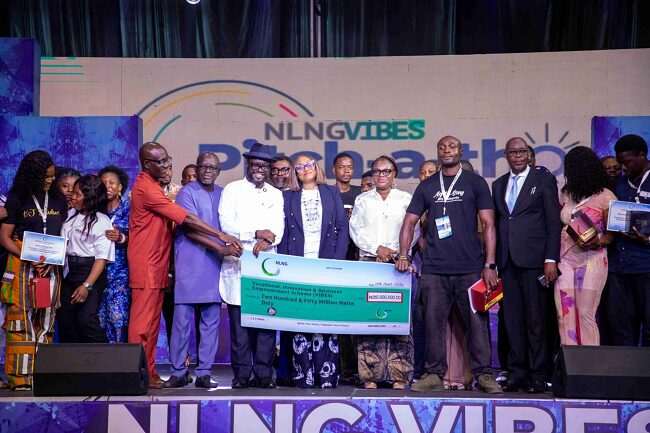
The General Manager, External Relations and Sustainable Development at Nigeria LNG Limited, Sophia Horsfall, has recently announced in Rivers State that the company disbursed N250 million in grants to 51 entrepreneurs from 103 participants under its Vocational Innovation and Business Empowerment Scheme, following a pitch-a-thon process that funded viable, scalable, and sustainable business proposals.
DECISION HIGHLIGHT
Nigeria LNG Limited is integrating capacity building with targeted grant financing to bridge the gap between skills acquisition and business execution.
DECISION MEMO
The Nigeria LNG Limited is applying a blended development model that combines training with immediate capital deployment. Horsfall stated that the initiative is “bridging the gap between learning and execution,” indicating a shift from skills development to outcome-driven enterprise support.
The selection mechanism, anchored on a competitive pitch-a-thon, introduces performance-based capital allocation. By prioritising viability, scalability, and sustainability, the programme attempts to improve capital efficiency and reduce failure rates typical in grant-based interventions.
The four-week training component, covering financial management, strategy, marketing, and operations, functions as a pre-investment filter, aligning beneficiaries with minimum operational standards before funding. This sequencing reflects a structured pipeline approach to enterprise development.
The Manager, Community Relations and Sustainable Development, Yemi Adeyemi, noted that the funding is intended to “enable beneficiaries to expand operations… and create jobs,” reinforcing the programme’s focus on local economic multipliers.
However, the model remains grant-dependent, raising questions about long-term scalability and replication without continuous corporate funding. Its impact will depend on post-disbursement monitoring and business survival rates.
DATA BOX
- Total grants disbursed: N250 million
- Beneficiaries: 51 entrepreneurs
- Total participants: 103
- Programme duration: Four weeks
- Selection method: Competitive pitch-a-thon
- Training focus: Financial management, strategy, marketing, operations
- Geographic scope: NLNG host communities in Rivers State
WHO WINS / WHO LOSES
Beneficiary entrepreneurs gain immediate access to growth capital and business support. Local communities benefit from potential job creation and economic activity. NLNG strengthens its social investment profile. Non-selected participants lose immediate funding access but retain training benefits.
POLICY SIGNALS
There is a growing emphasis on combining capacity building with financing in enterprise development programmes. Corporate-led interventions are increasingly complementing public sector efforts in local economic development.
INVESTOR SIGNAL
The initiative signals emerging pipelines of trained and capitalised small businesses, though largely within grant-supported ecosystems. Investors may view such programmes as early-stage incubation rather than investable opportunities.
RISK RADAR
Sustainability risk persists due to reliance on grant funding. Execution risk centres on beneficiaries’ ability to convert capital into viable businesses. Monitoring risk may limit long-term impact assessment. Scalability risk remains constrained without institutional replication beyond corporate programmes.
Discover more from StakeBridge Media
Subscribe to get the latest posts sent to your email.