

By Kingsley Ani
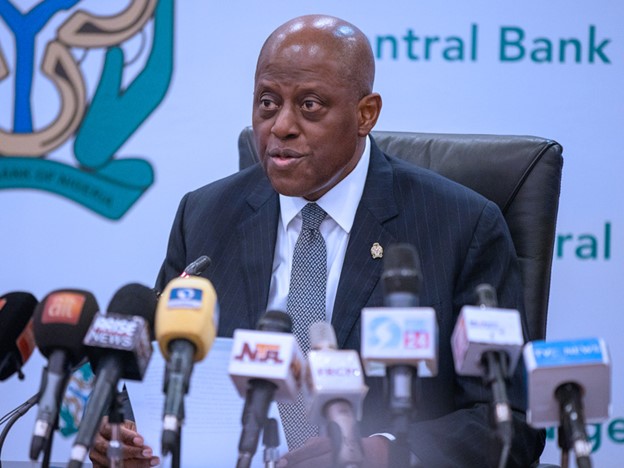
The Governor of Central Bank of Nigeria (CBN), Mr. Olayemi Cardoso, stated at the close of the just concluded International Monetary Fund and World Bank (IMF/World Bank) Spring Meetings, during a media briefing with Nigerian journalists, that the Bank will sustain reforms, deepen institutional capacity, and strengthen macroeconomic stability through data-driven policy, foreign exchange liberalisation, and financial sector recapitalisation.
DECISION HIGHLIGHT
The CBN is maintaining reform continuity, focusing on institutional strengthening, financial system resilience, and market-based policy transmission.
DECISION MEMO
The CBN is consolidating its reform narrative around durability and system-wide resilience rather than incremental policy shifts. Mr. Cardoso stated that the bank remains “firmly on track… focused on building on existing gains,” signalling a preference for policy consistency amid external volatility.
Cardoso linked reform outcomes to measurable macro indicators, asserting that policies are “strengthening the naira, boosting reserves, and building investor confidence.” This framing positions exchange rate liberalisation and monetary tightening as stabilisation anchors rather than transitional adjustments.
A key structural signal is the banking sector recapitalisation, which raised N4.65 trillion with 72.55 percent domestic and 27.45 percent foreign participation. This indicates both internal liquidity mobilisation and sustained external investor interest, reinforcing capital adequacy within the financial system.
Cardoso also highlighted a remittance target of $1 billion monthly by end-2026, emphasising system efficiency and diaspora channel integration as transmission mechanisms. His assertion that the foreign exchange market is “now more market-driven and has sufficient liquidity” reflects confidence in ongoing market reforms, though this remains contingent on sustained inflows.
Institutional expansion is evident in Nigeria hosting the African Monetary Institute, signalling ambitions for regional monetary integration. Cardoso’s emphasis on partnership with International Monetary Fund AFRITAC West II further underscores capacity-building as a policy priority.
DATA BOX
- Banking recapitalisation: N4.65 trillion
- Participation mix: 72.55% domestic, 27.45% foreign
- Remittance target: $1 billion monthly by end-2026
- Policy framework: Market-driven foreign exchange, monetary tightening, institutional reform
- Institutional initiative: African Monetary Institute hosted in Abuja
- Capacity partner: International Monetary Fund AFRITAC West II
WHO WINS / WHO LOSES
Financial institutions gain from strengthened capital buffers and regulatory clarity. The Central Bank of Nigeria reinforces policy credibility. Diaspora participants benefit from improved remittance channels. Households and small businesses may face tighter financial conditions as reforms prioritise stability.
POLICY SIGNALS
There is a clear commitment to policy continuity, institutional strengthening, and regional financial integration. Authorities are reinforcing market-based mechanisms as the foundation for macroeconomic management.
INVESTOR SIGNAL
The reform trajectory signals improving macroeconomic stability and financial system resilience, supporting investor confidence. Continued foreign participation in recapitalisation indicates sustained external interest, though dependent on policy consistency.
RISK RADAR
Execution risk remains around sustaining foreign exchange liquidity and remittance inflows. Policy risk could emerge if reform fatigue sets in domestically. External risk persists from global financial volatility. Institutional risk hinges on effective implementation of capacity-building initiatives.
Discover more from StakeBridge Media
Subscribe to get the latest posts sent to your email.