

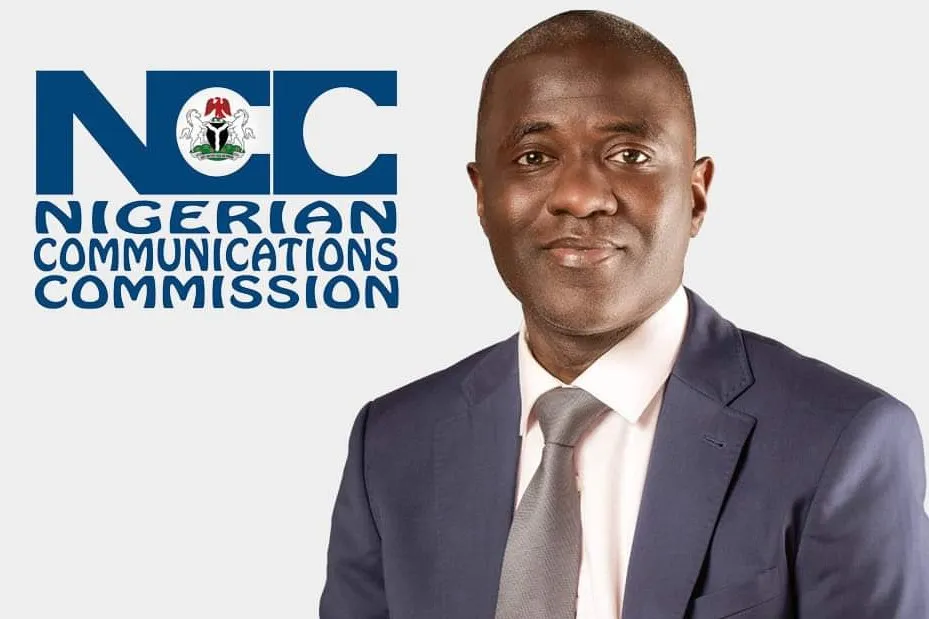
By Johnson Emmauel
The Nigerian Communications Commission (NCC) recently disclosed that telecommunications operators invested more than N2.5 trillion in network infrastructure and upgrades in 2025 as the regulator intensified efforts to address worsening service quality complaints across Nigeria. According to a statement signed by Head of Public Affairs, Mrs. Nnenna Ukoha, Mobile Network Operators invested over N2.13 trillion, while Tower Companies committed an additional N373.8 billion to sector expansion and modernisation.
The NCC said that the investments supported the deployment and upgrade of more than 2,800 telecom sites nationwide to reduce congestion, improve coverage and strengthen network capacity. The regulator acknowledged growing consumer dissatisfaction over dropped calls, unstable internet connectivity and slow data speeds, despite describing telecommunications infrastructure as critical to commerce, education, financial transactions and public services.
The commission stated that operators have already committed to adding or upgrading more than 12,000 sites in 2026, with nearly 3,000 sites already delivered. It also disclosed that over 730 additional 5G sites had been deployed across 27 states in 2026. The NCC further revealed that enforcement actions against operators failing service quality standards commenced in November 2025 under the updated Quality of Service Regulations 2024.
The regulator identified fibre vandalism, equipment theft, power disruptions and road construction damage as major operational threats, disclosing that over 27,000 avoidable fibre-cut incidents were recorded nationwide in 2025.
DECISION HIGHLIGHT
Nigeria’s telecommunications sector is entering a capital-intensive infrastructure recovery cycle driven by rising data demand, regulatory enforcement pressure and growing strategic dependence on digital connectivity.
DECISION MEMO
The NCC’s disclosure reflects both the scale of Nigeria’s digital infrastructure deficit and the increasing economic centrality of telecommunications networks within the broader economy.
The N2.5 trillion investment cycle indicates that operators are responding to a prolonged period of underinvestment that weakened service reliability amid accelerating digital consumption. The sector’s transition towards large-scale 4G and 5G expansion suggests that network quality has become both a commercial survival issue and a regulatory compliance requirement.
However, the significance of the announcement lies less in headline investment figures and more in the regulator’s acknowledgement that public dissatisfaction persists despite rising capital expenditure. This exposes the structural complexity of Nigeria’s telecom ecosystem, where infrastructure expansion alone does not automatically resolve operational inefficiencies, vandalism risks, power instability and urban congestion pressures.
The NCC’s enforcement posture also signals a shift towards stricter performance-based regulation. By introducing consumer compensation measures and additional investment obligations for underperforming operators and Tower Companies, the regulator is attempting to move beyond advisory oversight into measurable accountability enforcement.
The deployment of over 730 new 5G sites across 27 states further reveals an underlying policy objective, accelerating Nigeria’s digital economy transition through higher-speed connectivity infrastructure. Yet the continued prevalence of fibre cuts and equipment theft underscores how physical infrastructure insecurity remains one of the largest constraints to network stability.
The broader implication is that Nigeria’s telecom sector is increasingly evolving into critical national infrastructure rather than merely a commercial industry. The NCC’s collaboration with the Office of the National Security Adviser over telecom asset protection reinforces that shift.
DATA BOX
- Total telecom infrastructure investment in 2025: over N2.5 trillion
• Mobile Network Operators investment: N2.13 trillion
• Tower Companies investment: N373.8 billion
• Telecom sites added/upgraded in 2025: over 2,800
• Planned site expansion in 2026: over 12,000
• Sites already delivered in 2026: nearly 3,000
• Additional 5G sites deployed in 2026: over 730
• States covered by new 5G rollout: 27
• 4G penetration increase: 45 percent to 54 percent since January 2024
• Median download speed increase: 16.5Mbps to 20Mbps
• Telecom tower power availability improvement: 99.3 percent to 99.7 percent
• Fibre-cut incidents recorded in 2025: over 27,000
WHO WINS / WHO LOSES
Winners:
• Telecom infrastructure providers and Tower Companies
• Consumers in high-capacity urban and underserved expansion areas
• Digital economy businesses reliant on stable connectivity
• Equipment vendors, fibre providers and network contractors
• Financial technology and e-commerce platforms dependent on broadband growth
Losers:
• Operators failing quality-of-service benchmarks
• Criminal syndicates involved in fibre vandalism and equipment theft
• Smaller providers unable to finance large-scale infrastructure upgrades
• Consumers in persistently underserved locations facing delayed network improvements
POLICY SIGNALS
- Stronger regulatory enforcement within telecommunications sector
• Accelerated transition towards 5G-enabled digital infrastructure
• Increased classification of telecom assets as strategic national infrastructure
• Expanded government support for broadband penetration and wholesale connectivity
• Greater emphasis on consumer protection and service accountability
INVESTOR SIGNAL
The investment cycle reinforces long-term growth potential within Nigeria’s telecom infrastructure market, particularly around broadband expansion, fibre deployment and 5G services. Rising data consumption and deeper digital dependence continue to strengthen sector relevance.
However, persistent service complaints despite large capital injections may increase investor focus on operational execution efficiency, infrastructure security and regulatory compliance costs. The sector remains commercially attractive, but operational risk intensity is rising alongside regulatory scrutiny.
RISK RADAR
- Fibre vandalism and infrastructure theft
• High operating costs linked to power and maintenance
• Regulatory penalties for service quality failures
• Slow return on large-scale infrastructure investments
• Urban congestion pressures on network performance
• Cybersecurity and infrastructure sabotage risks
• Consumer dissatisfaction despite expanding capital expenditure
Discover more from StakeBridge Media
Subscribe to get the latest posts sent to your email.