

By Olumide Johnson
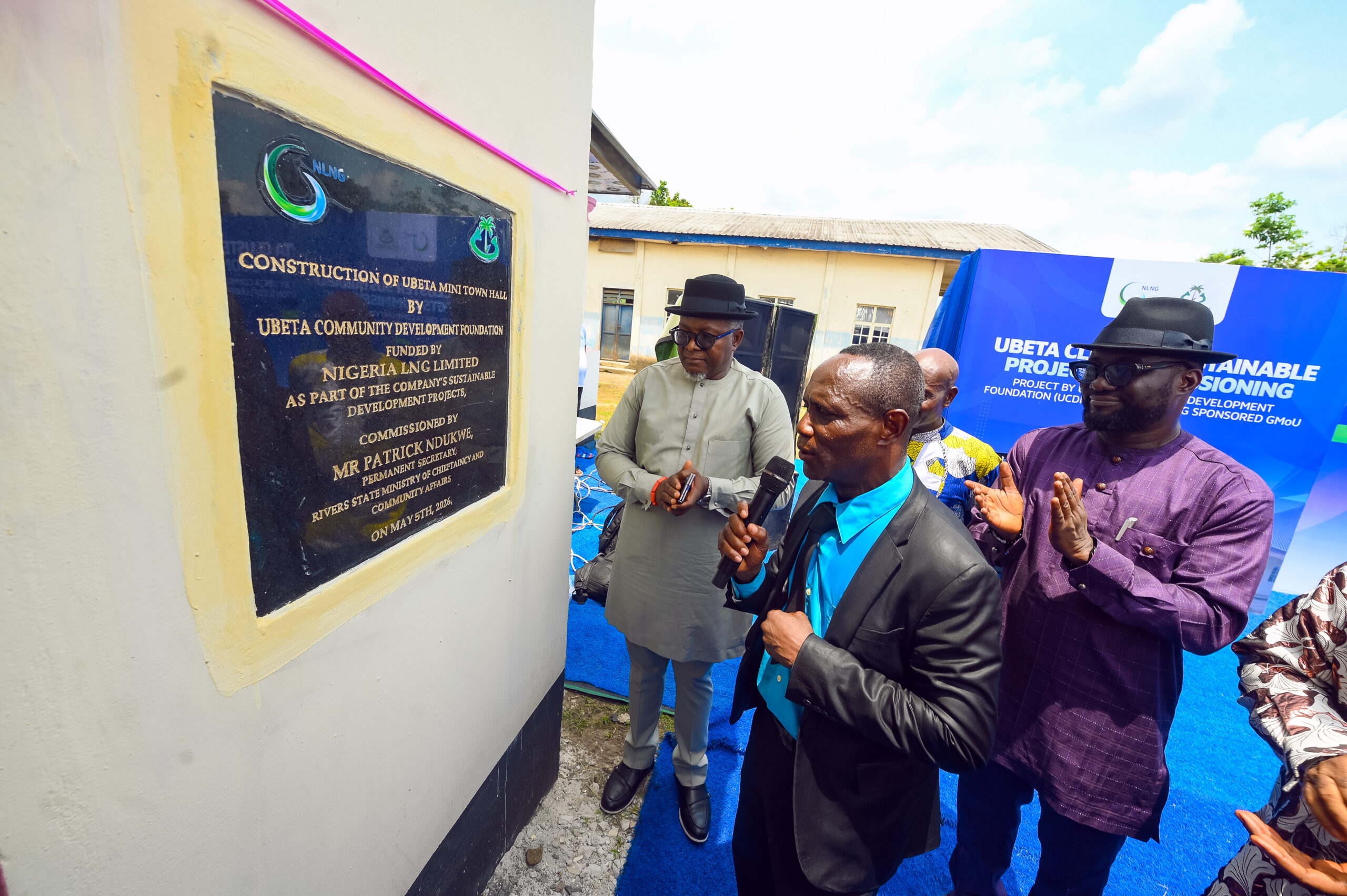
Nigeria LNG Limited (NLNG), through funding support under its Global Memorandum of Understanding (GMoU) framework, recently supported the commissioning of multiple community infrastructure and welfare projects executed by the Ubeta Community Development Foundation (UCDF) in Ubeta.
The projects include a town hall, walkways and a solar-powered water system at Government Secondary School, Ubeta, five lock-up shops, renovation of the women’s secretariat, and expansion of electricity infrastructure within the community.
The intervention was presented as part of NLNG’s broader community development partnership model aimed at improving infrastructure, strengthening social welfare, and encouraging local ownership to ensure sustainability of completed projects.
DECISION HIGHLIGHT
Nigeria LNG Limited is reinforcing its community relations strategy through infrastructure-focused social investment executed under a partnership-driven development framework.
DECISION MEMO
The Ubeta intervention reflects the continued evolution of community engagement models within Nigeria’s extractive sector, where operators increasingly rely on structured development agreements to manage social expectations, strengthen local legitimacy, and reduce operational friction.
The use of the GMoU framework is strategically important because it shifts community development away from ad hoc corporate philanthropy towards negotiated, institutionalised intervention structures with clearer implementation channels. Such frameworks are designed to improve project ownership, reduce conflict over resource allocation, and create more predictable engagement between host communities and corporate operators.
The combination of educational infrastructure, water access, electricity expansion, and small commercial facilities suggests a multi-layered social investment approach aimed at addressing both welfare and local economic activity. The inclusion of lock-up shops also indicates an attempt to stimulate micro-enterprise opportunities alongside basic infrastructure delivery.
For NLNG, the projects form part of a broader social licence strategy in a region where energy infrastructure operations remain closely linked to community stability, stakeholder trust, and operational continuity. Sustainable community investment increasingly functions not only as a corporate responsibility obligation but also as a risk management mechanism within Nigeria’s energy-producing regions.
However, the long-term developmental value of such interventions will depend heavily on maintenance culture, governance quality within community structures, and the extent to which projects integrate into wider local economic systems. Infrastructure delivery without sustained operational oversight has historically weakened the long-term impact of many host-community interventions across the Niger Delta.
The emphasis on community ownership therefore reflects awareness that sustainability risks often emerge after project commissioning rather than during construction phases.
DATA BOX
• Funding framework: Global Memorandum of Understanding (GMoU)
• Lead corporate institution: Nigeria LNG Limited
• Implementing community body: Ubeta Community Development Foundation
• Projects commissioned: Town hall, walkways, solar-powered water system, lock-up shops, women’s secretariat renovation, electricity expansion
• Core intervention areas: Infrastructure, water access, education support, electricity, community enterprise
• Strategic objective: Sustainable community development and stakeholder partnership
WHO WINS / WHO LOSES
Potential winners:
• Residents of Ubeta community
• Students and educational institutions benefiting from water infrastructure
• Women’s groups and community associations
• Small business operators using commercial shop facilities
• NLNG through stronger community relations and operational goodwill
Potential losers:
• Communities lacking structured development engagement frameworks
• Local infrastructure systems if maintenance responsibility weakens over time
POLICY SIGNALS
The intervention signals continued reliance on partnership-based community development frameworks within Nigeria’s extractive industries. It also reflects increasing emphasis on sustainability, stakeholder inclusion, and infrastructure-led social investment within corporate-community engagement strategies.
INVESTOR SIGNAL
The projects may reinforce perceptions of NLNG as a corporate operator prioritising structured host-community engagement and long-term social investment stability. Investors increasingly monitor community relations performance as part of broader environmental, social, and governance considerations within energy-sector operations.
RISK RADAR
Key risks include weak project maintenance systems, limited long-term funding continuity, governance disputes within community structures, and sustainability challenges after commissioning. There is also reputational risk if infrastructure projects fail to produce measurable long-term socioeconomic improvements within beneficiary communities.
Discover more from StakeBridge Media
Subscribe to get the latest posts sent to your email.