

By Kingsley Ani
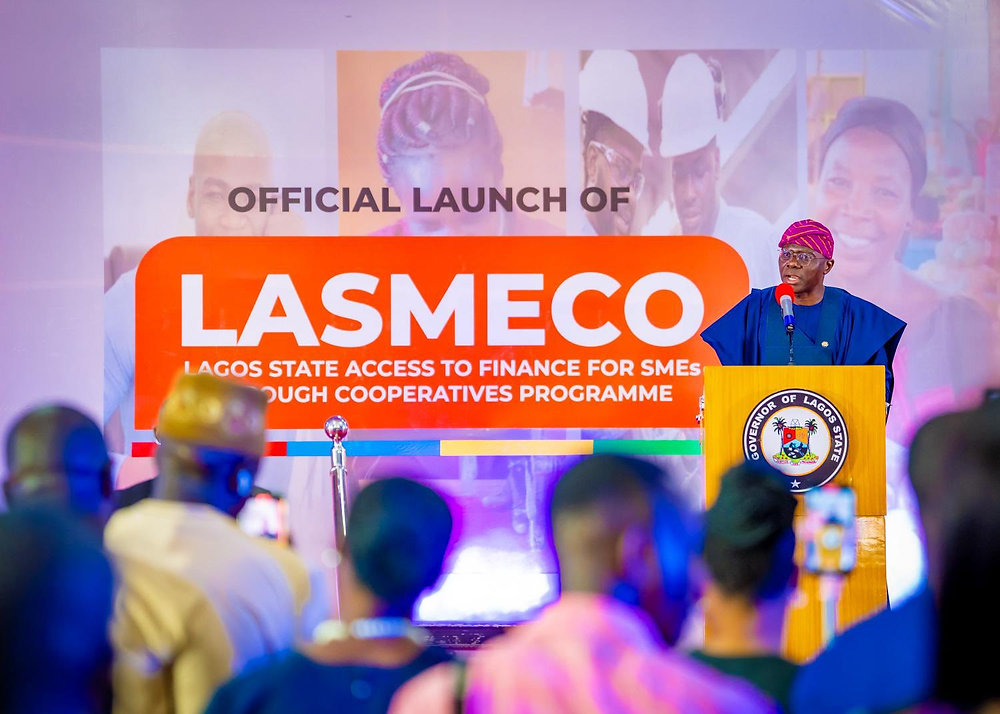
The Lagos State Government has signed agreements with 19 accelerators to implement the N10 billion Lagos State Micro Enterprise Support Initiative (LASMECO), a cooperative-based financing intervention targeted at Micro, Small and Medium Enterprises across the state.
The signing ceremony, held recently at the Ministry of Commerce, Cooperatives, Trade and Investment in Alausa, Ikeja, formally commenced the application and processing phase for eligible cooperative societies. The scheme offers single-digit interest financing without collateral requirements.
Commissioner for Commerce, Cooperatives, Trade and Investment, Folashade Ambrose-Medebem, said that the accelerators were selected through a merit-based process focused on competence, innovation, technical capacity, and alignment with the state’s economic agenda. She stated that the selected organisations would provide enterprise support services, monitoring systems, capacity building, accountability frameworks, mentorship, and market access support.
Ambrose-Medebem said the initiative was designed to bridge financing gaps affecting cooperative-based MSMEs, deepen financial inclusion, and strengthen cooperative institutions, while partnership with the Bank of Industry would expand capital access for underserved entrepreneurs. Permanent Secretary of the ministry, Babatunde Onigbanjo, urged stakeholders to ensure measurable economic impact across communities and industries.
DECISION HIGHLIGHT
Lagos State is shifting MSME intervention strategy beyond direct credit disbursement towards a structured enterprise support and cooperative-financing model anchored on accelerator-driven implementation.
DECISION MEMO
The LASMECO framework reflects increasing recognition that access to finance alone rarely guarantees MSME sustainability. By integrating accelerators into programme execution, Lagos State appears to be attempting a more institutionalised intervention structure combining financing with business development support, monitoring, mentorship, and accountability systems.
The cooperative-based approach is strategically significant because it leverages existing social and financial networks to reduce credit exclusion and improve repayment discipline. In an environment where many small businesses remain outside formal banking structures due to collateral constraints, cooperative financing offers an alternative risk-sharing mechanism capable of expanding grassroots economic participation.
The decision to deploy accelerators also signals awareness that MSME interventions often fail because of weak post-disbursement oversight, poor enterprise capacity, and limited market integration. The state is effectively outsourcing part of the programme’s technical execution to organisations expected to provide operational discipline and performance tracking.
The partnership with the Bank of Industry further suggests an attempt to align state-level enterprise support with broader development finance infrastructure. If effectively coordinated, the programme could strengthen credit access for small businesses while improving formalisation and financial inclusion outcomes.
However, implementation risk remains substantial. Nigeria’s MSME intervention landscape has historically been weakened by politicised beneficiary selection, weak repayment culture, fragmented monitoring systems, and limited long-term scalability. The absence of collateral requirements may improve inclusion but could also increase default exposure if enterprise support mechanisms fail to sustain business viability.
The initiative’s long-term credibility will therefore depend less on the size of the fund and more on measurable business survival rates, repayment performance, employment generation, and the operational quality of the accelerator network.
DATA BOX
- Intervention fund size: N10 billion
- Programme: Lagos State Micro Enterprise Support Initiative (LASMECO)
- Number of accelerators engaged: 19
- Financing structure: Single-digit interest, non-collateral loans
- Target beneficiaries: Cooperative-based MSMEs
- Implementation location: Alausa, Ikeja, Lagos
- Strategic partners referenced: Bank of Industry
- Support structure: Financing, mentorship, market access, enterprise development, monitoring
WHO WINS / WHO LOSES
Potential winners:
- Cooperative-based MSMEs lacking collateral access
- Women and youth entrepreneurs
- Enterprise accelerators and business support providers
- Informal businesses transitioning into structured financing systems
- Communities benefiting from MSME-driven employment growth
Potential losers:
- Weak enterprises unable to sustain repayment performance
- Financial institutions dependent on traditional collateral-based lending models
- Taxpayers if implementation oversight weakens and defaults rise significantly
POLICY SIGNALS
The initiative signals stronger subnational focus on MSME-led economic expansion, financial inclusion, and employment generation through blended development finance structures. It also reflects growing policy preference for cooperative and ecosystem-based financing interventions rather than isolated credit schemes.
INVESTOR SIGNAL
The programme may improve perceptions of Lagos as a commercially active subnational economy prioritising grassroots enterprise development and structured MSME financing. Effective implementation could strengthen confidence in cooperative financing models and development-focused enterprise ecosystems.
RISK RADAR
Key risks include weak loan recovery mechanisms, politicised beneficiary selection, inconsistent monitoring, operational inefficiencies among accelerators, and limited scalability beyond the initial funding cycle. There is also execution risk if non-collateral lending expands faster than enterprise support capacity and repayment enforcement systems.
Discover more from StakeBridge Media
Subscribe to get the latest posts sent to your email.