

By Kingsley Ani
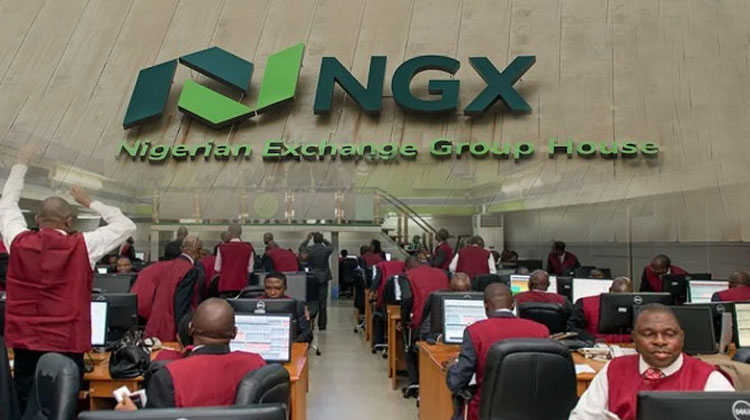
The Nigerian Exchange (NGX) closed the trading week with strong bullish momentum as investors increased exposure to industrial, premium and growth-oriented equities, driving key market indicators higher. The NGX All-Share Index advanced 2.27 percent to 250,330.92 basis points, while market capitalisation rose 2.13 percent to N160.444 trillion.
The NGX Industrial Goods Index led sectoral performance with a 4.66 percent gain, followed by the NGX Premium Index at 4.39 percent. The NGX Growth Index surged 20.83 percent, signalling aggressive positioning in high-risk, high-return counters.
Trading activity strengthened, with investors exchanging 7.772 billion shares valued at N374.040 billion in 402,945 deals, compared with 7.075 billion shares worth N324.351 billion in 474,436 deals recorded in the previous week.
The financial services sector dominated market activity with 4.774 billion shares valued at N196.352 billion, accounting for 61.43 percent of traded volume and 52.49 percent of traded value. FirstHoldCo Plc, United Bank for Africa Plc and Chams Holding Company Plc jointly accounted for 2.195 billion shares worth N99.820 billion.
However, the NGX Oil and Gas Index declined 1.19 percent, while the NGX Sovereign Bond Index and NGX Commodity Index fell 0.08 percent and 0.80 percent respectively.
DECISION HIGHLIGHT
The rally indicates renewed domestic risk appetite in equities despite lingering macroeconomic pressures, with investors rotating toward industrial production, financial intermediation and speculative growth assets rather than defensive commodity-linked positions.
DECISION MEMO
The week’s performance suggests the Nigerian equities market is increasingly being driven by liquidity concentration and sector rotation rather than broad macroeconomic confidence. Investors appeared to favour sectors perceived as immediate beneficiaries of exchange rate repricing, infrastructure activity and banking sector liquidity.
The sharp rise in the NGX Growth Index reflects speculative momentum returning to smaller-cap and high-volatility counters, while gains in industrial goods stocks indicate expectations of stronger pricing power and infrastructure-linked demand. The simultaneous strength in the NGX Premium Index shows that institutional investors largely remained within fundamentally stronger large-cap names even as speculative activity intensified elsewhere.
Financial services dominance also reinforces the centrality of banks and financial intermediaries in Nigeria’s capital market structure. Elevated trading volumes in FirstHoldCo Plc and United Bank for Africa Plc indicate continued positioning around banking recapitalisation expectations, treasury income resilience and potential balance sheet expansion under a high-interest-rate environment.
Conversely, weakness in oil and gas equities despite improved macro sentiment suggests investors remain cautious about regulatory uncertainty, operational costs and earnings sustainability within the downstream and upstream energy segments. The decline in sovereign bond indices also signals that some capital may be rotating from fixed income instruments into equities in search of stronger nominal returns.
The rally therefore reflects selective confidence, not universal optimism. Investors are rewarding liquidity, pricing power and speculative upside while remaining cautious toward sectors exposed to regulatory, commodity or policy volatility.
DATA BOX
- NGX All-Share Index: +2.27 percent
- Closing index level: 250,330.92 basis points
- Market capitalisation: N160.444 trillion
- Market capitalisation growth: +2.13 percent
- NGX Industrial Goods Index: +4.66 percent
- NGX Premium Index: +4.39 percent
- NGX Growth Index: +20.83 percent
- Total shares traded: 7.772 billion
- Total trade value: N374.040 billion
- Total deals executed: 402,945
- Financial services sector share of market volume: 61.43 percent
- Financial services sector share of market value: 52.49 percent
- Most active equities: FirstHoldCo Plc, United Bank for Africa Plc, Chams Holding Company Plc
- Best-performing stock: Berger Paints Plc (+55.57 percent)
- Worst-performing stock: Zichis Agro Allied Industries (-11.78 percent)
- Market breadth: 74 gainers, 24 losers, 48 unchanged
WHO WINS / WHO LOSES
Who Wins
- Industrial and infrastructure-linked companies
- Premium board equities attracting institutional flows
- Banking and financial services firms benefiting from liquidity concentration
- Speculative growth stocks attracting momentum traders
- Active retail investors exploiting volatility-driven gains
Who Loses
- Oil and gas equities facing weaker investor sentiment
- Fixed income instruments competing against rising equity returns
- Commodity-linked counters under pressure from weaker positioning
- Defensive investors excluded from speculative market upside
POLICY SIGNALS
- Domestic liquidity remains sufficiently strong to support equity market expansion
- Banking sector reforms and recapitalisation expectations continue influencing investor positioning
- Equity investors are increasingly favouring inflation-pass-through sectors with pricing flexibility
- Risk capital is gradually shifting away from purely defensive fixed-income allocations
INVESTOR SIGNAL
The rally reinforces perceptions that Nigerian equities remain one of the few domestic asset classes capable of delivering inflation-beating nominal returns. Institutional and retail investors appear increasingly willing to absorb short-term volatility in exchange for exposure to banking, industrial and growth-driven earnings expansion. Market breadth and transaction value also indicate improving participation depth.
RISK RADAR
- Overheating in speculative growth counters
- Profit-taking risks after rapid price appreciation
- Persistent inflation affecting corporate margins and consumer demand
- Monetary tightening pressures on financing costs
- Regulatory uncertainty within oil and gas equities
- Liquidity concentration risks around a limited number of heavily traded stocks
Discover more from StakeBridge Media
Subscribe to get the latest posts sent to your email.