

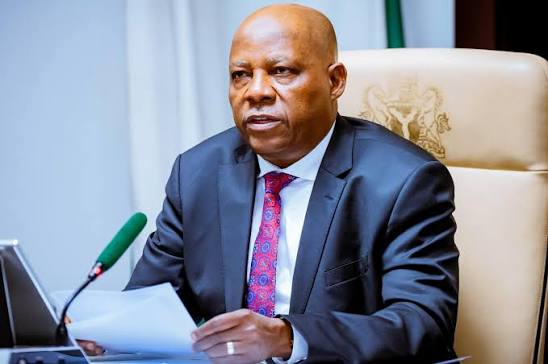
Nigeria’s fiscal reforms and tightening global development financing environment are forcing policymakers to confront a difficult reality: critical social programmes can no longer depend indefinitely on external donors. The decision by the Nutrition 774 Initiative Strategic Board, chaired by Vice President Kashim Shettima, to adopt a domestic financing model for nutrition interventions signals an emerging policy shift from aid dependence to institutional self-financing. With a N500bn nutrition funding gap, declining donor commitments and growing pressure on government to improve human capital outcomes, nutrition is increasingly being repositioned not merely as a health intervention but as an economic investment tied to productivity, workforce quality and long-term national development. Enam Obiosio writes.
Vice President Kashim Shettima, Chairman of the Nutrition 774 Initiative Strategic Board and National Council on Nutrition, has directed the adoption of a domestic financing model as the primary funding architecture for nutrition interventions in Nigeria. At the Second High-Level Strategic Board Meeting of the Nutrition 774 Initiative in Abuja, the board mandated the Federal Ministry of Finance and key stakeholders to activate existing financing instruments, including the Presidential Nutrition Intervention Fund (PNIF) and the ring-fenced Sugar-Sweetened Beverage (SSB) Levy. The board also directed the Nigeria Governors’ Forum (NGF) and the Association of Local Governments of Nigeria (ALGON) to accelerate the inauguration of the remaining State Councils on Nutrition and Local Government Committees on Food and Nutrition. Shettima further called for progress on the proposed National Nutrition Bill and warned that Nigeria must prepare for declining donor support by building sustainable domestic funding mechanisms.
DECISION HIGHLIGHT
Nigeria is attempting to move nutrition financing from a donor-supported framework to a domestically funded governance system anchored on fiscal instruments, legislation and institutional accountability.
DECISION MEMO
The most consequential decision taken by the Nutrition 774 Initiative Strategic Board was not the activation of another government programme. It was the recognition that donor-dependent nutrition financing may no longer be sustainable.
For decades, nutrition interventions across many developing countries have relied heavily on development partners, international agencies and philanthropic organisations. While those partnerships remain important, changing global economic realities are reducing the certainty of long-term external funding.
Nigeria’s response appears to be evolving from programme management to financing reform.
By adopting a domestic financing model, the government is effectively acknowledging that nutrition outcomes must increasingly be funded from within the country’s own fiscal architecture. The significance of this shift extends beyond nutrition policy.
It represents an emerging attempt to link social development directly to economic planning.
Vice President Kashim Shettima made this clear when he stated: “The domestic financing architecture must be activated now, in this administration, within this governance cycle, and under the accountability of this Board.”
The statement transforms nutrition from a welfare discussion into a fiscal governance issue.
The urgency becomes more pronounced when viewed through the lens of human capital development. Unlike infrastructure projects that can be delayed and resumed, nutrition outcomes are highly time-sensitive. Poor nutrition during early childhood often results in irreversible developmental consequences.
Shettima highlighted this reality when he warned: “The first 1,000 days of a child’s life do not wait for memos, circulars, or budget negotiations. While we deliberate, children across this country are within a window of growth that cannot be recovered once lost.”
This observation explains why the administration is increasingly linking nutrition to productivity, education and economic competitiveness rather than limiting it to public health outcomes.
The broader architecture of the initiative also reveals an important governance lesson. The board is not treating nutrition as the responsibility of the health sector alone. Agriculture, Finance, Budget and Economic Planning, Education, Water Resources, Women Affairs, Humanitarian Affairs and Social Protection have all been assigned implementation responsibilities.
This reflects a growing recognition that malnutrition is not merely a food problem. It is an institutional coordination problem.
Agriculture influences food availability. Budget authorities determine funding releases. Education shapes behavioural outcomes. Water and sanitation affect health conditions. Social protection influences household resilience.
Failure in any one of these areas can weaken nutrition outcomes.
The board’s insistence on activating the remaining State Councils on Nutrition and Local Government Committees further underscores the reality that nutrition outcomes are ultimately delivered at the subnational level. National policy may establish direction, but implementation occurs within states, communities and households.
Perhaps the most revealing aspect of the meeting was the treatment of nutrition as an economic variable.
According to Shettima, “The private sector must recognise nutrition as an economic issue, because productivity begins with a healthy body and a capable mind.”
This reframing has significant implications. A malnourished population affects workforce productivity, educational attainment, healthcare costs and long-term economic growth. In effect, nutrition becomes an investment in future labour quality.
The challenge, however, remains financing.
The board acknowledged a N500bn funding gap. Closing that gap will require more than policy declarations. It will require consistent budget releases, operational financing instruments, legislative support and stronger accountability mechanisms.
The proposed National Nutrition Bill therefore becomes a critical component of the architecture. Without legal backing, many of the reforms may remain dependent on administrative goodwill rather than statutory obligation.
The administration’s broader message appears clear: nutrition policy must move beyond advocacy into implementation, and implementation requires money, institutions and accountability.
Whether the strategy succeeds will depend less on the quality of the resolutions adopted and more on the speed with which financing mechanisms are activated and governance structures become functional.
DATA BOX
Financing Metrics
- Estimated nutrition financing gap: N500bn
- Domestic financing model adopted
- Key financing instruments:
- Presidential Nutrition Intervention Fund (PNIF)
- Sugar-Sweetened Beverage Levy ring-fence
Governance Metrics
- Coverage target: 774 Local Government Areas
- Remaining State Councils on Nutrition to be inaugurated: 26
- Remaining Local Government Committees on Food and Nutrition to be established: 304
Policy Instruments
- National Nutrition Bill
- Nutrition 774 Initiative
- National Council on Nutrition
- State Councils on Nutrition
- Local Government Committees on Food and Nutrition
WHO WINS / WHO LOSES
Who Wins
- Children in vulnerable communities
- State governments with functional nutrition structures
- Local governments implementing nutrition interventions
- Healthcare and nutrition service providers
- Human capital development objectives under the Renewed Hope Agenda
Who Loses
- Communities dependent on inconsistent donor-funded programmes
- States delaying nutrition governance reforms
- Households affected by weak service delivery systems
- Institutions that fail to align funding with implementation responsibilities
POLICY SIGNALS
- Nigeria is preparing for a future of reduced donor dependence.
- Human capital development is becoming a central economic policy objective.
- Nutrition is being repositioned from a health issue to a productivity issue.
- Dedicated financing mechanisms are emerging as preferred funding channels.
- Greater accountability is being transferred to states and local governments.
INVESTOR SIGNAL
The creation of domestic nutrition financing mechanisms could stimulate opportunities across food fortification, agricultural value chains, nutrition products, healthcare delivery, maternal and child health services, educational feeding programmes and social impact investments. It also signals growing government interest in measurable human capital outcomes.
RISK RADAR
- Delays in activating financing instruments.
- Insufficient budget releases despite appropriations.
- Legislative delays affecting the National Nutrition Bill.
- Weak subnational implementation capacity.
- Continued reliance on fragmented interventions.
- Economic pressures limiting government funding commitments.
- Governance structures existing without operational financing.
Discover more from StakeBridge Media
Subscribe to get the latest posts sent to your email.