

By Enam Obiosio
Whenever I think about the future of Nigeria’s economy, I return to one simple reality: no country achieves sustainable prosperity without a thriving small business sector. Governments can formulate policies, central banks can manage monetary conditions, and large corporations can attract investment, but the real engine of economic expansion remains the millions of entrepreneurs who create jobs, generate income and keep commerce moving. That is why I find the latest Mastercard SME Confidence Index both encouraging and instructive. It provides a rare glimpse into how Nigerian entrepreneurs see their future and, more importantly, what they believe will get them there.
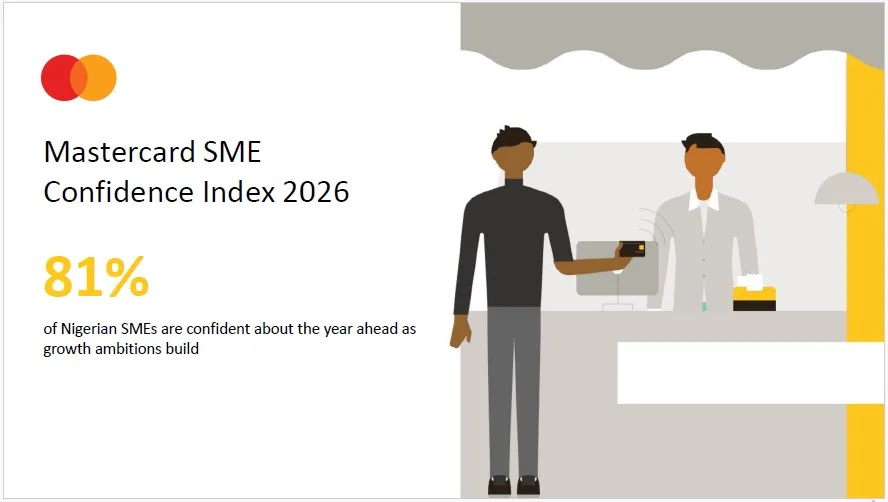
The headline statistic is impossible to ignore. About 81 percent of Nigerian SMEs are confident about the next 12 months. In a business environment still grappling with inflationary pressures, financing constraints and elevated operating costs, such confidence is not a trivial finding. It suggests that beneath the noise of macroeconomic challenges, many entrepreneurs see opportunities that outweigh the risks. More significantly, 68 percent expect revenue growth in the coming year. This optimism is not detached from reality. It is rooted in experience. More than half of SMEs surveyed, 56 percent, reported revenue growth over the past year, indicating that confidence is being supported by actual business performance.
What I find most revealing, however, is the complete consensus around digital payments. According to the survey, 100 percent of Nigerian SMEs agree that digital and online payments are vital to growing their businesses. It is rare to find unanimous agreement on any issue within the business community. When every respondent identifies the same factor as critical to growth, policymakers and investors should pay attention. To me, this finding confirms that digital payments are no longer merely a convenience. They have become essential business infrastructure.
For decades, Nigerian commerce relied heavily on cash transactions. While cash remains important, it has limitations. It restricts market reach, complicates record-keeping, increases security risks and often limits access to formal financial services. Digital payments solve many of these problems. They make transactions faster, safer and more transparent. More importantly, they connect businesses to a larger economy. A merchant in Aba can sell to a customer in Abuja. A fashion entrepreneur in Lagos can receive payments from buyers across Africa. A technology startup in Enugu can serve clients globally. Digital payments remove geographical barriers and expand commercial possibilities.
This is where Mastercard’s role becomes increasingly significant. I do not see Mastercard merely as a payment company. I see it as part of the infrastructure supporting Nigeria’s transition towards a more digitised economy. The company’s focus on payment acceptance, digital commerce and financial inclusion aligns closely with the needs identified by entrepreneurs themselves. The survey shows that mobile payment adoption among SMEs stands at 67 percent, card acceptance at 45 percent and online payments at 42 percent. Meanwhile, 57 percent of businesses now operate through both physical and online channels. These figures indicate that digitisation is already underway. The challenge is no longer whether businesses will embrace digital tools. The challenge is how quickly the remaining gaps can be closed.
I am particularly impressed by Mastercard’s efforts to lower barriers to digital adoption. Many Nigerian SMEs operate with limited resources. They cannot always afford expensive point-of-sale infrastructure or sophisticated payment systems. Solutions such as Tap on Phone, QR Pay-by-Link and SME-in-a-Box directly address this challenge by allowing merchants to accept payments using devices they already own. This approach matters because technology adoption often depends less on innovation and more on affordability. The easier and cheaper it becomes for businesses to accept digital payments, the faster adoption will occur.
The survey also reveals something important about the mindset of Nigerian entrepreneurs. Their priorities are remarkably strategic. Seventy-nine percent identify training and upskilling staff as a major growth priority. Seventy-eight percent want to digitise their businesses. Seventy-three percent see value in accepting digital payments across multiple channels. These are not the priorities of businesses merely trying to survive another year. They are the priorities of businesses preparing for long-term competitiveness. They reflect a growing recognition that sustainable growth depends on people, technology and operational efficiency.
I believe this mindset is one of the most encouraging aspects of the report. Successful economies are not built solely on entrepreneurship. They are built on productive entrepreneurship. There is a difference. Productive entrepreneurs invest in skills, systems, technology and innovation. They focus on scalability and sustainability rather than short-term gains. The Mastercard findings suggest many Nigerian SMEs are moving in that direction.
Yet ambition alone is not enough. Businesses also need capital. This brings me to what may be the most important statistic in the entire report. Sixty-nine percent of SMEs are seeking credit to grow their businesses. That figure tells a story that every banker, investor and policymaker should understand. Nigerian entrepreneurs want to expand. They want to hire workers, purchase equipment, increase inventory and enter new markets. What often stands in their way is access to finance.
The survey reveals another important detail. Sixty-three percent of SMEs currently use personal cards for business spending because they are convenient and accessible. While this demonstrates entrepreneurial adaptability, it also highlights a weakness in the financial ecosystem. Business owners are often forced to blur the line between personal and commercial finance because dedicated business financing solutions remain insufficient. This is where Mastercard’s emphasis on commercial cards and structured credit solutions becomes particularly relevant.
I believe one of the most transformative developments in SME financing will be the integration of payment data into credit assessment. Digital transactions create records. Records create visibility. Visibility improves risk assessment. Improved risk assessment increases lending confidence. In other words, every digital payment potentially contributes to a future credit profile. Businesses that operate digitally become easier to finance because lenders can better understand their performance. This is why digital payments should be viewed not only as transaction tools but also as gateways to capital.
The report also demonstrates that Nigerian entrepreneurs understand growth requires more than finance and technology. Sixty percent identified stronger physical and digital security as a critical business enabler, while 52 percent highlighted mentorship and advisory support. I find this particularly insightful because it reflects a holistic understanding of enterprise development. Businesses do not succeed because they receive funding alone. They succeed when funding is combined with knowledge, security, operational efficiency and strategic guidance.
Mastercard appears to recognise this reality. Beyond payment solutions, the company is investing in broader ecosystem development. Through initiatives such as Start Path and Product Express, it is supporting local fintech innovation and helping entrepreneurs develop new financial products. This approach acknowledges an important truth. No single institution can solve the challenges facing SMEs. Sustainable progress requires collaboration among payment providers, banks, fintech firms, regulators and development partners. Mastercard’s partnership-oriented model reflects this understanding.
I am equally encouraged by the company’s emphasis on cybersecurity. As more businesses adopt digital tools, trust becomes indispensable. Entrepreneurs will only embrace digital systems if they believe their transactions and customer data are secure. Mastercard’s investment in tokenisation and its Trust Center resources addresses a concern that often slows digital adoption. Security is not a peripheral issue. It is a prerequisite for confidence in the digital economy.
Ultimately, what stands out to me about the Mastercard SME Confidence Index is not simply the optimism it records. It is the clarity it reveals. Nigerian entrepreneurs know what they need. They need digital payments. They need access to capital. They need training and technology. They need security and advisory support. Most importantly, they need institutions willing to help them access these tools at scale.
The findings suggest Mastercard understands this opportunity. Gabriel Swanepoel, Division President for Africa at Mastercard, noted that Nigerian entrepreneurs represent one of the most ambitious SME communities anywhere in the world. I agree. The evidence supports that conclusion. What impresses me even more is that this ambition is increasingly matched by practical action. Businesses are digitising. They are seeking training. They are adopting new payment channels. They are looking for growth capital.
Nigeria’s economic future will not be determined solely by government budgets, oil production figures or foreign investment announcements. It will be shaped by the success of millions of small businesses. Every SME that expands creates jobs. Every entrepreneur that gains access to finance generates economic activity. Every merchant that adopts digital payments strengthens the formal economy. Every business that invests in skills improves national productivity.
For these reasons, I believe Mastercard’s strategy deserves attention. The company is not simply facilitating transactions. It is helping to build the infrastructure through which entrepreneurial ambition can become economic reality. If Nigeria’s SMEs continue on their current trajectory and if institutions like Mastercard continue providing the tools, partnerships and financial solutions they require, the next chapter of Nigeria’s growth story may well be written not by large corporations, but by the entrepreneurs who power the nation’s economy every day.
Discover more from StakeBridge Media
Subscribe to get the latest posts sent to your email.