

By Jennete Ugo Anya
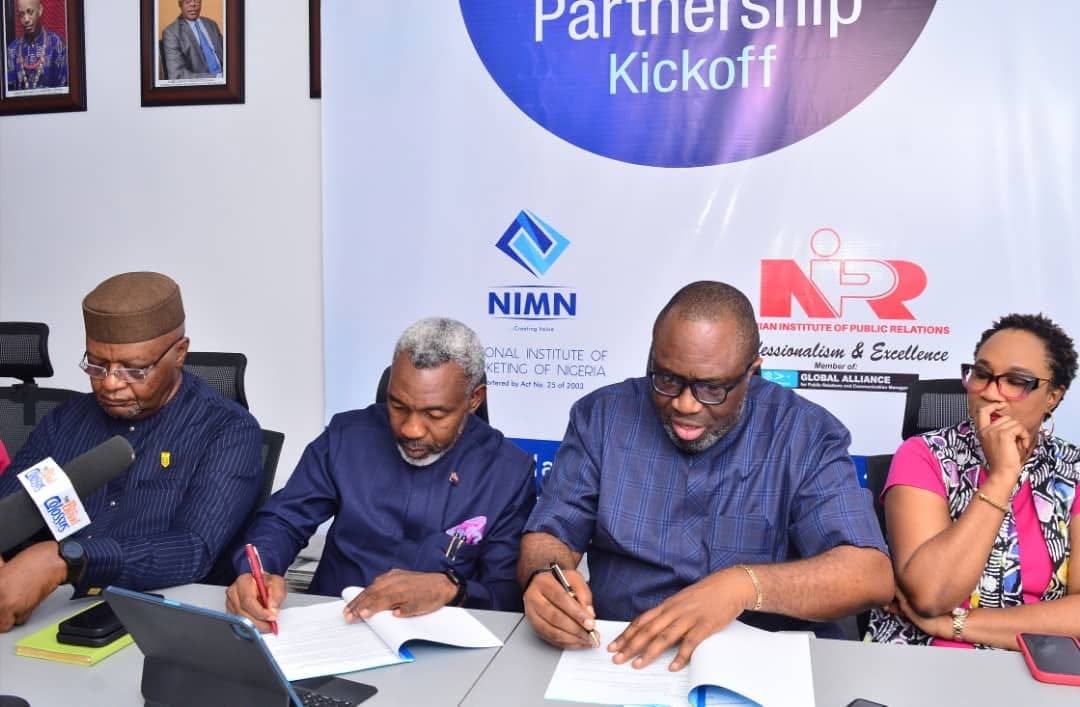
The Nigerian Institute of Public Relations (NIPR) has formalised partnerships with the Advertising Regulatory Council of Nigeria (ARCON) and the National Institute of Marketing of Nigeria (NIMN) through memoranda of understanding (MoU) designed to strengthen professional standards, regulatory compliance and cross-disciplinary collaboration.
DEVELOPMENT
The agreements establish frameworks for reciprocal professional membership, corporate registration, capacity building and joint enforcement of professional regulations across Nigeria’s public relations, advertising and marketing industries.
The NIPR-ARCON memorandum, signed in January 2025, brings together the public relations regulator and the advertising regulator. The NIPR-NIMN memorandum, dated November 1, 2024, establishes a similar framework between public relations and marketing professionals.
Under both agreements, members of one institute may pursue membership of the other, subject to specified qualifications, professional experience and programme requirements. The partnerships also provide for corporate membership, honorary fellowship, reciprocal exemptions for holders of professional certificates, information sharing and joint membership enforcement.
The agreements were signed by Dr Ike M. Neliaku, President and Chairman of Council of NIPR; Dr Olalekan Fadolapo, Director-General and Chief Executive of ARCON; and Mr Idorenyen Enang, President and Chairman of Council of NIMN, for their respective institutions.
DATA
The two memoranda establish three principal areas of professional cooperation:
- Reciprocal membership: Eligible practitioners can pursue membership of partner institutes under agreed conditions.
- Professional development: The agreements provide for fast-track programmes, capacity building and access to professional resource persons.
- Regulatory compliance: The institutes commit to collaboration on membership registration and enforcement of applicable professional requirements.
The NIPR-ARCON agreement specifies a minimum of five years’ practical advertising experience for public relations practitioners seeking ARCON Associate membership through its direct membership programme. It also identifies exemptions and prescribed professional diploma subjects for eligible applicants.
The NIPR-NIMN agreement provides membership pathways based on five, 10 and 15 years of practical experience, with corresponding programmes leading to Associate, Full and Fellow membership, subject to the stated conditions.
DECISION HIGHLIGHT
NIPR is using institutional partnerships to connect professional regulation with broader industry collaboration, creating structured routes for practitioners to acquire complementary qualifications while encouraging compliance with the rules governing their respective professions.
DECISION MEMO
The strategic importance of the agreements lies in their attempt to address the professional boundaries separating public relations, advertising and marketing. Although the disciplines have distinct responsibilities, they frequently converge in corporate communications, brand management, campaign planning, reputation management and stakeholder engagement.
The reciprocal membership provisions could reduce barriers to professional mobility and encourage practitioners to develop competencies beyond their primary disciplines. For agencies operating across integrated marketing communications, the arrangements may also provide a clearer pathway for building multidisciplinary teams with recognised professional credentials.
However, the agreements distinguish between reciprocal membership and automatic professional qualification. Applicants must satisfy the relevant experience, examination, programme and membership conditions. The memoranda therefore do not establish unrestricted admission into either institute.
Their practical value will depend on implementation, particularly the consistency of registration procedures, enforcement activities, capacity-building programmes and the administration of applicable fees. Both agreements provide for mutually agreed charges, while each party bears the cost of fulfilling its own obligations.
The NIPR-NIMN memorandum states that it will remain in force for 10 years, subject to its provisions on termination and renewal. The NIPR-ARCON agreement remains in force until terminated by either or both parties, with six months’ written notice required under its termination clause.
For the wider communications industry, the agreements offer an institutional basis for stronger professional coordination. Their effectiveness, however, will ultimately be measured by improved compliance, professional competence and the quality of services delivered to organisations and the public.
WHO WINS / WHO LOSES
Potential winners: Qualified public relations, advertising and marketing practitioners seeking cross-disciplinary membership; eligible organisations pursuing corporate membership; and employers requiring professionals with complementary skills.
Potential pressure points: Practitioners who do not meet the prescribed eligibility conditions, as well as institutions responsible for administering the programmes, harmonising procedures and sustaining effective enforcement.
POLICY SIGNALS
The agreements indicate a preference for collaboration between professional bodies as a means of strengthening standards, improving regulatory compliance and building capacity. They also establish a framework for information sharing and the pooling of professional expertise.
INVESTOR SIGNAL
For communications agencies, corporate organisations and businesses purchasing professional services, stronger coordination among the institutes could improve confidence in professional credentials and service standards. However, the agreements alone do not establish measurable improvements in market performance, client outcomes or industry revenue.
RISK RADAR
The principal implementation risks include inconsistent interpretation of eligibility requirements, administrative delays, unclear fee arrangements and weak follow-through on joint enforcement commitments. Sustained coordination and transparent implementation will be necessary to translate the memoranda into practical industry benefits.
Jennete Ugo Anya is a journalist and researcher with interests across Nigeria’s economy, public policy, business, MSMEs, development and strategic communications, Foreign direct investments, development finance institutions.
Discover more from StakeBridge Media
Subscribe to get the latest posts sent to your email.