

By Hannah Yemisi
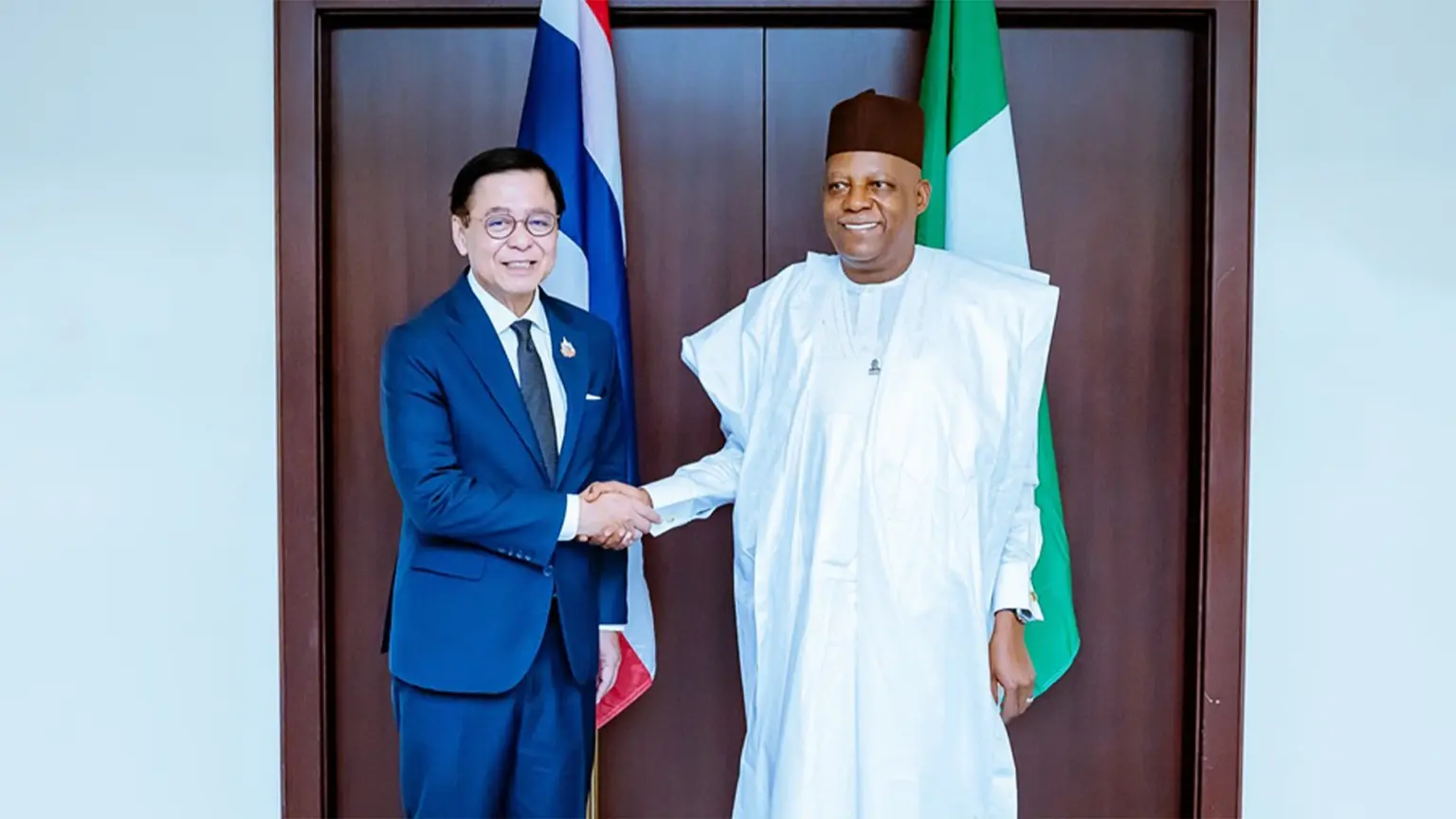
Vice President Kashim Shettima has called for a strategic review of Nigeria’s bilateral relationship with Thailand, seeking deeper cooperation in technology, agriculture, commerce, renewable energy and solid minerals. He made the call recently at the Presidential Villa, Abuja, while receiving a Thai delegation led by Deputy Prime Minister and Foreign Affairs Minister Yousef Hassan Khalawi. Khalawi described Nigeria as a strategic partner and proposed a Thailand-Africa Initiative to expand economic cooperation, business relations and people-to-people ties between Thailand and key African economies.
DECISION HIGHLIGHT
The proposed reset would move Nigeria-Thailand relations beyond established trade links, particularly crude oil and rice, towards sectors capable of supporting investment, technology transfer and economic diversification. Thailand’s positioning of Nigeria as a gateway to West Africa adds a regional-market dimension to the proposed partnership.
DECISION MEMO
The emerging Nigeria-Thailand framework reflects an attempt to convert a conventional bilateral relationship into a broader economic partnership. The emphasis on technology, renewable energy, agriculture and solid minerals is significant because these sectors connect Nigeria’s resource and consumer-market advantages with Thailand’s proposed expansion of commercial ties across Africa.
Shettima’s argument rests partly on Nigeria’s scale. Its large consumer market, young population and natural-resource base provide potential demand and investment opportunities, but converting those advantages into bilateral commerce requires partnerships that move beyond commodity exchange.
The proposed Thailand-Africa Initiative could provide that wider framework. Khalawi’s description of Nigeria as an important gateway to Africa, particularly West Africa, suggests that Thailand sees the relationship not only through the Nigerian market but also through its regional commercial reach.
The technology component is particularly consequential. Greater Thai-Nigerian engagement in information and communications technology and renewable energy could support diversification while creating channels for technology, expertise and capital to enter emerging sectors.
Agriculture and commerce provide more immediate areas for expanded trade, while solid minerals and renewable energy offer longer-term investment possibilities. However, the material does not specify investment commitments, financing arrangements or implementation timelines.
The central policy challenge is therefore execution. A strategic review can broaden the scope of bilateral relations, but its economic significance will depend on whether the proposed sectors generate identifiable projects, investment flows, technology transfer and measurable trade expansion.
DATA BOX
- Bilateral partners: Nigeria and Thailand
- Nigerian representative: Vice President Kashim Shettima
- Thai representative: Deputy Prime Minister and Foreign Affairs Minister Yousef Hassan Khalawi
- Location: Presidential Villa, Abuja
- Priority sectors: Technology, agriculture, commerce, renewable energy and solid minerals
- Proposed framework: Thailand-Africa Initiative
- Regional focus: Africa, particularly West Africa
- Existing relationship referenced: Crude oil and rice production
WHO WINS / WHO LOSES
Potential winners: Nigerian businesses, Thai investors, technology and renewable-energy firms, agricultural enterprises and solid-mineral operators if the proposed cooperation produces investment and market access.
Potential losers: Existing commodity-centred trade relationships could lose relative importance as bilateral engagement shifts towards higher-value and technology-linked sectors.
POLICY SIGNALS
Nigeria is signalling a preference for bilateral economic relationships that support diversification, investment and technology transfer rather than remaining concentrated in traditional commodity trade.
INVESTOR SIGNAL
Thailand’s identification of Nigeria as a gateway to West Africa potentially strengthens Nigeria’s proposition as a regional investment base. The immediate signal is strategic interest rather than committed capital, since no specific investment values or projects were announced.
RISK RADAR
The main risk is implementation. Without defined projects, financing mechanisms, timelines and institutional responsibilities, the proposed strategic reset could remain diplomatic positioning rather than translate into deeper economic integration.
Discover more from StakeBridge Media
Subscribe to get the latest posts sent to your email.