

By Johnson Emmanuel
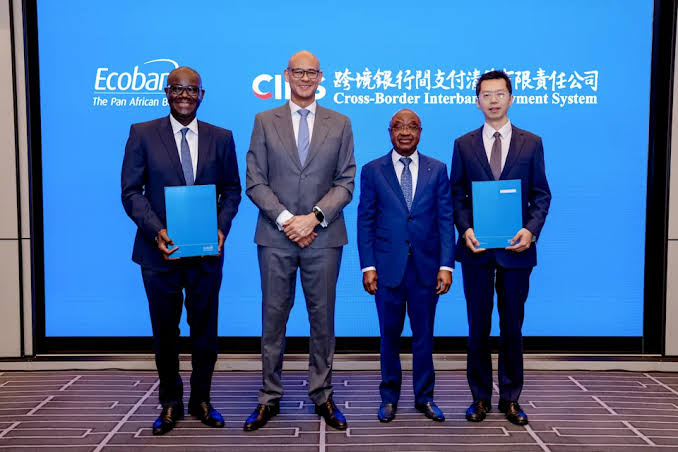
Ecobank Group has signed a Memorandum of Understanding (MoU) with China’s Cross-Border Interbank Payment System (CIPS) to strengthen renminbi (RMB) payment and clearing connectivity between China and Africa. The agreement was signed during the official visit to China by Faure Gnassingbé, President of the Council of the Republic of Togo, in the presence of Togo’s Minister of Finance and Budget. The partnership supports Ecobank’s strategy to connect Chinese businesses with its banking network across 34 African markets as China-Africa trade, valued at approximately $348 billion in 2025, increases demand for efficient cross-border settlements.
DECISION HIGHLIGHT
The partnership targets a critical trade constraint: payment connectivity. Its commercial value will depend on whether improved RMB settlement translates into lower transaction friction and greater access for businesses across African markets.
DECISION MEMO
Ecobank’s agreement with CIPS strengthens the financial infrastructure supporting China-Africa commerce. By connecting China’s RMB payment ecosystem with Ecobank’s pan-African network, the collaboration is intended to simplify payments, reduce settlement complexity and improve cross-border access for importers, exporters and investors.
Group Chief Executive Officer of Ecobank, Jeremy Awori said: “As trade relationships deepen and investment flows increase, supporting financial infrastructure must evolve accordingly.”
He stated: “Our partnership with CIPS strengthens the connectivity between China’s RMB payment ecosystem and Ecobank’s extensive African network. It enhances our ability to support importers, exporters and businesses seeking to operate across Africa and China more efficiently and with greater confidence. Ultimately, our objective is to make Africa more accessible for businesses operating from China while helping African companies engage more effectively with Chinese markets.”
The agreement builds on Ecobank’s presence in China since 2012, including its Beijing office and dedicated Chinese Desks across West, Central and East Africa. These provide local expertise and services covering trade finance, payments, cash management and cross-border investment.
The partnership also complements Ecobank’s cooperation with Bank of China in Mauritius and payment platforms XTransfer, YeePay and WorldFirst. Together, these relationships indicate a strategy to strengthen the financial channels supporting trade and investment.
However, connectivity alone does not guarantee cheaper transactions, faster settlement or wider access to finance. Those outcomes will depend on implementation, service pricing, regulatory requirements and adoption by businesses. The agreement’s significance will therefore be measured by its practical effect on cross-border commerce, rather than the partnership announcement alone.
DATA BOX
- China-Africa trade: Approximately $348 billion in 2025.
- Ecobank network: 34 African markets.
- Ecobank’s China presence: Since 2012.
- Core mechanism: RMB payment and clearing connectivity through CIPS.
- Services supported: Payments, trade finance, cash management and cross-border investment.
- Related partnerships: Bank of China, XTransfer, YeePay and WorldFirst.
WHO WINS / WHO LOSES
Potential winners: Importers, exporters, financial institutions and investors seeking more accessible China-Africa payment channels.
Potential losers: Businesses may see limited benefits if transaction costs, compliance requirements or settlement barriers remain high despite improved connectivity.
POLICY SIGNALS
The agreement highlights the importance of interoperable payment infrastructure and regulatory coordination in supporting Africa’s trade diversification and financial integration.
INVESTOR SIGNAL
Stronger RMB connectivity could support trade-related banking activity and facilitate commercial engagement between Chinese businesses and African markets. The scale of the opportunity will depend on transaction volumes, pricing and actual business adoption.
RISK RADAR
Key risks include implementation delays, regulatory differences, currency exposure, compliance costs and limited uptake. The central test is whether the partnership delivers measurable improvements in settlement efficiency and business access.
Johnson Emmanuel is a journalist, covering business, investment, monetary & fiscal policies, CBN, economic affairs and issues of significance to Nigeria’s corporate and public sectors.
Discover more from StakeBridge Media
Subscribe to get the latest posts sent to your email.