

By Kingsley Ani
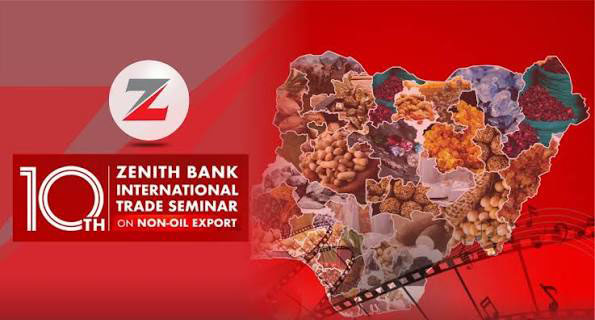
Zenith Bank Plc used its 10th International Trade Seminar on Non-Oil Export, held virtually on 25 August 2026, to advance a policy and financing framework for scaling Nigeria’s non-oil exports through value addition, trade infrastructure, market access and structured finance. Group Managing Director/Chief Executive Officer of Zenith Bank, Dame Dr Adaora Umeoji, said that the objective was to convert rising export volumes into sustainable economic value, while Minister of Industry, Trade and Investment, Dr Jumoke Oduwole, and other policymakers and business leaders focused on processing, competitiveness and access to African markets.
DECISION HIGHLIGHT
The seminar’s underlying proposition is that Nigeria’s export challenge has shifted from increasing volumes to retaining more economic value domestically. The record $6.1 billion in non-oil exports in 2025 provides evidence of expansion, but the speakers broadly identified processing, manufacturing, certification, logistics, finance and market access as the constraints determining whether that growth becomes structural industrialisation.
DECISION MEMO
Zenith Bank’s decade-long trade seminar has evolved from an advocacy platform into a discussion of the infrastructure required to make Nigerian exports more competitive. The emphasis on value chains reflects a central weakness in commodity-led trade: export growth can increase foreign-exchange earnings without proportionately expanding domestic industrial capacity.
Umeoji framed the issue around that transition: “Our theme, ‘Unlocking Value and Harnessing Growth’, is not just a slogan. It speaks to the opportunities before us and the need to translate our collective efforts into sustainable economic value.” She noted that non-oil exports rose from $612 million a decade ago to $6.1 billion in 2025, and also said, “it is important that, as a nation, we accelerate growth by creating more value locally and exporting finished products, rather than just raw materials.”
Oduwole sharpened the policy question: “The question before us now is not simply how to export more, but how to retain more value in Nigeria from everything we export.” Her proposed pathway is to “produce more competitively in Nigeria, process more in Nigeria, connect Nigerian businesses to bigger markets”, while ensuring adequate financing, infrastructure and trade systems.
That approach aligns with Professor Benedict Oramah’s broader assessment that Africa must strengthen its internal productive and financial capacity. “The question is whether Africa, and Nigeria within it, can build her own internal demand, participate effectively in global supply chains, build the capacity to finance her own trade and industries, and create her own markets.”
The private-sector case is equally direct. Patricia Poku-Diaby, Plot Enterprise Ghana Limited Founder and Executive Chair, said: “The future of our economy will not be determined simply by what we grow or what we mine, but by what we transform.” Her prescription is to move from raw-material supply towards “producers, processors, manufacturers, exporters and owners of strong African brands.”
The African Continental Free Trade Area (AfCFTA) provides the market architecture for that transition. The Secretary-General of AfCFTA Secretariat, Wamkele Mene, said that the private sector is “at the heart of the fundamental restructuring of Africa’s economy”, adding that the agreement’s success should ultimately be measured by whether businesses can access markets, expand productive capacity and create jobs.
Zenith Bank’s own infrastructure reflects this market-access strategy. Umeoji said that the bank had begun developing the SMARTAfCFTA portal with the AfCFTA Secretariat and integrating with the Pan-African Payment and Settlement System to facilitate cross-border transactions.
DATA BOX
- Non-oil exports, 2025: $6.1bn
- Growth from 2024: 11.5 percent
- Non-oil exports a decade earlier: $612m
- Seminar editions: 10
- Participants: thousands
- Countries represented: 97
- Core value-chain objective: processing, manufacturing and branded exports
- Zenith Bank trade infrastructure: SMARTAfCFTA portal and Pan-African Payment and Settlement System integration
- AfCFTA market: more than 1.4 billion people; approximately $3.4tn GDP
WHO WINS / WHO LOSES
Potential winners: Nigerian manufacturers, processors, exporters, logistics providers and financial institutions able to capture expanding intra-African trade. Producers that successfully move up value chains stand to retain a larger share of export earnings.
Potential losers: Businesses dependent on unprocessed commodity exports face greater competitive pressure as regional markets increasingly favour quality, certification, processing and branding.
POLICY SIGNALS
The policy direction is moving beyond export promotion towards export capability. Customs efficiency, port logistics, certification, trade finance, productivity and AfCFTA implementation are increasingly interconnected components of the competitiveness agenda.
INVESTOR SIGNAL
The opportunity lies in businesses positioned between Nigeria’s resource base and expanding African demand, particularly processors, manufacturers, logistics operators, digital trade platforms and firms with scalable export products. The stronger signal is not simply rising export value, but the potential emergence of deeper domestic and regional value chains.
RISK RADAR
The principal risk is that improved market access outpaces productive capacity. Without reliable infrastructure, competitive financing, certification, logistics and productivity improvements, AfCFTA access could expand the market for imports more quickly than it expands Nigeria’s exports. As Mene noted, the success of AfCFTA will ultimately depend on whether the private sector can “scale their investment and scale their productive capacity to create jobs across the continent.”
Discover more from StakeBridge Media
Subscribe to get the latest posts sent to your email.