

By Johnson Emmanuel
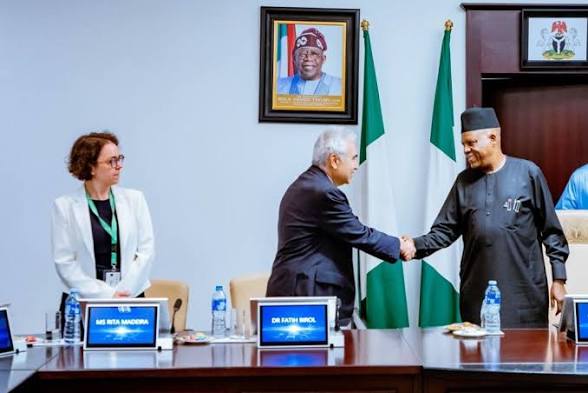
President Bola Ahmed Tinubu’s administration has formalised Nigeria’s strategic energy partnership with the International Energy Agency (IEA) through a Joint Work Programme signed in Abuja recently, creating a framework for cooperation on energy data, policy development and investment across the value chain. Vice President Kashim Shettima, representing Tinubu, said that the agreement would enable Nigeria to draw on the IEA’s institutional knowledge and technical expertise, while IEA Executive Director Fatih Birol said the agency would provide policy advice and technical support across areas including clean cooking, gas markets and expert training.
DECISION HIGHLIGHT
The strategic value of the agreement lies less in institutional affiliation than in its potential to improve the quality of information underpinning Nigeria’s energy decisions. The Joint Work Programme places data development at the centre of policy and investment planning, potentially reducing information gaps that have constrained long-term energy-sector decisions.
DECISION MEMO
Nigeria’s admission as an IEA association country creates a more formal channel for accessing international energy expertise at a time when the country is attempting to expand production, improve energy security and diversify its energy mix.
Shettima described the admission as “a significant milestone for our country”, arguing that it reflects Nigeria’s strategic importance in the global energy landscape and the confidence placed in its commitment to international energy cooperation. He added that “the country will benefit from IEA’s institutional knowledge, the intellectual resources, the reach and expertise to support our nation’s ambitions in this sector.”
The more consequential mechanism, however, is the Joint Work Programme. By focusing on energy data across the value chain, it can connect policy formulation with investment planning, potentially improving the evidence base for decisions covering oil, gas, renewables and emerging technologies.
Birol said the IEA would “accompany the Nigerian energy sector for the next few years to come for a much better energy future”, providing policy advice “from clean cooking to gas markets” and training Nigerian experts.
The arrangement also formalises a relationship that already produced technical cooperation. Director General of the Energy Commission of Nigeria, Mustapha Abdullahi, noted that the commission and IEA had jointly sponsored Nigeria’s last National Energy Master Plan despite the absence of a formal institutional structure.
The implication is that Nigeria is moving from ad hoc technical cooperation towards a defined framework for sustained policy support. Its effectiveness will depend on whether improved data and expertise translate into bankable projects, stronger regulation and measurable improvements in energy access and security.
DATA BOX
- Partnership: Nigeria-IEA Joint Work Programme
- Status: Nigeria admitted as an IEA association country
- Agreement setting: Abuja
- Core focus: Energy data, policy and investment
- Coverage: Energy value chain
- IEA technical reach: Oil, gas, solar, nuclear power, artificial intelligence and electric vehicles
- Proposed support: Policy advice, data, expertise and training
- Existing cooperation: Joint sponsorship of Nigeria’s National Energy Master Plan
WHO WINS / WHO LOSES
Wins: Government agencies gain access to international expertise and data; energy investors potentially gain a stronger policy information base; Nigerian technical professionals gain access to specialised training.
Potential losers: Projects and investment propositions built on weak or fragmented data face greater scrutiny as evidence-based planning becomes more institutionalised.
POLICY SIGNALS
The agreement signals a shift towards evidence-led energy policymaking and stronger integration between energy data, regulation and investment planning. It also reinforces the administration’s stated objective of leveraging Nigeria’s oil, gas and renewable resources while participating in a “fair and just energy transition”.
INVESTOR SIGNAL
For investors, the value is primarily institutional. Better sector data, technical capacity and policy advice can reduce information asymmetry and improve project preparation. The stronger signal will emerge if the partnership produces transparent datasets, credible sector plans and investment frameworks capable of converting Nigeria’s resource base into investable projects.
RISK RADAR
The principal risk is implementation. Institutional cooperation does not automatically produce better investment outcomes. The test will be whether technical advice is absorbed into Nigerian institutions, whether data becomes accessible and reliable, and whether recommendations translate into consistent regulatory and investment decisions.
Discover more from StakeBridge Media
Subscribe to get the latest posts sent to your email.