

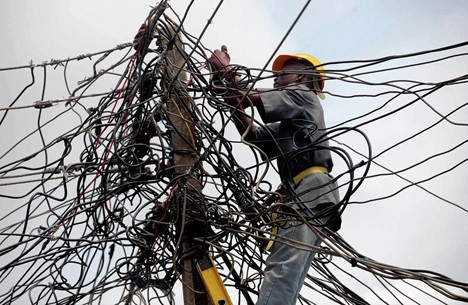
We must be direct, because the situation demands it. Nigeria’s power sector is not merely underperforming, it is failing in ways that are now economically dangerous and socially unsustainable. The federal government must move beyond assurances and urgently fix the structural dysfunction that keeps millions of Nigerians in darkness.
The latest explanation, gas supply constraints, is not new. It is a recurring excuse dressed as a fresh development. When power generation drops below 4,000 megawatts in a country of over 200 million people, we are not dealing with a temporary setback. We are confronting a systemic breakdown.
The Honourable Minister of Power, Adebayo Adelabu, says “concrete measures” are being implemented and that Nigerians will “soon witness the full benefits.” We have heard this language before. We must ask, how soon is soon? And why do these assurances consistently arrive after the system has already deteriorated?
We cannot ignore the numbers. Thermal plants require approximately 1,629.75 million standard cubic feet of gas per day to function optimally. What they receive is less than half of that. At about 692 million cubic feet per day, the deficit is not marginal, it is crippling. This is not a technical fluctuation. It is a supply failure tied directly to unresolved debts, estimated at N3.3 trillion, owed to gas suppliers.
This is where the problem becomes inexcusable.
A power system dependent on gas cannot function if its suppliers are unpaid. We cannot expect continuity of supply in the absence of financial discipline. The federal government cannot continue to manage a sector where obligations are ignored while output is expected. That model has collapsed, and it is collapsing in real time.
We must also reject the framing of this crisis as a transitional inconvenience. Nigerians are being asked, once again, to exercise patience. But patience is not a policy. It is not a solution. It does not power homes, sustain businesses, or protect livelihoods.
Across the country, households are forced to rely on generators at increasingly unsustainable fuel costs. Businesses are absorbing energy expenses that erode margins and reduce competitiveness. Small enterprises are shutting down. Productivity is declining. The broader economy is paying the price for a power system that cannot deliver.
We must state this clearly: Nigeria cannot achieve economic growth, industrial expansion, or digital transformation on an unreliable power foundation. It is not possible. Every sector, manufacturing, technology, services, depends on consistent electricity. Without it, all other reforms are undermined. The federal government must act with urgency on three fronts.
First, the financial impasse in the power value chain must be resolved immediately. The debt owed to gas suppliers is not just a liability, it is the central trigger of the current crisis. Without clearing or restructuring these obligations, supply will remain unstable.
Second, gas-to-power coordination must be treated as a national priority. Power generation cannot be held hostage by fragmented agreements and weak enforcement. There must be a clear, enforceable framework that guarantees supply to generation companies.
Third, infrastructure protection and operational efficiency must be enforced rigorously. It is not enough to classify assets as critical national infrastructure. That classification must translate into real protection, accountability, and uninterrupted operations.
We acknowledge that reforms are underway. We acknowledge that structural changes take time. But we reject the normalisation of failure while reforms are being discussed. Nigerians are not asking for perfection. They are demanding reliability.
This is not a sector that can be fixed gradually while the economy absorbs continuous shocks. It requires decisive intervention, financial discipline, and execution at speed. We must be clear in our conclusion.
Nigeria’s power problem is no longer a technical challenge. It is a governance test. And until it is treated as such, the cycle of promises, breakdowns, and renewed assurances will continue. The time for reassurance has passed. The time for resolution is now.
Discover more from StakeBridge Media
Subscribe to get the latest posts sent to your email.