

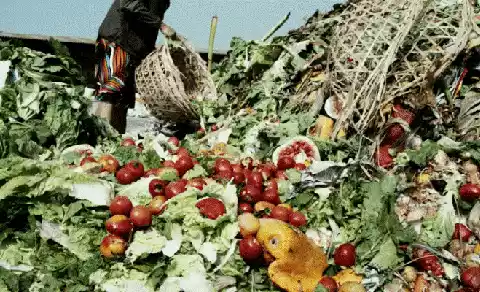
We are not facing a food shortage problem. We are confronting a systems failure of staggering proportions, one that we have normalised for far too long.
When a country wastes 38 million tonnes of food annually, the highest on the African continent, the issue is no longer agricultural productivity. It is structural inefficiency.
We must be clear about what this means. Every tonne of wasted food represents wasted water, wasted energy, wasted labour, and wasted capital. It represents a breakdown between production and consumption, between policy intent and operational reality. It is not just an environmental issue; it is an economic contradiction.
We produce, and we lose. We harvest, and we discard. We invest, and we fail to deliver value. This is not accidental. It is systemic.
Zissimos Vergos, Deputy Ambassador of the European Union Delegation to Nigeria and ECOWAS, did not understate the issue when he described food waste as “a squandering of precious resources” and “a missed opportunity to combat hunger.” He is correct, but we must go further. It is also a failure of coordination, infrastructure, and accountability.
We cannot continue to speak about food insecurity in the same breath as we ignore the scale of waste embedded within our own system. The contradiction is too large to ignore. A country that loses 38 million tonnes of food annually cannot credibly claim that scarcity is its primary challenge. The problem lies elsewhere. It lies in the last mile.
It lies in the absence of storage infrastructure, weak rural road networks, and limited cold chain systems that make it impossible to preserve value between farm and market. It lies in the inability to connect smallholder farmers to processors and structured markets. It lies in a consumption culture that has not internalised the cost of waste. We are not short of food. We are short of systems.
The environmental implications alone should compel urgency. Food waste contributes up to 10 percent of global greenhouse gas emissions and as much as 40 percent of methane emissions. That places Nigeria not just as a domestic outlier, but as a contributor to a global sustainability challenge. But even that framing is incomplete. The deeper issue is economic.
When Amb. Philbert Johnson, Director of the United Nations Industrial Development Organisation Sub-Regional Office in Nigeria, stated that food systems underpin “wealth, health, and security,” he was pointing to something fundamental. Efficient food systems are economic multipliers. Inefficient ones are economic drains.
Nigeria’s current position places it firmly in the latter category. We are bleeding value at scale. And yet, the policy response remains fragmented.
Yes, there are signals of intent. The Circular Economy Roadmap. The Interministerial Circular Economy Committee. Efforts to develop a National Plastic Waste Management Regulation. These are not insignificant steps. They indicate awareness. They indicate direction. But awareness is not execution.
Balarabe Lawal, Minister of Environment, acknowledged that food waste “affects not only our environment, but also our economy and society.” That acknowledgement is important, but it must now translate into measurable outcomes. Because the scale of the problem demands more than statements. It demands system redesign. We must move from reactive interventions to structural correction.
First, infrastructure must be treated as a non-negotiable foundation. Rural roads, storage facilities, and cold chain systems are not optional enhancements, they are core economic assets. Without them, production gains will continue to evaporate before they reach the market.
Second, value addition must be institutionalised. Perishable goods cannot remain at the mercy of weak logistics. Processing capacity must be expanded to convert raw output into shelf-stable products, linking farmers directly to industrial demand.
Third, behavioural change must be engineered, not assumed. Waste reduction cannot rely solely on awareness campaigns. It must be embedded into education systems, pricing structures, and regulatory frameworks. We must also confront a harder truth. Food waste persists because it is not priced correctly.
When waste carries no immediate consequence, it becomes embedded behaviour. Until the cost of inefficiency is internalised across the value chain, from producers to consumers, the system will continue to tolerate loss at scale. This is where policy must become decisive.
We cannot continue to approach this as a peripheral sustainability issue. It is a central economic priority. Every tonne of food saved is value retained. Every inefficiency eliminated is productivity gained. We must therefore reframe the conversation. This is not about reducing waste for environmental optics. It is about recovering economic value, strengthening food security, and improving system efficiency. The data has already made the case.
The question now is whether we are prepared to act with the urgency and discipline that the situation demands. Because if we are not, we will continue to operate an economy where abundance coexists with scarcity, where production coexists with loss, and where potential is consistently undermined by preventable failure. And that is not a food problem. It is a systems problem.
Discover more from StakeBridge Media
Subscribe to get the latest posts sent to your email.