

By Ogbuefi O. Emelike
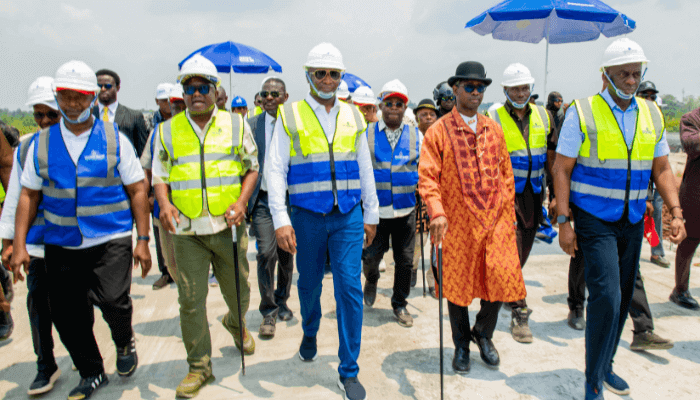
The Niger Delta Development Commission (NDDC) has intensified construction activities on the 1.2-kilometre Kaa-Ataba Bridge linking Khana and Andoni Local Government Areas of Rivers State, with project execution now approaching completion despite earlier disruptions caused by irregular tidal conditions. Speaking at the project site, Engineer Christian Emeozor confirmed that additional manpower, equipment, and mitigation measures had been deployed to fast-track delivery of the multi-billion-naira infrastructure project. The intervention follows recent briefings by Managing Director of the NDDC, Dr. Samuel Ogbuku, to President Bola Ahmed Tinubu on progress recorded across the commission’s legacy infrastructure portfolio. Emeozor stated that the bridge would significantly improve regional mobility, reduce river-crossing risks, and strengthen movement of agricultural produce and commercial goods across adjoining communities.
DECISION HIGHLIGHT
Under Samuel Ogbuku’s leadership, the NDDC appears to be repositioning itself from a historically criticised intervention agency into a delivery-focused regional infrastructure institution centred on visible project execution and strategic connectivity.
DECISION MEMO
The accelerated execution of the Kaa-Ataba Bridge reflects a broader institutional recalibration within the NDDC under Ogbuku’s management framework, where project completion and infrastructure visibility are increasingly becoming instruments of credibility restoration.
For years, the commission’s reputation was weighed down by unfinished projects, fragmented execution patterns, and public scepticism over developmental impact in the Niger Delta. The renewed momentum around the Kaa-Ataba Bridge therefore carries significance beyond transportation infrastructure alone. It functions as a political, institutional, and economic signal that the Commission is attempting to redefine operational outcomes through project continuity and execution discipline.
The bridge itself addresses a long-standing physical disconnect between riverine communities whose economic productivity has historically been constrained by weak transport infrastructure and dependence on risky water crossings. By linking Khana and Andoni more efficiently, the project potentially alters movement patterns for agriculture, trade, labour mobility, and social access within a strategically important coastal corridor.
What distinguishes the current intervention is the commission’s apparent willingness to sustain execution despite environmental and logistical disruptions. Emeozor’s disclosure that tidal conditions slowed material movement reveals the infrastructural realities of building within the Niger Delta’s terrain. Yet the response, increased workforce deployment, equipment scaling, and accelerated site activity, suggests a more aggressive delivery posture than previously associated with the agency.
The project also reinforces Ogbuku’s growing emphasis on legacy infrastructure as measurable governance capital. His direct briefing to President Tinubu on the bridge and other projects reflects an emerging accountability structure in which delivery milestones are being elevated within federal development conversations.
Economically, the Kaa-Ataba Bridge may become one of the more consequential rural connectivity projects within Rivers State if completed within revised timelines. Reduced transportation friction could improve agricultural logistics, lower movement costs, stimulate inter-community commerce, and expand economic participation for previously isolated populations.
More importantly, the project reflects an institutional shift from intervention symbolism towards infrastructure functionality. In practical terms, the NDDC under Ogbuku appears increasingly aware that public legitimacy in the region will now depend less on project announcements and more on visible, completed, and economically useful assets.
DATA BOX
- Project: Kaa-Ataba Bridge
- Executing institution: Niger Delta Development Commission
- Managing Director: Dr Samuel Ogbuku
- Project length: 1.2 kilometres
- Location: Rivers State
- Communities connected: Khana and Andoni Local Government Areas
- Project classification: Multi-billion-naira regional bridge infrastructure
- Key execution challenges identified:
- Irregular tidal waves
- Reduced working hours
- Material movement disruptions
- Mitigation measures introduced:
- Increased manpower
- Additional equipment deployment
- Accelerated site operations
- Expected economic impact:
- Improved transport access
- Reduced river-crossing risks
- Increased movement of farm produce and goods
WHO WINS / WHO LOSES
Riverine communities in Khana and Andoni stand to gain substantially through safer mobility, expanded market access, and lower transportation barriers. Farmers, traders, transport operators, and small businesses dependent on inter-community logistics are also positioned to benefit from improved infrastructure connectivity.
The NDDC leadership may equally gain reputational capital if the bridge is completed within operational expectations, particularly amid long-standing scrutiny surrounding intervention project delivery in the region.
Conversely, informal transport systems and river-crossing operators dependent on existing movement limitations could experience reduced demand once road connectivity becomes fully operational.
POLICY SIGNALS
The project reinforces renewed emphasis on infrastructure-led regional stabilisation within the Niger Delta.
The commission’s accelerated execution strategy suggests increasing federal preference for visible, high-impact connectivity projects capable of producing measurable socio-economic outcomes rather than fragmented intervention spending.
The direct engagement between Ogbuku and President Tinubu also signals stronger alignment between the NDDC’s project pipeline and broader federal infrastructure accountability expectations.
INVESTOR SIGNAL
Improved transportation infrastructure within underserved riverine corridors may gradually strengthen investor confidence in agricultural logistics, regional commerce, and localised infrastructure opportunities across parts of Rivers State.
The bridge also demonstrates that strategic public infrastructure investments remain critical enablers for unlocking economic productivity in difficult terrain markets often neglected by private capital due to accessibility constraints.
For development-focused investors, the project could reinforce perceptions that infrastructure execution discipline within the Niger Delta is becoming more institutionally coordinated under current leadership.
RISK RADAR
Environmental and terrain-related execution risks remain significant given the operational realities of construction within tidal riverine zones.
There is also sustainability risk. Long-term value creation will depend not only on project completion but on maintenance quality, traffic integration, and broader supporting infrastructure around connected communities.
A secondary risk involves public expectation management. Accelerated delivery narratives increase pressure on the NDDC to sustain comparable execution standards across other legacy projects under review.
Discover more from StakeBridge Media
Subscribe to get the latest posts sent to your email.