

By Ovio Peters
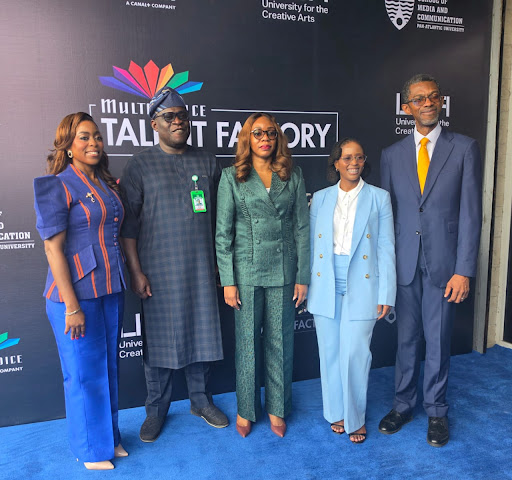
National Film and Video Censors Board (NFVCB) is increasing its engagement with emerging filmmakers through structured industry orientation and talent-development collaboration with the MultiChoice Talent Factory, signalling a broader institutional role in shaping Nollywood’s next generation.
At the NFVCB Lagos office, cohorts from the MultiChoice Talent Factory West Africa programme recently participated in regulatory and classification sessions led in collaboration with Academic Director Atinuke Akoma. The sessions exposed trainees to film-review procedures, age-classification systems, and compliance expectations within Nigeria’s evolving media environment.
The engagement extended to the MultiChoice Talent Factory Class of 2026 graduation ceremony, where Executive Director and Chief Executive Officer (CEO) of the NFVCB, Dr. Shaibu Husseini, urged graduating filmmakers to “Arise, Fly and Shine,” positioning creative professionals as cultural and developmental actors beyond entertainment alone.
DECISION HIGHLIGHT
The NFVCB is shifting from passive regulation toward ecosystem participation and talent-shaping within Nollywood.
DECISION MEMO
The deeper significance of the NFVCB’s engagement lies in the institutional repositioning of regulation itself within Nigeria’s creative economy. Traditionally viewed primarily as a compliance authority, the Board now appears increasingly focused on upstream industry formation rather than downstream content control alone.
By engaging filmmakers during training rather than after production, the regulator is attempting to embed compliance awareness, ethical considerations, and market realities earlier within the creative process. This potentially reduces future friction between creators and regulatory institutions while professionalising production standards.
Dr. Husseini’s emphasis on filmmakers as “nation builders” also reflects the growing policy perception that Nollywood functions not merely as a cultural sector but as a strategic soft-power and economic asset.
The MultiChoice Talent Factory partnership is equally significant. Structured training platforms are becoming increasingly important as Nollywood transitions from informal creativity-driven expansion toward more industrialised production systems requiring technical competence, regulatory understanding, and scalable storytelling capacity.
However, the article’s central unresolved issue remains structurally important: talent creation without ecosystem absorption capacity may intensify underemployment within the sector. Training pipelines alone cannot guarantee commercial sustainability without stronger financing systems, distribution infrastructure, and institutional support mechanisms.
DATA BOX
- Institution involved: National Film and Video Censors Board
- Training partner: MultiChoice Talent Factory West Africa
- Key engagement areas: Film classification, age ratings, compliance systems
- Film review timeline highlighted: 24–48 hours in certain cases
- Event focus: MultiChoice Talent Factory Class of 2026 graduation
- Core policy theme: Structured talent development and industry professionalisation
WHO WINS / WHO LOSES
Winners:
- Emerging filmmakers gaining structured industry exposure
- Nollywood institutions benefiting from stronger regulatory awareness
- Training platforms integrating technical and compliance education
Losers:
- Informal production structures resistant to professionalisation standards
- Unstructured entrants lacking institutional access or technical training
- Smaller independent creators facing rising compliance expectations
POLICY SIGNALS
- Nigeria’s creative-sector regulation is becoming increasingly developmental rather than punitive
- Government institutions are treating Nollywood as an economic-growth ecosystem
- Structured capacity development is emerging as a strategic priority within the creative industry
- Soft-power industries are gaining greater policy relevance within national development frameworks
INVESTOR SIGNAL
The increasing institutionalisation of training, regulation, and industry engagement may improve Nollywood’s long-term commercial credibility. Better-trained talent pipelines and clearer regulatory integration could strengthen investor confidence in scalable film production and content monetisation models.
RISK RADAR
- Talent development may outpace industry absorption capacity
- Financing constraints remain significant for emerging filmmakers
- Regulatory engagement could still be perceived as restrictive by parts of the creative community
- Distribution bottlenecks and monetisation limitations may constrain sustainability
- Industry professionalisation could widen access gaps between structured and informal creators
Discover more from StakeBridge Media
Subscribe to get the latest posts sent to your email.